

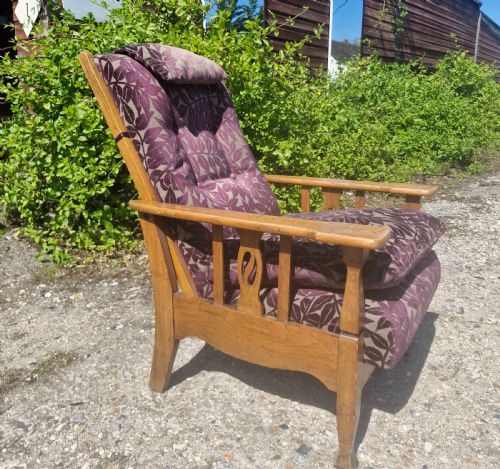


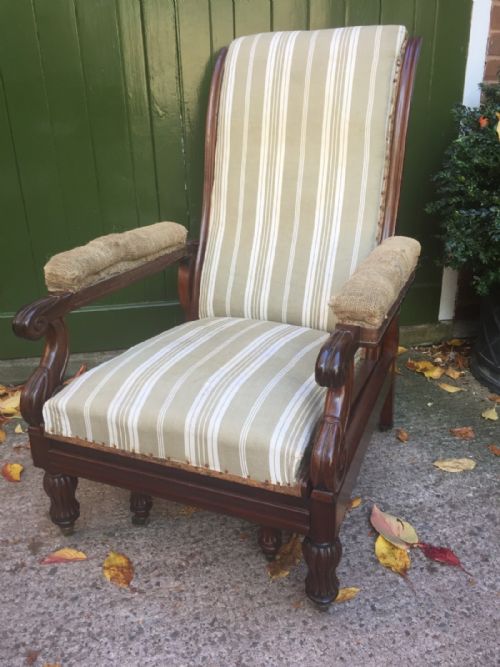


Adjustable Reclining Armchair
These adjustable reclining armchairs offer mechanical comfort built in mahogany, oak, and walnut across the nineteenth and early twentieth centuries.
Adjustable Reclining Armchair
An adjustable reclining armchair serves as a seat designed to alter its back angle for rest and reading. When searching for an adjustable reclining armchair, you encounter pieces dating from the late eighteenth century through the 1930s.
The selection ranges from campaign chairs and steamer chairs to library reading chairs and garden loungers. Oak and mahogany frames dominate the offerings, often fitted with leather or fabric upholstery.
Victorian and Edwardian iterations appear frequently alongside earlier Regency and William IV examples. Forms span from heavy timber library chairs to lighter wicker and cast iron garden pieces.
How they were made
Frames are constructed from hardwoods such as mahogany, oak, walnut, and teak, joined to endure mechanical movement. Brass mechanisms, castors, and iron ratchets facilitate the adjusting movement of the backrest and footrest components.
Upholstery materials include brown leather, velvet, cane, and various woven fabrics. Timber surfaces show French polish, ebonisation, or natural waxed finishes depending on the period and style.
Adjustable Reclining Armchair Retail Price Guide 2026
Typical asking prices for adjustable reclining armchair among the pieces listed under this phrase on Sellingantiques today, from the lower quarter to the upper quarter. They describe what is for sale here now, not the wider market.
Listings feature oak, mahogany, walnut, and teak frames spanning the nineteenth and early twentieth centuries.
What varies in quality
Quality rests in the sophistication of the mechanical action, whether patent brass ratchets or simple wooden tooth adjustments. The integrity of the timber framing and the retention of original castors or footstools influence the character of the piece.
Finer examples bear attribution to known makers or patent designs, demonstrating superior cabinetmaking in the movement joints. The choice of primary timber and the execution of carved details further separate standard production from high-grade workshop output.
Angraves of Leicester·Foot and Sons·Heals of London·Robert Daws
The Adjustable Reclining Armchair Glossary
- Campaign chair
- A portable folding or dismantling chair made for travel during the eighteenth and nineteenth centuries. These pieces often incorporated reclining backs and folding footrests for officer use.
- Ratchet mechanism
- A mechanical device using a toothed wheel and catch to lock the adjustable backrest at various angles. This hardware is commonly fashioned from brass or iron.
- Steamer armchair
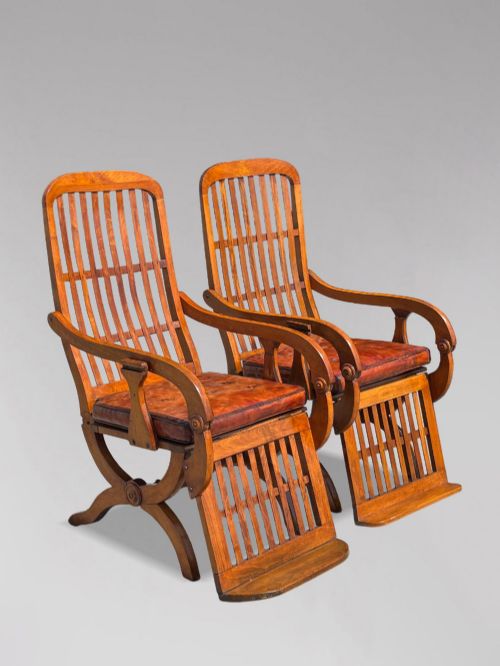
- A timber lounger featuring a long seat and adjustable ladderback frame, traditionally used on ocean liners. Examples frequently include sliding footrests and rear castors.
- Metamorphic chair
- Furniture designed to transform from a standard armchair into a daybed, chaise longue, or chair with footstool. These pieces rely on hidden hinges and pivots.
- Wing back
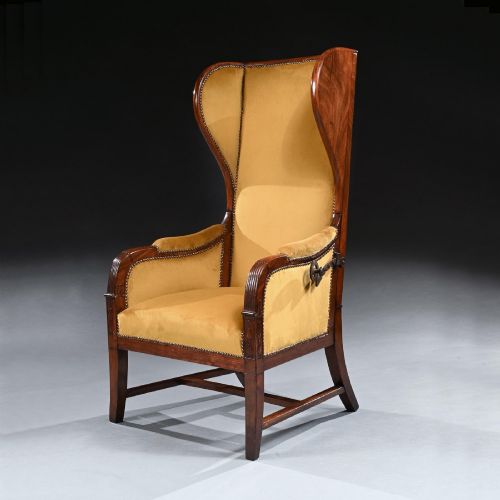
- An upholstered armchair with side panels designed to shield the sitter from draughts. In reclining variants, this form combines with adjustable mechanics for library use.
Adjustable Reclining Armchair: Frequently Asked Questions
How do adjustable reclining armchairs work?
These chairs use mechanical ratchets, hinges, or sliding arms operated by the sitter to alter the angle of the backrest. Many incorporate matching footstools or extension sections that slide away beneath the seat.
Period examples often rely on brass friction arms or notched wooden supports concealed within the upholstery framework. Users adjust the position manually before settling into the desired posture for reading or resting.
Where were these chairs used historically?
Library reading rooms, private studies, and drawing rooms accommodated the heavier mahogany and leather library variants. Campaign versions travelled with military officers on expeditions.
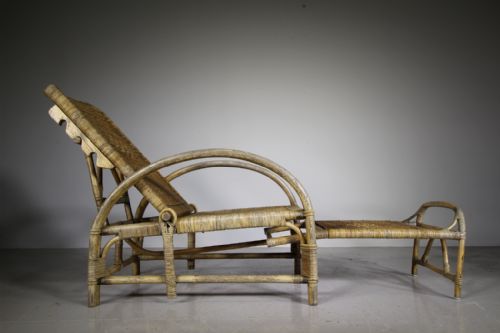
Garden terraces and steamships utilised lighter wicker and teak models designed for outdoor relaxation. Daybed combinations served multiple functions in domestic interiors where space required versatility.
How do I care for antique leather upholstery?
Period leather requires regular dusting with a soft, dry cloth to prevent abrasive particle buildup. Conditioning with appropriate museum-grade leather balms maintains flexibility without damaging historical patination.
Direct sunlight and artificial heat sources should be avoided to prevent the material from drying and cracking. Professional conservation is recommended for structural repairs to the underlying webbing and springs.
How can I tell a Victorian recliner from an Edwardian one?
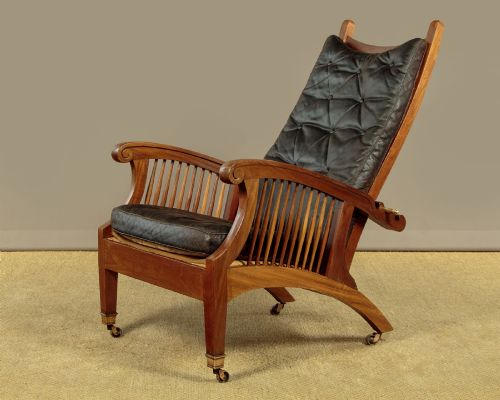
Victorian examples generally feature heavier timbers such as dark mahogany or walnut, often paired with deep buttoned brown leather. The carving tends to be more ornate, following revival styles like French Empire or William IV.
Edwardian pieces often display lighter oak frames influenced by the Arts and Crafts movement or manufacturers like Heal's. The lines are typically cleaner, prioritising functional simplicity over elaborate decorative carving.