


Adam Revival Table
An adam revival table brings neoclassical symmetry and carved mahogany into a room, offering the refined proportions of eighteenth-century design.
Adam Revival Table
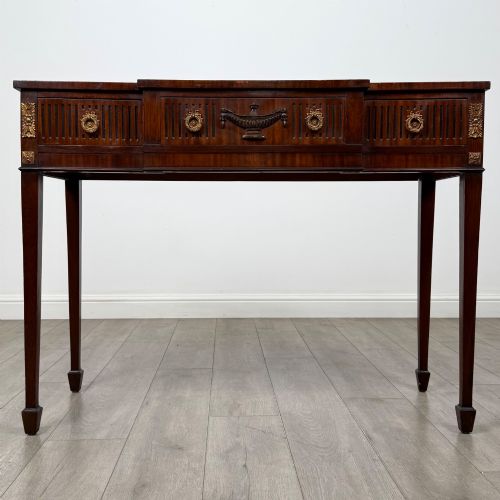
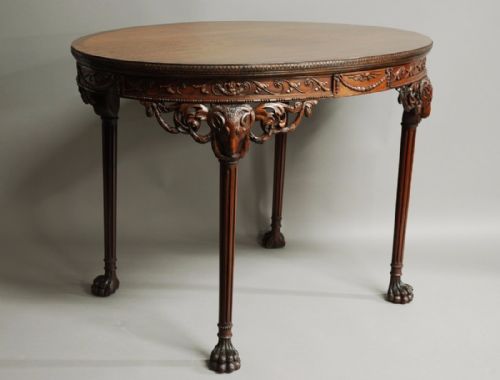
An adam revival table draws upon neoclassical design principles, featuring rectilinear or demilune forms executed in mahogany. These pieces emerge across the nineteenth and twentieth centuries, including Edwardian examples alongside items dated from eighteen-eighty to nineteen-ten.
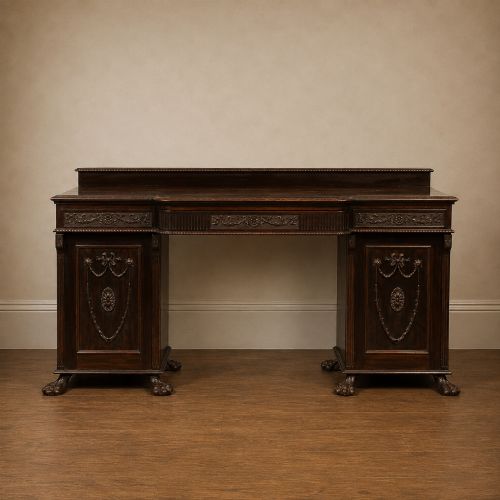
Buyers encounter console tables, side tables, and centre tables alongside serving tables and breakfront sideboards. The proportions remain balanced, echoing the classical vocabulary associated with Robert Adam through carved details and refined edges.
Materials and construction
Cabinet makers utilised solid mahogany and occasionally satinwood for framing and tabletops, shaping surfaces into rectangular or semicircular formats. Brass hardware and silver plate appear on related lamps and candlesticks, complementing the timberwork.
Joinery techniques supported complex breakfront and demilune shapes, whilst manual carving produced the classical motifs along friezes and legs. Timber selection prioritised grain pattern and depth of colour, finished through traditional polishing methods.
Paw feet occasionally anchor Edwardian sideboards, reminding us that even neoclassical revivalists enjoyed a touch of creature comfort.
Assessing quality in revival pieces
Quality rests upon the crispness of the carved neoclassical details and the proportion of the timber frame. Finer examples display precise execution in motifs like urns and swags, whereas simpler items rely on plain moulded edges.
The choice of mahogany veneer or solid timber alters the visual weight of a console or centre table. Structural integrity in the legs and joints dictates how well the piece holds its form over decades of domestic use.
Harrison Brothers & Howson
The Adam Revival Table Glossary
- Adam revival
- A decorative style looking back to the neoclassical designs of Robert Adam from the eighteenth century. This revival movement gained particular momentum during the Victorian and Edwardian periods.
- Console table
- A table designed to stand against a wall, frequently secured with brackets or supported by front legs. These pieces often feature demilune or rectangular tops suited to hallways and reception rooms.
- Centre table
- A freestanding table intended to occupy the middle of a room rather than sit against a wall. Such pieces require finished detailing on all sides.
- Demilune
- A half-moon shape used for tabletops and console designs. This profile allows furniture to sit flush against a wall while projecting outward in a curve.
- Breakfront
- A piece of furniture whose central section projects forward from the flanking wings. This configuration adds depth and architectural interest to sideboards and large consoles.
Adam Revival Table: Frequently Asked Questions
What rooms suit an adam revival table?
These tables fit naturally in entrance halls, formal dining rooms, and drawing rooms where linear symmetry and classical detailing complement existing interior proportions.
Demilune console variants work well against narrow corridor walls, whilst freestanding centre tables occupy prominent floor space in larger reception areas.
How do I distinguish Edwardian pieces?
Edwardian examples typically date from the turn of the twentieth century, often showing lighter timber treatments and crisp revival carving influenced by Georgian precedents.
Comparing construction traits with nineteenth-century counterparts helps clarify the manufacturing period, alongside any documented provenance or retailer marks.
Are these tables solid mahogany?
Many pieces combine solid mahogany framing with selected veneers on tabletops and friezes to achieve decorative grain patterns without warping.
Cabinet makers balanced structural strength in the legs with stable panel construction across wider surfaces during both the Victorian and Edwardian eras.
How should I care for the timber?
Maintain mahogany surfaces by avoiding direct sunlight and excessive moisture fluctuations that can affect polished finishes and wood joints.
Occasional dusting with a soft cloth preserves the natural lustre of the timber without building up heavy wax residues over time.