
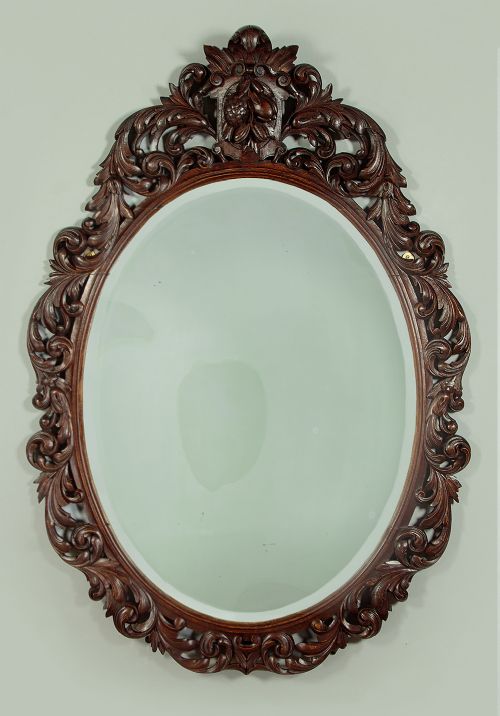


Acanthus Carved Oak Mirror
These acanthus carved oak mirror examples offer heavy timber frames and deep relief work that suits period interiors.
Acanthus Carved Oak Mirror
An acanthus carved oak mirror combines sturdy timber frames with classical leaf motifs rendered in deep relief. These wall hangings draw on styles ranging from 18th century Baroque to Victorian Gothic Revival and French Provincial interpretations.
Most pieces seen here date from the nineteenth century, including specific years like 1860, 1880, 1890, and 1900, alongside broader eighteenth century examples. Oval formats, cushion frames, and large wall mirrors dominate the selections currently available on this page.
How they were made
Cabinetmakers built these frames from solid oak, a dense timber that accepts deep hand chiselling without splitting. Craftsmen shaped the characteristic scroll foliage directly into the wood before fitting the reflective glass plates.
Makers utilised bevel edges on select plates to catch the light, mounting the heavy wooden structures securely behind original or replacement mirror glass.
Listings span the eighteenth and nineteenth centuries, featuring Victorian, Edwardian, and French Provincial stylistic influences.
What varies in quality
The depth and crispness of the chisel work separates standard production from finer craftsmanship. Superior examples show undercut leaves and crisp scrolls that retain their sharpness across the entire wooden frame.
Proportion and scale also dictate quality, particularly on large cushion frames and oval formats where the weight of the timber demands careful joinery to prevent warping.
The Acanthus Carved Oak Mirror Glossary
- Acanthus
- A classical ornamental motif derived from Mediterranean foliage, carved into wood as scrolling leaves.
- Cushion frame
- A frame profile that slopes inward toward the mirror glass in a rounded, pillow-like swell.
- Bevel edge
- An angled slope ground around the perimeter of the mirror plate to refract light.
- Renaissance Revival
- A nineteenth century design movement drawing inspiration from sixteenth century Italian and French architecture.
Acanthus Carved Oak Mirror: Frequently Asked Questions
How do I hang a heavy oak mirror?
These timber frames carry considerable weight and require secure wall fixings screwed directly into masonry or solid wall studs.
Professional mirror hangers utilise heavy-duty brackets rated for the specific load of the oak and glass.
Are these frames made of solid oak?
The listings consist entirely of oak construction, utilising the dense hardwood for both structural stability and deep relief carving.
This material choice ensures durability and supports the substantial weight of large wall-hanging formats.
How do I clean an antique mirror plate?
Use a soft cloth and a minimal amount of mild glass cleaner sprayed onto the cloth rather than directly onto the glass.
Avoid letting moisture seep behind the wooden frame where it might damage the original backing or silvering.
What rooms suit a carved oak mirror?
Hallways and principal living spaces accommodate the substantial presence and dark timber tones of these nineteenth-century wall pieces.
They pair effectively with period furniture, stone fireplaces, and panelled walls.