


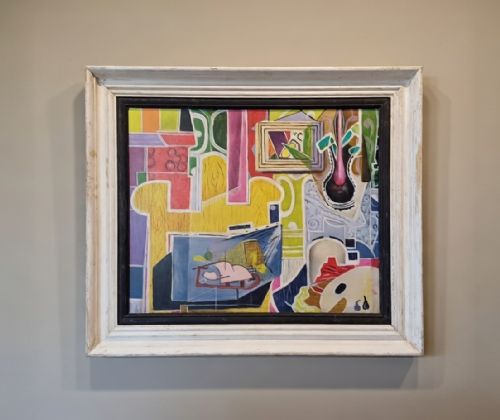


Abstract Still Life
An abstract still life brings domestic objects and interiors into modernist geometry, offering a sharp visual energy for any room.
Abstract Still Life
When you search for abstract still life, you encounter works that reimagine everyday items like fruit, bowls, and flowers through a modernist lens. These pieces span from the nineteen twenties to nineteen sixty, capturing domestic scenes and kitchen geometry.
The version you are most likely to meet on this page is a mid-century oil painting on canvas or board. French and British artists dominate these selections, often applying cubist or modernist principles to humble subjects like onions, tureens, and chairs.
Materials and construction
Artists painted primarily in oil on canvas or board, though pastels on paper also appear in the archive. The medium allows for rich layering of colour, visible brushwork, and structured compositions.
Wooden supports and framed canvases provide the physical structure for these works. The handling of paint ranges from flat, geometric planes of cubism to vibrant colourist expressions.
Abstract Still Life Retail Price Guide 2026
Typical asking prices for abstract still life among the pieces listed under this phrase on Sellingantiques today, from the lower quarter to the upper quarter. They describe what is for sale here now, not the wider market.
Materials across the listings focus heavily on oil paint applied to canvas or board, supplemented by occasional works on paper.
Distinctions in quality
Quality rests upon the strength of the composition and the confidence of the brushwork. Works that balance abstraction with recognisable domestic geometry show a more assured artistic hand.
Provenance and exhibition history elevate specific pieces. Signed works by documented artists command greater interest than anonymous examples from the same decades.
Denis Mitchell·Edward Carter Preston·Nicolas Issaiev·Jacques Carelman·Jean Herbin
The Abstract Still Life Glossary
- Cubism
- An early twentieth-century style that breaks down subjects into geometric shapes and multiple viewpoints. This approach defines many compositions on the page.
- Oil paint
- A slow-drying paint made with pigments suspended in oil, commonly applied to canvas or board. It permits deep colour saturation and visible texture.
- Mid-Century Modern
- A design movement spanning roughly from the nineteen thirties to the sixties, embracing clean lines and abstraction. Paintings from this era often feature simplified forms.
- Still life
- A work of art depicting mostly inanimate subject matter, typically commonplace objects. In these pieces, items like soup tureens and fruit serve as geometric studies.
- Fauvism
- A style characterised by strong colours and painterly qualities rather than realistic values. Several works utilise this expressive palette.
Abstract Still Life: Frequently Asked Questions
What is an abstract still life?
An abstract still life takes traditional domestic subjects, such as fruit, flowers, or kitchen utensils, and reimagines them through modern artistic movements.
Instead of realistic portrayal, artists use simplified shapes, flattened perspectives, and bold brushwork to emphasise form and colour.
How were these paintings displayed?
These works typically reside within wooden frames, designed to complement the modernist aesthetic of mid-century interiors.
They function as wall art in domestic spaces, bringing concentrated bursts of colour and geometric structure to a room.
How do I date a piece?
Dating relies on stylistic clues, framing materials, and inscribed dates on the canvas or reverse of the board. Mid-century works often reflect the aesthetic shifts of the nineteen forties and nineteen fifties.
Artists frequently signed and dated their work, providing a clear marker of its origin.
What subjects appear most often?
Common subjects include kitchen items like coffee pots, soup tureens, bowls, and onions. Floral arrangements and tablescapes also recur across the decades.
These ordinary objects provided artists with stable subjects to explore cubist and modernist abstraction.