

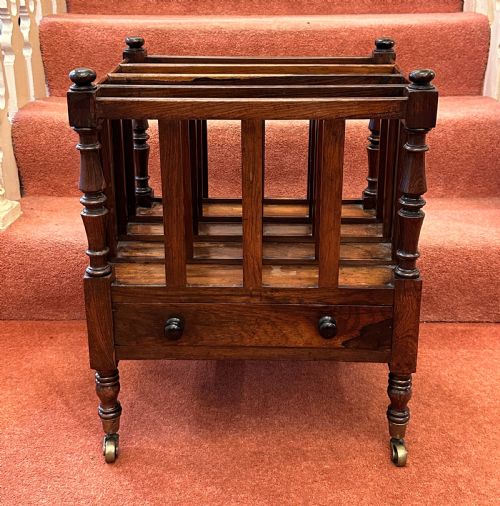


4 Division Music Rack
A 4 division music rack organises sheet music or folios neatly, offering solid timber construction and distinct period charm.
4 Division Music Rack
A 4 division music rack, also catalogued as a Canterbury or music stand, provides upright storage divided into four distinct sections. These pieces serve primarily to hold folios, sheet music, newspapers or magazines within a domestic setting.
The versions most commonly met on this page date from the Georgian, Regency, and 19th Century periods. They frequently appear in mahogany, Cuban mahogany, or rosewood, sometimes incorporating turned carrying handles, drawers, or X-frame supports.
How they were made
Cabinet makers constructed these pieces predominantly using dense timbers such as mahogany, Cuban mahogany, and rosewood. Sections are formed with upright divisions that are occasionally pierced or scrolled for aesthetic effect.
Details such as brass castors, carrying handles, and integrated drawers are applied to facilitate mobility and utility. Construction relies on traditional joinery suited to supporting heavy paper goods within framed structures.
Listings on this page span the 18th century, Georgian, Regency, and 19th century periods, executed in mahogany, Cuban mahogany, and rosewood.
What varies in quality
Quality separates ordinary utility pieces from superior examples through the selection of timber and the refinement of detail. Denser grain figures, particularly in Cuban mahogany and rosewood, indicate a higher grade of material chosen by the maker.
Refinements such as pierced scrollwork on the divisions, the inclusion of a functional drawer, and robust frame construction distinguish finer examples. The integration of structural elements like X-frames further elevates the sophistication of the piece.
The 4 Division Music Rack Glossary
- Canterbury
- A low stand with upright divisions used originally for music sheets and later for newspapers and magazines. It often includes a low drawer beneath the divisions.
- Cuban Mahogany
- A dense, richly figured timber harvested in the West Indies, highly prized in cabinet making during the 18th and 19th centuries. Its dark coloration and deep grain make it readily identifiable.
- X-frame
- A structural support formed by two intersecting diagonal members resembling the letter X. This configuration provides lateral stability while maintaining an open profile.
- Rosewood
- A heavy, durable timber featuring pronounced dark grain figuring and reddish-brown tones. It was frequently utilised for high-status furniture during the Regency and Victorian eras.
4 Division Music Rack: Frequently Asked Questions
What is a 4 division music rack used for?
These pieces function as dedicated storage for sheet music, folios, newspapers, and periodicals in a sitting room or music room.
The four vertical sections keep bound or loose papers upright and separated for easy retrieval during practice or performance.
How do you date a 4 division music rack?
Dating relies on identifying period characteristics in the timber, hardware, and overall architectural style of the piece.
Listings span the 18th century through the Victorian era, encompassing Regency, George IV, and William IV stylistic traits.
Are these racks the same as canterburys?
The terms are frequently used interchangeably in historical and modern cataloguing for pieces with upright timber partitions.
Some variations include lower drawers or carrying handles, while others focus purely on the divided rack structure.
What timbers are typically used?
Cabinet makers utilised dense hardwoods capable of supporting the weight and pressure of upright paper goods.
Mahogany, Cuban mahogany, and rosewood appear consistently across the available pieces on this page.