
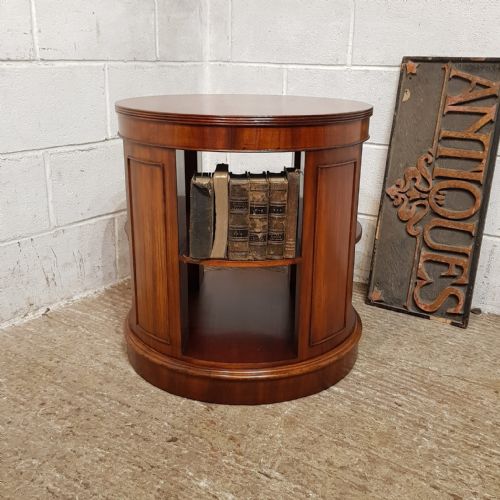

2 Tier Bookstand
A 2 tier bookstand offers compact shelving for daily reading, turning on a pivot or standing open in mahogany, oak, and rosewood.
2 Tier Bookstand
A 2 tier bookstand provides practical book storage across compact levels, frequently appearing in revolving formats from the Edwardian period. These pieces sit comfortably beside armchairs or desks to keep volumes within arm's reach.
The version most commonly met on this page is the Edwardian mahogany revolving bookcase, alongside open oak waterfalls from the late nineteenth and early twentieth centuries. Makers constructed these items to rotate smoothly or to display open shelves against a wall.
Materials and construction
Cabinetmakers built these pieces primarily in solid mahogany, oak, and rosewood, often incorporating satinwood stringing and brass fittings. Turning mechanisms relied on robust internal iron or brass ball bearings to support two stacked tiers of books.
Workshops utilised fret-cut detailing on side panels and flame mahogany veneers on top surfaces to catch the light. Open waterfall designs stepped back tier by tier, fixed with traditional joinery.
Listings span periods from the Regency era through to the nineteen thirties, with Edwardian examples forming the majority.
Distinctions in quality
The standard of a 2 tier bookstand rests on the choice of timber and the precision of the revolving action. Pieces featuring figured flame mahogany veneers and inlaid satinwood demonstrate superior cabinet work compared to plain utility items.
The stability of the tier structure and the crispness of fret-cut side panels separate standard workshop output from finer retail pieces. Original brass and iron mechanisms that turn silently denote higher tier manufacture.
Maple & Co
The 2 Tier Bookstand Glossary
- Revolving bookcase
- A freestanding bookstand designed to turn on a central pivot base for easy access to volumes from any angle. They typically feature two stacked tiers divided by cross-shaped partitions.
- Waterfall bookcase
- An open shelving unit where each successive tier steps back from the one below it. This creates a cascading silhouette often seen in oak and mahogany.
- Flame mahogany
- A distinct wood veneer cut from the fork of the mahogany tree, producing a repeating flame-like pattern. Cabinetmakers reserved this timber for primary display surfaces.
- Satinwood
- A pale, hard timber utilised for decorative inlay and banding on darker woods like mahogany and rosewood. It provides a sharp visual contrast on Edwardian furniture.
- Fret-cut
- A technique where intricate patterns are pierced through thin wood panels using a fine saw. This ornamentation appears on the sides of revolving stands.
2 Tier Bookstand: Frequently Asked Questions
How do revolving bookstands work?
These bookstands rest on a hidden internal pivot mechanism fitted with metal ball bearings. This allows the upper tiers to spin freely in either direction.
Users can reach every stored volume without moving the heavy base from its position beside a chair or desk.
Which woods appear most often?
Mahogany and oak dominate the selection across both Edwardian and Victorian examples. Cabinetmakers also utilised rosewood, satinwood, and kingwood for decorative contrast.
Metal components like brass and cast iron appear in the revolving mechanisms and mounts.
How do I date an Edwardian piece?
Edwardian items date from the reign of King Edward VII between nineteen hundred and nineteen ten. Makers during this era favoured inlaid satinwood on mahogany bodies and lighter proportions than Victorian furniture.
Specific dates often rely on maker stamps or stylistic clues recorded in the woodwork.