


19th Century Walnut Suite
A 19th century walnut suite brings rich timber and period upholstery together to furnish a reception space with matched formality.
19th Century Walnut Suite
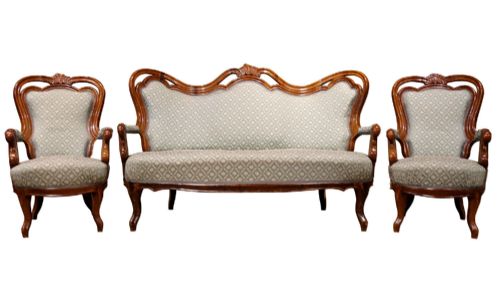
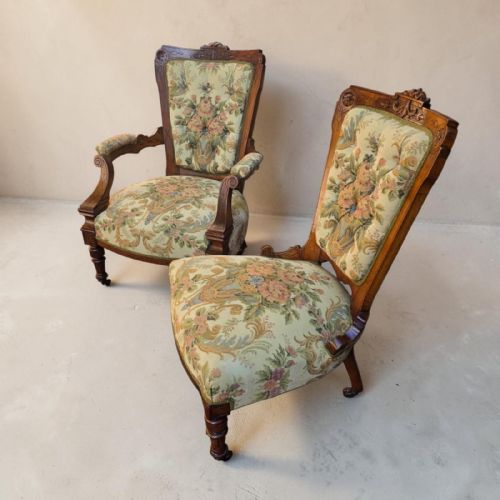
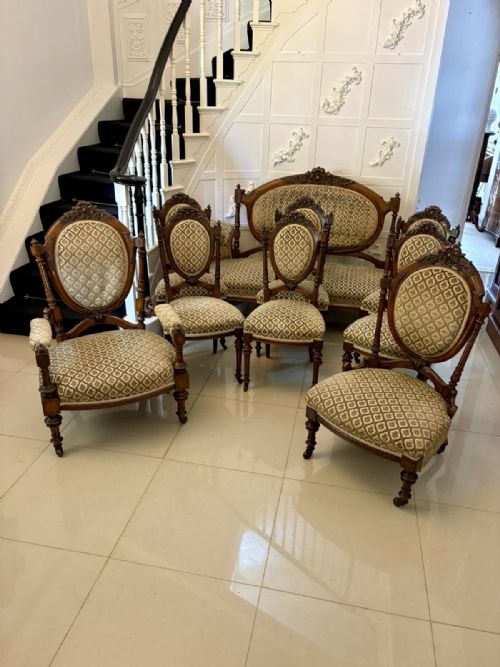
A 19th century walnut suite comprises matched groupings of seating and drawing room furniture designed for formal reception spaces during the Victorian era. These ensembles range from intimate two-piece settings up to extensive nine and eleven-piece drawing room arrangements including settees, armchairs, side chairs, and footstools.
Buyers encountering this search phrase will most frequently find Victorian walnut salon and drawing room suites featuring carved frames. The evidence records distinct iterations from mid-century productions to later Continental and French salon suites dating toward eighteen ninety.
Stylistic variations within these groupings span traditional Victorian forms alongside elaborate Rococo Revival curves and occasional Egyptian Revival details. These suites furnish period interiors with cohesive timber framing and coordinated upholstery fabrics.
How they were made
Makers shaped these suites from solid and veneered walnut, relying on dense grain patterns to provide a dark, polished foundation for intricate carved ornament. Artisans executed elaborate cameo backs, cabriole legs, and scrollwork entirely by hand.
Upholstery completed the framework, utilising traditional textiles including velvet, tapestry fabric, and general textile coverings secured with brass elements and ceramic components. These materials were chosen to offer both decorative impact and comfortable seating support for the Victorian drawing room.
Footstools occasionally snuck into the eleven-piece gatherings, ensuring even the smallest Victorian ankles rested in matching walnut luxury.
What varies in quality
The distinction between standard commercial production and superior execution lies in the depth and crispness of the walnut carving. Exhibition quality pieces demonstrate highly detailed sculptural work across every component of the suite, from the crest rails down to the footstools.
Completeness and original proportion also determine the standing of a suite. Retaining an entire matched set of eleven pieces or three-piece groupings in unified timber and upholstery shows a higher level of original preservation than assembled groups.
The 19th Century Walnut Suite Glossary
- Walnut
- A dense, dark timber utilised extensively throughout the nineteenth century for furniture framing. Its stability allowed carvers to execute deep relief work without splitting.
- Cameo back
- A chair or settee back shaped with an oval or medallion upholstered centre surrounded by carved wood. This form defines many Victorian drawing room seats.
- Rococo Revival
- A decorative style popular in the nineteenth century mimicking eighteenth-century French curves, scrollwork, and asymmetrical floral carving. It dominates the aesthetic of several listed salon suites.
- Egyptian Revival
- A distinct stylistic movement incorporating pharaonic motifs, geometric lines, and exotic symbols into nineteenth-century European design. It appears selectively among furniture suites of the period.
- Salon suite
- A coordinated group of seating furniture intended for a formal reception room. These sets typically unite a settee with matching armchairs and side chairs.
19th Century Walnut Suite: Frequently Asked Questions
What rooms did these suites furnish?
These suites were designed specifically for formal reception spaces, including Victorian drawing rooms, salons, and occasionally grand hall settings where guests were received.
The matching chairs and settee provided cohesive seating arrangements that displayed the household's social standing and taste.
How do I distinguish Rococo Revival pieces?
Rococo Revival pieces are identified by their curving lines, asymmetrical floral carvings, and scrolled feet executed in walnut timber.
This style rejects strict geometric symmetry in favour of organic, flowing forms derived from mid-eighteenth-century French design.
What textile types appear on the upholstery?
Surviving upholstery on these suites includes velvet, tapestry fabric, and various traditional textile coverings.
Many pieces retain later replacement fabrics, while others showcase period materials secured alongside brass and ceramic detailing.
How large are typical suites?
Suites vary significantly in scale, ranging from compact two-piece parlor chairs up to sprawling eleven-piece drawing room ensembles.
Larger configurations typically include a central settee accompanied by multiple armchairs, side chairs, and occasional footstools.