


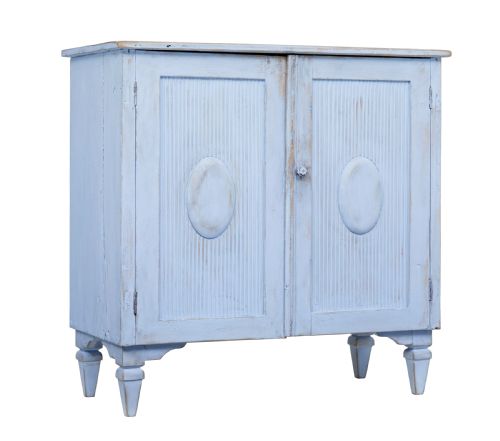


19th Century Swedish Credenza
A 19th century Swedish credenza brings functional Scandinavian storage to a room, offering generous interior space wrapped in historic painted or timber finishes.
19th Century Swedish Credenza
A 19th century Swedish credenza encompasses substantial storage furniture from the period, frequently categorized under cupboards, cabinets, sideboards, and buffets. These pieces serve as practical anchor furniture for dining rooms and hallways, combining deep enclosed shelving with broad top surfaces.
The selections encountered here span styles from Scandinavian country and Gustavian to Swedish Biedermeier. Buyers regularly meet painted pine and rich birch surfaces, often showing original scraped paint or distinctive ragwork decoration.
Materials and Construction Methods
Local timber forms the structural core of these items, utilising solid pine and birch alongside decorative satin birch veneers. Workshops employed traditional joinery to construct durable frames capable of housing heavy dishware and household provisions.
Surface finishes define much of the visual character, utilising layers of paint, scraped polychrome treatments, and ragwork techniques. Metal elements in brass and iron appear as hinges, locks, and key escutcheons.
19th Century Swedish Credenza Retail Price Guide 2026
Typical asking prices for 19th century swedish credenza among the pieces listed under this phrase on Sellingantiques today, from the lower quarter to the upper quarter. They describe what is for sale here now, not the wider market.
Every listed piece dates strictly to the 19th century, constructed from pine, birch, or satin birch with iron and brass hardware.
Distinguishing Quality
Quality rests significantly on the survival and integrity of the original surface finishes. Pieces retaining undisturbed scraped paint or early ragwork decoration demonstrate superior historical preservation compared to later overpainting.
Construction substance also separates grades, with dense pine and figured birch timbers showing tighter joinery and more substantial hardware execution. The subtlety of proportion across Gustavian and Biedermeier influences dictates the visual refinement of the form.
The 19th Century Swedish Credenza Glossary
- Ragwork paint
- A decorative paint technique applied with rags to create mottled or textured patterns on the wood surface. This finish appears frequently on country pine cupboards from the period.
- Scraped paint
- A finish revealing earlier layers of polychrome decoration through deliberate abrasion or wear. Collectors prize this surface for its authentic patina and depth of colour.
- Satin birch
- A timber featuring a lustrous, light-reflecting grain widely utilised for veneering high-status Scandinavian furniture. It brings a pale warmth to Biedermeier and mid-century case pieces.
- Gustavian
- The neoclassical design style spanning late eighteenth and early nineteenth-century Sweden, characterised by restrained symmetry and pale finishes. It heavily influences the lighter sideboards and cabinets of the era.
19th Century Swedish Credenza: Frequently Asked Questions
What is a 19th century Swedish credenza used for?
These large storage pieces serve primarily to hold tableware, linens, and provisions within dining rooms and large hallways. Their sturdy top surfaces also provide ample display space for lamps, ceramics, or decorative objects.
Inside, deep shelving accommodates bulky household items while keeping rooms orderly. They function as both practical storage cupboards and defining decorative anchors in an interior.
How do I identify painted pine versus birch finishes?
Painted pine pieces usually present an opaque surface of historic pigment, sometimes showing textured ragwork or exposed layers via scraped paint. The wood underneath is soft and pale, though entirely hidden beneath the decorative coat.
Birch and satin birch pieces instead display the natural grain of the hardwood under a clear finish. The timber exhibits distinctive golden tones and wavy figuring that differentiates it sharply from solid painted softwood.
What distinguishes Gustavian style from country pieces?
Gustavian pieces draw on neoclassical proportions, often featuring fluted columns, subtle carved moulding, and pale, restrained painted surfaces. They reflect the sophisticated tastes of Swedish manor houses and urban interiors.
Country pieces lean towards robust utility, expressed through simpler lines, sturdier pine construction, and folk art paint treatments like ragwork. These items originated in rural homesteads where durability outweighed courtly fashion.
How do I care for historic painted surfaces?
Historic paint finishes require gentle treatment, avoiding modern chemical solvents and abrasive cleaners entirely. Dusting with a dry, soft cloth prevents particulate buildup without disturbing fragile underlying pigments.
Maintaining stable indoor humidity levels also protects both the pine or birch substrates and the surface paint from cracking. Direct sunlight should be avoided to prevent the gradual fading of original colours.