


19th Century Swedish Birch Table
A 19th century swedish birch table brings pale warmth and striking grain patterns to a room.
19th Century Swedish Birch Table
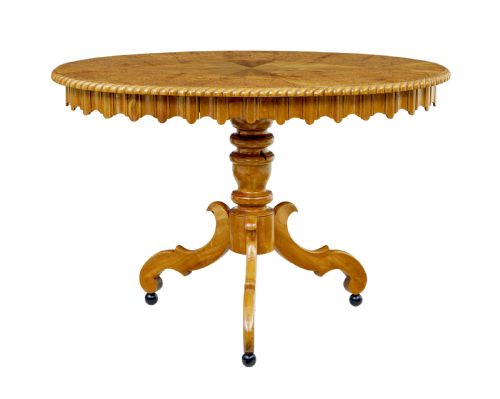
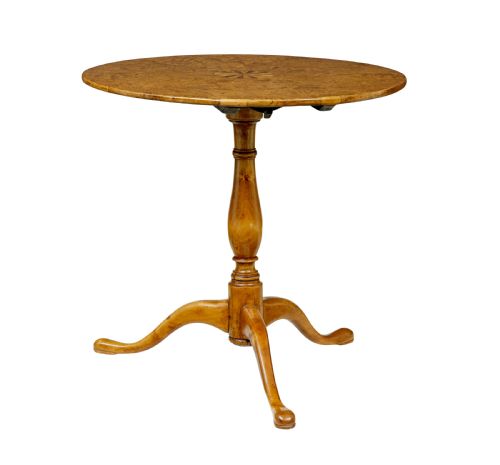
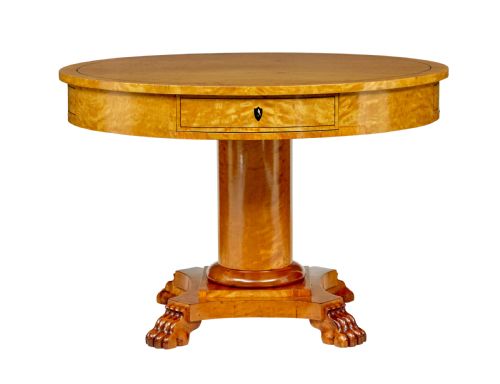
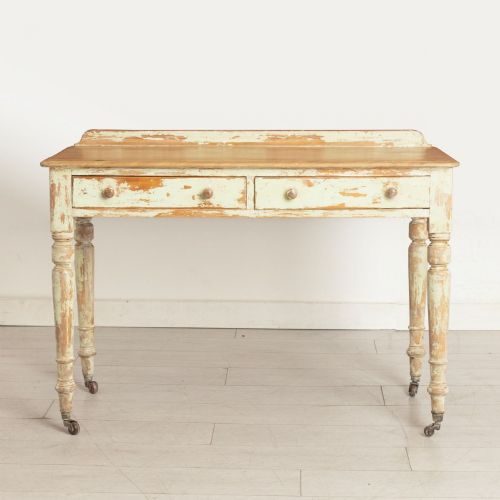
A 19th century swedish birch table encompasses a range of domestic forms designed for daily use and formal reception alike. Occasional tables, centre tables, and side tables appear most frequently, alongside writing desks, tea tables, and games tables. These pieces reflect the clean lines and practical elegance characteristic of Scandinavian cabinet-making during the period.
The aesthetic bridges several distinct styles, drawing heavily on Swedish Biedermeier, Karl Johan, Empire, and occasional revival movements such as Rococo Revival and Empire Revival. Sturdier rustic farmhouse pieces also emerge alongside refined drawing-room furniture. Regional workshops across Sweden adapted continental European fashions into a lighter, more restrained domestic vocabulary.
Makers utilised native timbers to create furniture with strong visual character. While standard birch forms the structural core of many examples, burr birch, satin birch, and birch root provide decorative surfaces with rich figuring. Accents in ebony, ebonised wood, and brass provide sharp linear contrast against the pale golden tones of the wood.
Materials and Technique
Cabinet-makers relied on solid birch frames faced with carefully matched veneers of burr birch or satin birch to achieve dramatic patterning on table tops. The swirling figuring of the grain is highlighted through French polishing or clear varnishing. Contrasting dark details, including ebony inlay and ebonised mouldings, frame the lighter timber.
Structural elements frequently incorporate secondary timbers such as pine, whilst functional mounts and details utilise brass and occasionally ormolu. Turned tripod bases, pedestal columns, and lyre-shaped supports provide the engineering foundation for circular, oval, and shaped table tops.
Tree burls form as a tree reacts to stress, turning a botanical injury into the swirling burr birch patterns that fascinated 19th-century Swedish cabinet-makers.
The Spectrum of Quality
Quality rests upon the selection and bookmatching of the veneer, particularly on prominent surfaces like occasional and centre table tops. Superior pieces display harmonious, swirling burr patterns that wrap symmetrically across the timber. Lesser examples utilise plain or patched veneers with disjointed grain direction.
The crispness of inlay work and the integration of contrasting elements such as ebony stringing dictate the refinement of the piece. Master cabinet-makers achieved seamless transitions between primary veneers and structural mounts, whereas provincial work relies on simpler joinery and heavier proportions.
The 19th Century Swedish Birch Table Glossary
- Burr birch
- A growth deformity on the tree that produces tightly swirled, highly decorative grain patterns when sliced into veneer. Cabinet-makers prized this material for the dramatic visual texture it lent to table tops.
- Biedermeier
- A dominant Central European design style from the early to mid nineteenth century characterised by utilitarian comfort, clean lines, and minimal ornamentation. Swedish interpretations adapted these principles using pale native timbers.
- Karl Johan
- The Scandinavian neoclassical style named after King Karl XIV John, heavily influenced by French Empire design. It favours restrained classical motifs, architectural proportions, and dark wood contrasts.
- Occasional table
- A small, movable table designed for specific, intermittent tasks such as holding lamps, books, or tea services. These forms make up a large proportion of surviving Scandinavian domestic furniture.
- Satin birch
- A term applied to birch timber exhibiting a smooth, reflective sheen resembling satin, often achieved through careful polishing of select logs. It provides a luminous, pale surface favored in high-status furniture.
19th Century Swedish Birch Table: Frequently Asked Questions
How do I clean a birch table?
Dust regularly with a soft, dry cloth to prevent the accumulation of abrasive particles on the polished surface. Avoid commercial sprays or silicone polishes, which can build up and dull the historic finish over time.
Apply a microcrystalline wax sparingly if the surface appears dry, buffing it gently to maintain the natural sheen. Keep the timber away from direct sunlight and strong heat sources to prevent the veneer from drying and splitting.
What is the difference between Biedermeier and Empire?
Empire style draws heavily on Roman and Napoleonic grandeur, featuring formal symmetry, architectural columns, and prominent gilt-bronze or ormolu mounts. It projects a sense of stately authority and ceremonial elegance.
Biedermeier simplifies these classical forms for domestic comfort, stripping away excessive ornamentation in favour of unadorned wood grain and practical utility. Swedish interpretations of Biedermeier lean into the pale beauty of birch rather than relying on dark mahogany.
Are these tables suitable for daily use?
These pieces were built for functional domestic interiors and handle everyday activities such as writing, dining, or displaying lamps with ease. Their sturdy construction ensures they remain stable under normal household conditions.
Use coasters and protective mats beneath hot cups or damp items to safeguard the polished wooden surface from rings and moisture marks. Treat the antique joints with care by lifting rather than dragging the furniture when rearranging a room.