
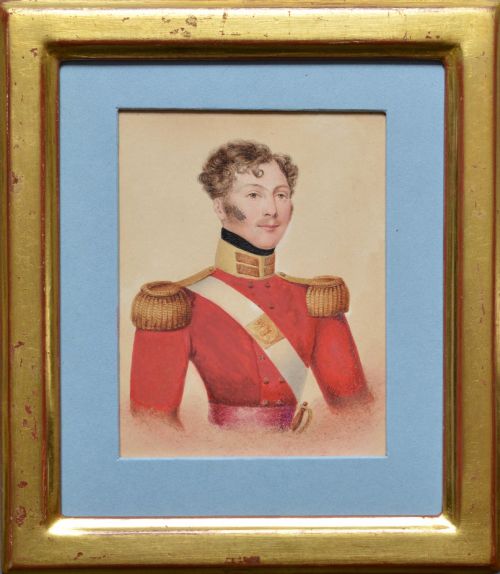


19th Century Military Watercolour
These 19th century military watercolour paintings record officers, campaigns and regiments in pigment on paper, prized by collectors for their precise uniform details and historical documentary value.
19th Century Military Watercolour
A 19th century military watercolour depicts soldiers, officers, naval figures and historic campaign scenes rendered in pigment upon paper. These works capture the uniforms, equipment and personages of British and European armed forces during the Regency, Victorian and Edwardian eras.
The version you are most likely to meet on this page is a framed portrait of an individual officer or a scene involving cavalry and hussars. Examples range from detailed studies of specific regiments like the Staffordshire 80th Regiment of Foot to broader depictions of military life and naval service.
What varies in quality
The distinction between standard works and superior examples rests upon the accuracy of uniform rendering and the skill of the portraiture. Works by named artists or those depicting identifiable historical figures carry greater artistic and documentary weight.
Condition also governs standing, with well-preserved pigment and minimal fading on paper setting finer pieces apart. The quality of the original framing, particularly period giltwood surrounds, contributes to the overall integrity of the piece.
The selection includes individual portraits, cavalry sketches and campaign scenes dated from the Regency era through to the Edwardian period.
J Hardy·Thomas Mackay·Frank Dadd·Frederick Tayler·George Cattermole·Sir William John Newton·Leslie Moore·Sir William Charles Ross·Wiliam Ousey Lindley·John Leech·Christiaan Andriessen·Orlando Norie
The 19th Century Military Watercolour Glossary
- Watercolour
- A painting method in which the paints are made of pigments suspended in a water-based solution. On this page, it forms the primary medium for all listed artworks.
- Giltwood
- Wood carved and covered with a thin layer of gold leaf or gilt. This material frequently appears in the antique frames enclosing these paintings.
- Regency
- A period in British history spanning from 1811 to 1820, though the term often describes a broader aesthetic style from the early nineteenth century. Works from this era display distinct sartorial and artistic characteristics.
- Hussar
- A member of a class of light cavalry officer originating in the 15th century. These figures appear frequently in dynamic battle and combat scenes within the collection.
19th Century Military Watercolour: Frequently Asked Questions
What subjects do these watercolours show?
The subjects include individual portraits of army officers, naval commanders and soldiers alongside battle scenes and cavalry charges. Many identify specific regiments or historical campaigns from the nineteenth century.
Other works depict military personnel accompanied by family members or set within domestic and landscape backgrounds.
How should I frame and display them?
These works on paper require protection from direct sunlight to prevent the watercolour pigments from fading over time. Displaying them behind glass in stable indoor environments helps preserve the paper support.
Many retain their original wood or giltwood frames, which should be inspected gently to ensure the structural safety of the artwork.
How do I identify the regiment?
Uniform details such as braiding, headdress, facings and medals often reveal the specific regiment and rank of the sitter. Contemporary inscriptions on the mount or reverse of the paper frequently record the soldier's name and unit.
Reference works on nineteenth-century military dress provide further assistance in matching uniform designs to historical corps.
Are these works signed by the artist?
Certain pieces bear the signature or monogram of the painter, whilst others remain attributed to specific British or European schools of art. Attribution often relies on stylistic comparison with known works by artists of the period.
Archival records and historical notes accompanying the piece frequently support the recorded authorship.