


19th Century Italian Views
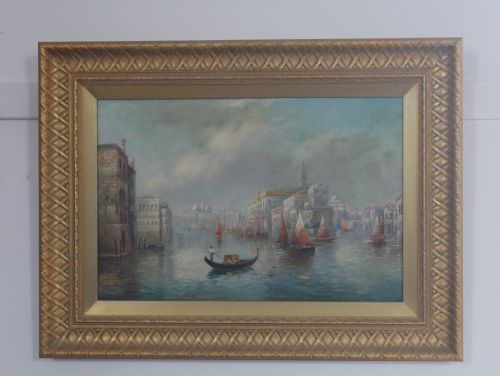
These 19th century italian views capture sunlit Venetian canals and Roman landmarks on canvas and paper.
19th Century Italian Views
These pieces encompass oil paintings, watercolours, gouaches and micro mosaics depicting landmarks such as the Grand Canal, Padua Cathedral and the Spanish Steps. Buyers seeking 19th century italian views encounter framed fine art and decorative plaques originating from travels across the peninsula.
How they were made
Makers utilised oil on canvas, paper and board, applying pigments to create textured townscapes and luminous water surfaces. Watercolours and gouaches on paper capture delicate atmospheric effects in architectural studies and landscape views.
Framing often involved wood, giltwood and gold leaf to house these paintings and paper works. Miniature formats and micro mosaics required intricate assembly on small tablets.
Canal water remains perpetually calm in these watercolours, offering a permanent escape to a sunlit lagoon.
What varies in quality
Quality rests in the handling of light and perspective across water and stone, distinguishing confident artist execution from rigid illustration. The precision of architectural detail in Venetian canals and Roman monuments elevates specific works.
The preservation of the paper, canvas or mosaic surface alongside the originality of the giltwood or wood frame contributes to the standing of each piece.
F.D. Campo·William Raymond Dommersen·Jane Vivian·Alfred Pollentine·Hercules Brabazon Brabazon·Ettore Ascenzi·J. Yates·Charles Clement Calderon·ARTHUR SEVERN·Thomas Brabazon Aylmer·Hugh Vane Turner
The 19th Century Italian Views Glossary
- Grand Tour
- A traditional trip through Europe undertaken by upper-class Europeans, resulting in the acquisition of local art and views. These souvenirs recorded famous Italian sights.
- Micro mosaic
- A decorative technique using tiny coloured glass tesserae to form intricate pictorial scenes. Tablets created this way were popular souvenirs.
- Gouache
- An opaque water-based paint that dries to a matte finish, used for vivid depictions of landscapes and landmarks. Artists employed it for bright southern light.
- Giltwood
- Wood carved and covered with a thin layer of gold leaf, frequently forming ornate frames for paintings. It provides a reflective border.
- Townscape
- A painting or drawing depicting a city's urban landscape, street scenes or architectural landmarks. Venice and Rome offered primary subjects.
19th Century Italian Views: Frequently Asked Questions
What subjects appear in these views?
The works depict recognizable Italian locations, focusing particularly on Venetian canals, the lagoon, Roman steps, and Neapolitan landscapes.
Artists recorded specific architecture including the Doge's Palace, Padua Cathedral, and the Santa Maria della Salute.
Which mediums were used by artists?
Makers worked in oil on canvas, watercolour, gouache on paper, and miniature oil paintings on board.
Micro mosaic tablets also feature among the decorative items.
How do I date these pieces?
Dates appear through period styles like Victorian, Regency, and nineteenth-century Romanticism, alongside specific artist signatures and inscriptions.
Many works originate from the decades spanning the 1870s through to the 1890s.
How should I hang framed paintings?
Ensure paintings in wood and giltwood frames hang away from direct sunlight to protect the canvas, paper pigments, and gold leaf.
Allow adequate wall space for pairs and sets of gouaches or watercolours.