
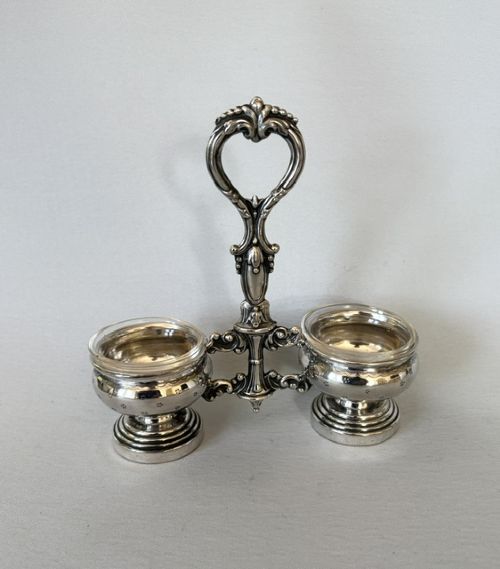


19th Century Glass Caddy
A 19th century glass caddy brings heavy crystal and precious metalwork together on the table, housing loose tea or spirits behind locked lids.
19th Century Glass Caddy
A 19th century glass caddy typically takes the form of a tea canister, mixing bowl, or decanter vessel housed within periods ranging from the Georgian era through to the late Victorian years. These pieces combine heavy glass or crystal elements with fitted wooden boxes, brass mounts, and silver plate.
The selections on this page span several distinct functional categories, including traditional double tea caddies fitted with internal glass mixing bowls, French liquor caves, and elaborate condiment stands. Collectors encounter variations running from Regency rosewood and satinwood inlay down to simple mahogany and walnut frames.
While many items use glass as an internal component like a mixing bowl or bottle insert, others feature cut glass bodies mounted in silver plate or bronze frames. The diversity reflects how households stored and served valuable commodities during the nineteenth century.
Assessing quality and execution
Quality rests upon the crispness of the glass cutting and the weight of the metal mounts, where deeper facets and heavier gauge silver plate separate finer work from simpler production. The choice of timber veneer, such as figured flame mahogany or burr yew-wood, signals the maker's ambition.
Internal architecture dictates the standing of a piece, with surviving original glass mixing bowls, intact matching stoppers, and functioning locks commanding greater attention. The precision of the parquetry inlay and the tightness of the mitred joints reveal the joiner's hand.
Listings feature woods including mahogany, flame mahogany, rosewood, walnut, coromandel, and burr yew-wood.
William Rudkins London·Mappin Brothers·Wade Wingfield Wilkins
The 19th Century Glass Caddy Glossary
- Mixing bowl
- A central glass bowl housed inside a tea caddy, used for blending different teas before brewing. These bowls are frequently cut or moulded.
- Tantalus
- A locking frame that holds decanters securely visible while preventing access without a key. They often combine wood frames with silver-plated or brass hardware.
- Sarcophagus form
- A style of tea caddy shaped like an ancient stone coffin, featuring a domed lid and tapering sides popular during the Regency period.
- Cruet set
- A collection of glass bottles mounted in a metal frame for holding condiments, oil, vinegar, or sauces at the dining table.
- Penwork
- A decorative surface technique using fine ink lines to draw intricate patterns onto a light wood background, seen on specific tea caddies.
19th Century Glass Caddy: Frequently Asked Questions
What is a glass caddy used for?
These pieces served to store and protect high-value dry goods like loose tea leaves, or held glass bottles for serving spirits and condiments at the table.
Locked lids kept precious tea and liquor secure from household staff during the nineteenth century.
How do I identify a Regency caddy?
Regency examples frequently display architectural shapes like the sarcophagus form, often executed in rosewood with contrasting satinwood stringing and brass lion paw feet.
Inside, you will often find fitted wooden canisters flanking a central cut glass mixing bowl.
Are the glass components original?
Many pieces retain their original heavy cut glass bowls or bottles, which fit precisely into the dedicated wooden or metal compartments.
Because glass breaks easily over two centuries, replacements do occur, making matching dimensions and wear patterns important clues.
How should I clean wood and glass?
Wood surfaces respond best to traditional beeswax applied sparingly, avoiding modern silicone polishes that can damage old veneer and polish.
Glass inserts can be washed in warm soapy water, taking care to remove them from the wooden frames entirely before cleaning.