



19th Century Export Lacquerware
These 19th century export lacquerware pieces are worked in rich dark finishes with gilded detail, bringing practical luxury and fine oriental craftsmanship into the home.

19th Century Export Lacquerware
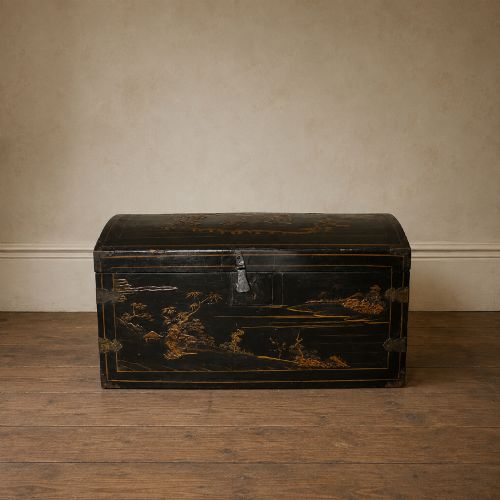
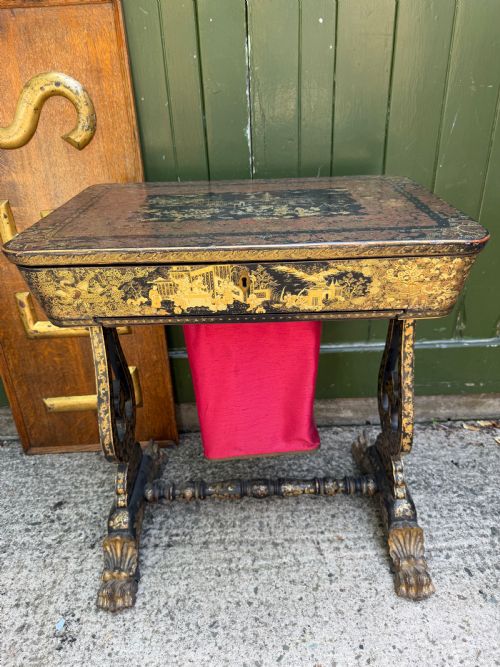
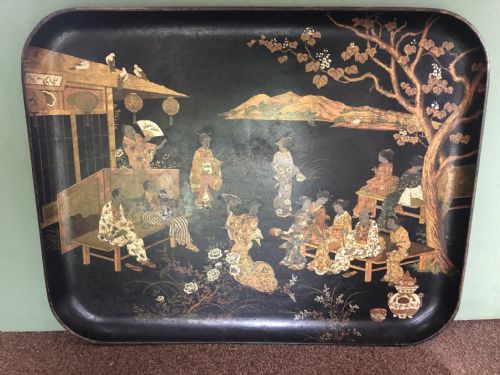
When you search for 19th century export lacquerware, you encounter portable furnishings and decorative objects made in Asia for Western markets. These items include trunks, sewing tables, tea caddies, cabinets, trays, hand fans and panels produced across the nineteenth century.
The objects most frequently met on this page are Chinese export items in black lacquer with gilt decoration, alongside Victorian-era variations and mid-nineteenth century pieces. Forms range from large domed chests to small desk cabinets and table cabinets.
Originating primarily from workshops producing Chinese export ware and Japanese export pieces, these items combine utilitarian function with intricate pictorial scenes. They reflect nineteenth-century trade patterns and the Victorian taste for exotic furnishings.
How they were made
These pieces utilise wood and lacquered wood as a base substrate, shaped into structural forms such as chests, tables and caddies. Some rectangular trays employ papier-mâché alongside lacquer layers.
Decoration relies heavily on gold leaf and gilt work applied over the dark lacquer surface. Brass, iron and metal fittings provide structural hardware and functional clasps for trunks and cabinets.
Some fans record the lively bustle of mandarin thousand faces scenes, packing dozens of tiny painted dignitaries onto a single folding blade.
What varies in quality
The refinement of the gilt decoration determines much of the visual hierarchy across these items. Pieces featuring dense, finely rendered figures and landscapes demonstrate superior handwork compared to simpler linear motifs.
The integrity of the lacquer surface and the stability of the wooden carcass dictate structural grade. Well-preserved finishes retain deep tonal contrast without extensive cracking or loss to the underlying material.
The 19th Century Export Lacquerware Glossary
- Lacquer
- A durable protective and decorative finish applied to wooden substrates. It hardens into a smooth, lustrous coating that resists moisture and wear.
- Gilt
- Gold leaf or gold powder applied to the surface for decoration. This technique highlights pictorial details against dark lacquer grounds.
- Canton
- A major Chinese port and manufacturing centre for export goods. Items from this region often feature characteristic figural and floral compositions.
- Chinoiserie
- Western artistic style reflecting Chinese motifs and decorative techniques. It influenced nineteenth-century European interiors through imported furnishings.
- Tea caddy
- A small container designed for storing loose tea leaves. These boxes frequently feature internal compartments and secure lids.
19th Century Export Lacquerware: Frequently Asked Questions
What is 19th century export lacquerware?
These items are decorative and functional furnishings made in Asia specifically for Western buyers during the nineteenth century. They encompass practical household goods finished with polished lacquer and gold decoration.
The inventory includes trunks, sewing tables, tea caddies and small cabinets produced in workshops catering to international trade.
How were these cabinets used?
Table cabinets and desk cabinets served as secure storage for letters, writing implements and small valuables. Their compartmentalised interiors kept personal items organised.
Larger chests and trunks transported garments and prized possessions across maritime trade routes before settling in Victorian parlours.
How do I care for lacquerware?
Keep pieces away from direct sunlight and steady heat sources to prevent the lacquer finish from drying and cracking. Maintain stable indoor humidity levels.
Dust surfaces gently with a soft, dry cloth and avoid chemical polishes or abrasive cleaners that damage the delicate gilt layer.
What periods do these pieces span?
The selection covers items produced across the nineteenth century, including specific dates such as eighteen hundred, eighteen sixty and eighteen eighty. Victorian-era pieces also appear alongside Qing Dynasty items.
Stylistic markers range from early nineteenth-century work tables to later Japanese export trays and mid-century Chinese cabinets.