


19th Century Dutch Marine Art
These oil paintings and watercolours capture maritime life through 19th century Dutch marine art, offering timeless views of coastal waters and sailing vessels.
19th Century Dutch Marine Art
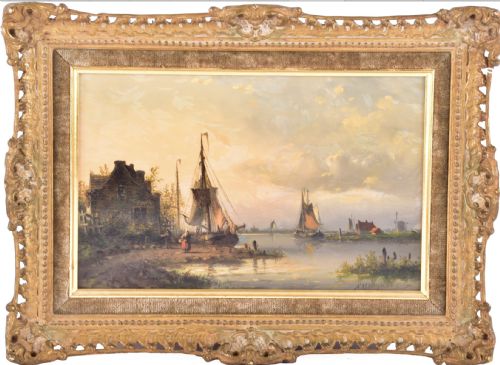
When you search for 19th century dutch marine art, you encounter oil paintings and watercolours depicting coastal scenes, estuaries, and shipping off the Dutch coast. These works typically feature fishing boats, sail boats, and windmills set against expansive skies and open waters.
The pieces on this page span the 19th century, including specific dates such as 1860, 1880, 1900, 1910, alongside Victorian examples and occasional later works. Most compositions focus on maritime activity near the shore, capturing the shifting light and atmosphere of the Netherlands.
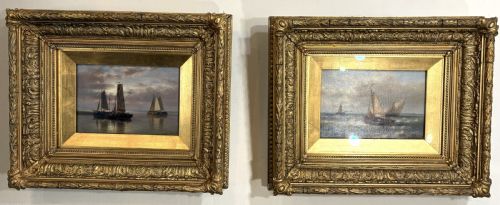
The selection ranges from detailed pairs of oil paintings on canvas to watercolours and works on board. Artists of the period recorded both tranquil coastal views and dynamic scenes of shipping traffic in all weather conditions.
How these artworks were constructed
The works rely primarily on oil paint applied to canvas or wood panels, alongside watercolours on paper. Giltwood frames decorated with gesso and gold leaf frequently enclose the paintings, adding traditional weight and border structure.
Artists built their compositions using layered brushwork to render the transparency of water and the heavy atmosphere of cloudscapes. Support materials range from stretched canvas to solid wood boards and watercolour paper.
Several artists signed their canvases while sitting in muddy Dutch estuaries, dodging tides and curious seagulls.
What separates the best examples
Quality rests in the handling of light on water and the confident rendering of rigging and hull structures on the vessels. Stronger works demonstrate a sure command of atmosphere and atmospheric perspective rather than mere mechanical precision.
The depth of the paint layers and the preservation of the original giltwood and gesso frames contribute significantly to the overall presence of the piece. Masterful brushwork distinguishes works by named artists from anonymous studio productions.
Abraham Hulk I·Pieter Cornelis Dommersen·Thomas Bush Hardy·Adrian Van Porten·Hendrik Willebrord Jansen·Paul Jean Clays·William Dommersen·Charles Martin Powell·Alfred Montague
The 19th Century Dutch Marine Art Glossary
- Marine Art
- Artwork depicting maritime subjects, including ships, coastal views, and naval battles. This genre holds a central place in Dutch artistic traditions.
- Gesso
- A plaster-like mixture applied to wooden frames as a base for gilding. It provides a smooth surface for the application of gold leaf.
- Giltwood
- Wood that has been coated with gold leaf or gold paint. It forms the traditional decorative framing for 19th-century oil paintings.
- Estuary
- The tidal mouth of a large river, where the tide meets the stream. These areas provided frequent subject matter for marine artists.
19th Century Dutch Marine Art: Frequently Asked Questions
What subjects appear in 19th century dutch marine art?
The compositions show sailing boats, fishing vessels, and coastal estuaries along the Dutch shoreline. Canals, windmills, and shipping traffic also feature prominently.
Artists recorded both calm waters and turbulent seas, often including figures on the shore or near castles and ports.
How do I hang a framed oil painting safely?
Use secure picture hooks rated well above the weight of the framed canvas. Ensure the wall fixings anchor directly into solid masonry or studwork.
Position the artwork away from direct sunlight and heat sources to protect both the oil paint and the giltwood frame.
Are watercolours different from oil paintings in care?
Watercolours require glazing with glass or acrylic to protect the paper from moisture and dust. They are particularly sensitive to direct sunlight and fade much faster than oil paints.
Oil paintings on canvas tolerate ambient light better but still benefit from stable indoor humidity and temperature levels.
Can I identify the exact location in a painting?
Many works include specific geographical markers in their titles or inscriptions, such as Scheveningen or the Maas river. Artists often recorded recognizable Dutch towns and coastal landmarks.
Background details like church spires and windmills can also help pinpoint the exact stretch of coastline depicted.