


19th Century Cattle Portrait
These 19th century cattle portrait works capture pastoral life on canvas, offering buyers a genuine slice of Victorian realism and rural history.
19th Century Cattle Portrait
When you search for a 19th century cattle portrait, you encounter oil paintings on canvas depicting bulls, cows, and sheep within pastoral landscapes or stables. These works range from naive English folk art to detailed studies by named artists of the period.
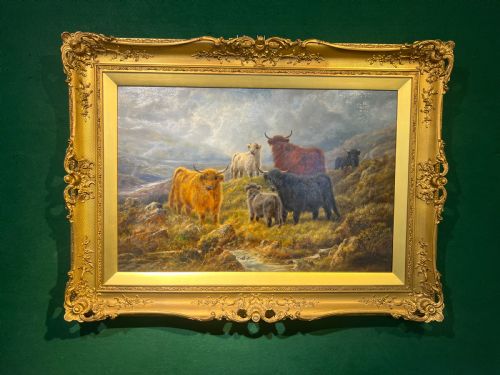
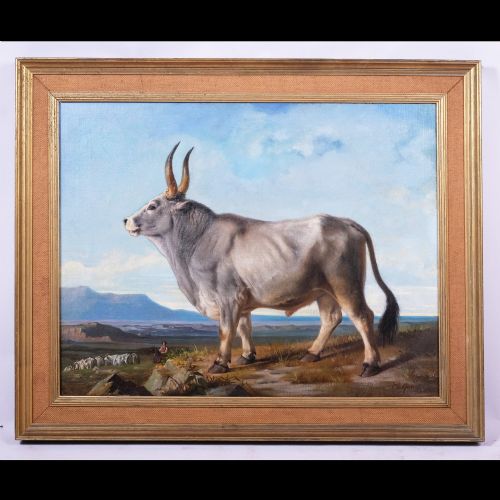
The pieces on this page heavily feature Victorian realism and English country school styles, focusing on individual animals such as short horns, Hereford cows, and Tuscan bulls. Highland cattle in Scottish winter scenes also appear frequently across the inventory.
Most examples date from the Victorian era, spanning the mid to late 19th century and extending slightly into the early 20th century. Buyers will find both framed canvases in giltwood and larger scale pastoral scenes suited to traditional interiors.
Materials and methods
Artists of this period painted primarily with oil paint applied to canvas supports, building up rich textures to render the coats and forms of the animals. This medium allowed for careful blending of natural light across rural landscapes and stable interiors.
Many of these oil paintings are housed within their original or period frames constructed from wood, plaster, and gilt leaf, often finished in giltwood. The combination of oil on canvas within a substantial gilt frame defined the standard presentation for animalier and pastoral art of the era.
One canvas captures a bull resting peacefully in a German landscape, proving even large livestock enjoyed a quiet afternoon.
Assessing quality in pastoral portraits
Quality in a 19th century cattle portrait rests on the anatomical precision of the animal and the atmospheric depth of the surrounding landscape. Finer works display subtle handling of light on fur and hide, whereas simpler pieces lean towards naive folk art charm.
The provenance and attribution to a recognised painter significantly influence the standing of a piece within this genre. Works by established Victorian animalier artists command greater interest than unsigned or simpler compositions.
Robert Watson·A M Gauci·Thomas Sidney Cooper·Heinrich Harder·Charles Jones·John W Morris·William Huggins
The 19th Century Cattle Portrait Glossary
- Animalier
- A term describing artists who specialised in the realistic portrayal of animals. This style flourished during the Victorian period.
- Giltwood
- Wood carved and covered with gold leaf or a gilt finish. It forms the decorative framing typical of nineteenth century oil paintings.
- Recumbent
- Posing an animal in a lying or resting position. This posture is common in cattle portraits depicting cows in fields or stables.
- Naive art
- Artwork created by a person without formal training, often characterised by a charming simplicity in perspective. Several rural paintings on this page reflect this folk art tradition.
19th Century Cattle Portrait: Frequently Asked Questions
What is a 19th century cattle portrait?
A 19th century cattle portrait is an oil painting on canvas that focuses on cows, bulls, or sheep, often set in rural landscapes or stables.
These works reflect Victorian pastoral realism and range from detailed studies by named artists to naive folk art pieces.
How were these cattle paintings displayed?
These oil paintings were typically housed in substantial giltwood frames made from wood, plaster, and gilt leaf.
The framing was designed to complement the rich tones of the canvas and suit the formal interiors of Victorian homes.
Who painted these nineteenth century animals?
Numerous artists worked in this genre, including Victorian animalier painters and regional specialists from the English country school.
Names such as Thomas Sidney Cooper, William Huggins, and Charles Jones appear frequently among works from this period.
How do I live with an antique cattle painting?
These works suit traditional study rooms, living spaces, or hallways where their pastoral subjects can anchor a room's decor.
Keeping them away from direct sunlight protects the oil paint and canvas from fading over time.