


Dutch Pastoral Oil Canvas
A dutch pastoral oil canvas brings the quiet expanse of rural life and livestock into a room through rich oil paint.
Dutch Pastoral Oil Canvas
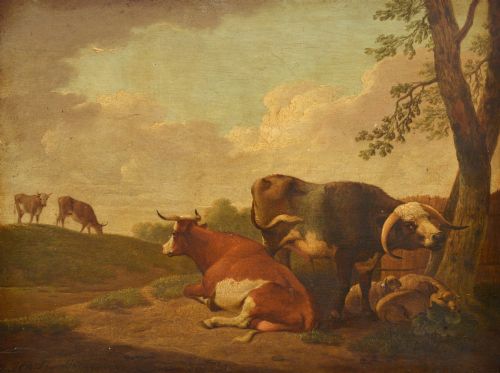
A dutch pastoral oil canvas depicts rural scenes featuring cattle, sheep, and shepherds across centuries of artistic tradition. These works capture agricultural life, from quiet grazing fields to farm buildings, reflecting the landscapes of the Netherlands and beyond.
The pieces on this page span the seventeenth, eighteenth, and nineteenth centuries, alongside twentieth-century interpretations. Buyers encounter styles ranging from the Dutch Golden Age and eighteenth-century compositions to nineteenth-century realism, romanticism, and the Hague School.
Most entries take the form of framed oil paintings on canvas, often housed in period wooden or gilt frames. Subject matter focuses heavily on livestock, farm workers, and pastoral land rendered in oil paint.
Materials and technique
Artists painted primarily with oil paint applied to stretched canvas, building up layers of pigment to achieve depth in landscapes and animal subjects. This medium allowed for careful blending of light and shadow across skies and open fields.
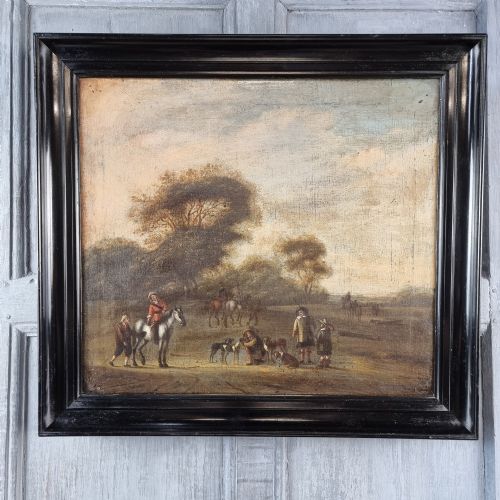
Many works retain their original or period framing materials, utilising wood, gesso, and gold leaf or gilt finishes. Ebonised frames also appear, providing a dark, contrasting border that highlights the lighter tones within the canvas.
Quality and execution
The distinction between standard works and finer examples lies in the handling of light, anatomical precision of figures and animals, and the subtlety of the brushwork. Masterful execution creates atmospheric depth rather than a flat depiction of scenery.
The condition of the oil paint surface and the integrity of the canvas matter significantly, as does the retention of a sympathetic period frame using gold leaf or gesso. Original framing contributes to the historical context of the piece.
Hendrik Willem Schweickhardt·Willem Anton Alexander Knip·James de Rijk·Gudrun Sibbons·Anthonij Anton Mauve·Laurens Plas·Hermanus van Brussel·Aelbert Cuyp
The Dutch Pastoral Oil Canvas Glossary
- Oil on Canvas
- A painting medium where pigments suspended in oil are applied to a woven fabric surface stretched across a wooden frame. This combination allows for rich colour saturation and varied brush textures.
- Gilt
- A thin layer of gold or gold-like material applied to wood or gesso frames. It provides a reflective border that enhances the tones of the painting within.
- Gesso
- A plaster-like mixture applied to wooden frames as a base before gilding or painting. It creates a smooth surface for detailed ornamentation.
- Hague School
- A group of nineteenth-century Dutch artists inspired by the Realism of the French Barbizon school. They painted rural landscapes and peasant life with subdued, atmospheric tones.
- Ebonised Frame
- Wooden framing treated to resemble dark ebony wood. This finish offers a sharp, formal boundary for nineteenth-century and earlier canvases.
Dutch Pastoral Oil Canvas: Frequently Asked Questions
What subjects appear in these paintings?
These works primarily depict rural landscapes featuring livestock such as cattle and sheep, often tended by shepherds or farmers. Farm buildings and open pastures form the common backdrop across the centuries represented.
Scenes range from idealized eighteenth-century compositions to the more grounded realism of the nineteenth-century Hague School.
How do I date a canvas?
Dating relies on stylistic clues, framing materials, and the signatures or recorded dates associated with specific artists. Seventeenth-century works differ markedly in palette and composition from nineteenth-century realism or 1920s pieces.
Examining the preparation of the canvas and the construction of the wooden stretcher frame also provides chronological context.
Are original frames important?
Original or period frames made of wood, gesso, and gold leaf complement the historical authenticity of the artwork. They were designed to set off the specific tones of the oil paint.
A matching period frame helps anchor the painting to its era of production.
Where were these artists working?
The artists represented worked primarily within Dutch painting traditions, though some associations extend to French influences like the Barbizon school. Their output reflects both domestic Dutch landscapes and broader European pastoral themes.
Workshops and individual studios spanned the Netherlands and surrounding regions during the eighteenth and nineteenth centuries.