
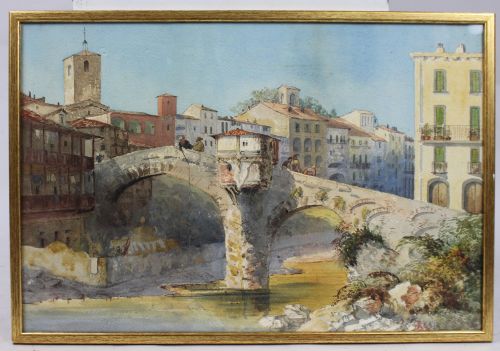


19th Century Bridge Watercolour
A 19th century bridge watercolour captures river crossings and rural spans with delicate pigment on paper.

19th Century Bridge Watercolour
A 19th century bridge watercolour is a fine art painting executed on paper, depicting architectural spans and pastoral river crossings. These works capture stone bridges, toll bridges and ancient masonry structures across English, Scottish, Welsh and continental landscapes.
Buyers commonly encounter pastoral scenes, cityscapes and romantic river views originating from the Victorian era and earlier decades. Many pieces feature figures crossing rural structures or working boats passing beneath arches.
The selections range from regional British school studies to Italianate compositions and works associated with recognised artists. These watercolours document historical views of locations such as the River Thames, York, and various mountain streams.
How they were made
These works utilise watercolour paint applied directly to paper supports, capturing tonal gradations and atmospheric light. Artists built compositions through fluid washes of pigment, often finished with finer brushwork for architectural details like stone bridge masonry.
Surviving pieces frequently retain their period framing materials, including wood, gilt wood and gilt metal surrounds. Protective glass covers many of the surviving paintings to shield the fragile paper and water-soluble pigments from environmental moisture and damage.
Listings feature works executed on paper using watercolour paint, housed in wood, gilt wood and glass frames.
What varies in quality
Quality rests upon the confidence of the brushwork and the precision with which the artist handles light and perspective. Finer examples demonstrate a sure command of architectural structure, rendering stone arches and river reflections with distinct clarity.
The strength of provenance and documentation also elevates certain pieces, particularly those bearing legible signatures, dates or attribution to known practitioners of the period. Condition of the paper surface and the retention of original framing elements further distinguish individual works.
Thomas Lound·James H Hulse·Frederick Tully Lott·Carleton Grant·John Wilson Carmichael·Thomas Colman Dibdin·Edward Richardson·WT Longmire·James Drummond·William Grey·Clarkson Frederick Stanfield·John Wright Oakes·Thomas Danby·William Page·George Fall
The 19th Century Bridge Watercolour Glossary
- Watercolour
- A painting method where fine pigment is suspended in a water-based solution and applied to paper. This medium allows for transparent washes and luminous atmospheric effects.
- Victorian School
- A broad classification for British art produced during the reign of Queen Victoria. These works frequently embrace romanticism and detailed observation of landscape and architecture.
- Gilt Wood
- Timber framing finished with a thin layer of gold leaf or metallic gilt. This finish provides a reflective border that complements the tones of the painting within.
- Norwich School
- A regional art movement comprising artists who depicted the scenery of Norfolk. Members captured local rivers, bridges and rural landscapes with direct observation from nature.
- Provenance
- The documented history of a painting's ownership and origin. A clear record helps establish authenticity and attribution to specific historical artists.
19th Century Bridge Watercolour: Frequently Asked Questions
How do I date a bridge watercolour?
Dating relies on visible inscriptions, artist signatures, framing styles and stylistic markers from specific decades. Paper characteristics and handwritten notes on the reverse also provide chronological clues.
Comparison with documented works by the same hand helps narrow the period of creation further.
Where should I hang these watercolours?
These works require placement away from direct sunlight to prevent the fading of delicate pigments on paper. Stable indoor humidity levels protect both the artwork and its historic frame.
Positioning them at eye level in low-traffic rooms ensures proper appreciation of their fine detail.
What is the difference between a study and a finished painting?
Studies are typically looser, rapid observations created outdoors to capture immediate lighting effects or compositional ideas. Finished works exhibit greater detail, controlled washes and a more resolved subject.
Both forms were common practice among nineteenth-century landscape artists.