


19th Century Aneroid Barometer
A 19th century aneroid barometer brings reliable weather indication and rich nineteenth-century craftsmanship into a room.
19th Century Aneroid Barometer
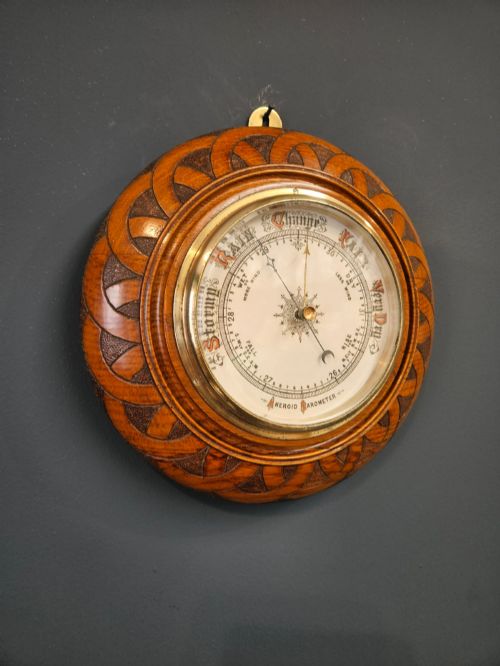
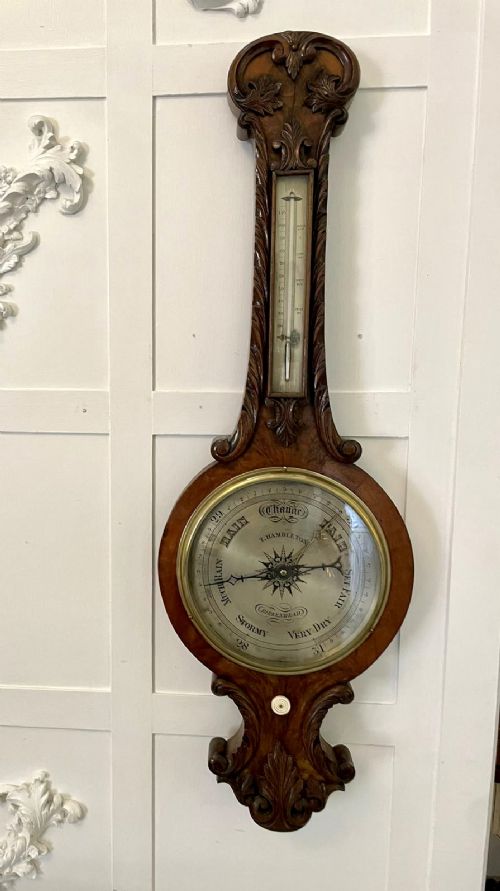
A 19th century aneroid barometer is a domestic meteorological instrument designed to measure atmospheric pressure without liquid mercury, housed in decorative wooden cabinetry. You encounter these instruments predominantly as Victorian banjo barometers or wall-hanging dials shaped by regional preferences from British, Scandinavian, American, and Black Forest workshops.
The selection on this page ranges from compact carved oak pieces to substantial burr walnut and mahogany banjo formats featuring subsidiary dials or thermometers. Makers housed these mechanisms in varied timbers such as rosewood, oak, and walnut, frequently applying hand-carved ornamentation or inlaid mother-of-pearl.
Buyers look for these pieces to anchor a study, hallway, or living room with functional period interest. The designs span simple turned cases to elaborate carved compositions incorporating acanthus leaves and ceramic dials.
How they were made
Cabinetmakers constructed the housing using dense hardwoods like oak, walnut, and mahogany, often selecting burr walnut veneers for rich grain figures. Carved wood variations utilise manual chisel work to produce decorative motifs such as acanthus foliage.
Glazed bezels protect the paper, metal, or ceramic dials, beneath which the mechanical aneroid bellows operate. Inlaid models integrate contrasting materials like mother-of-pearl directly into the wooden face of the wheel barometer or banjo frame.
One exceptional 19th-century wall clock successfully combined a thermometer and an aneroid barometer directly into its ticking face.
What varies in quality
Quality separates through the depth of cabinetwork and the crispness of the timber carving. Superior examples display finely figured burr walnut or deeply undercut carved woodwork rather than plain, machine-finished mouldings.
The legibility and material of the dial influence the standing of the piece. Ceramic dials and detailed engraved brass plates demonstrate superior production values compared to simpler paper faces.
Blake & Son of London & Gosport·L. Malacrida·Negretti & Zambra
The 19th Century Aneroid Barometer Glossary
- Aneroid barometer
- An instrument measuring atmospheric pressure by the expansion and contraction of a flexible metal capsule inside, avoiding liquid mercury. This dry mechanism allowed barometers to be mounted on walls in various orientations.
- Banjo barometer
- A domestic weather glass housed in a vertically elongated wooden case shaped like a banjo. This form typically accommodates a hygrometer, thermometer, or spirit level alongside the main dial.
- Black Forest
- A mountainous region in Germany renowned for intricate wood carving traditions. Pieces from this area often feature deep, naturalistic foliage carvings in oak or walnut.
- Burr walnut
- Timber taken from a tree growth where grain swirls in intricate patterns. Cabinetmakers prized this veneer for high-status Victorian instrument cases.
- Wheel barometer
- A mercurial or aneroid design where pressure changes move a visible pointer around a circular dial via a system of pulleys and a weight. These frequently incorporate mirrors or spirit levels in the trunk.
19th Century Aneroid Barometer: Frequently Asked Questions
How do aneroid barometers work?
An aneroid barometer uses a sealed, corrugated metal box called an aneroid capsule that expands or contracts with shifting air pressure. Levers connect this capsule to the pointer on the dial.
This enclosed metallic system replaced traditional mercury tubes, making barometers safer and easier to mount vertically on domestic walls.
Where should I hang my barometer?
Mount your barometer on an interior wall away from direct sunlight, radiators, and draughts. Stable ambient temperatures ensure the internal metal mechanism reacts solely to atmospheric pressure changes.
Entrance halls and studies suit these instruments well, echoing their traditional nineteenth-century domestic placement.
How do I tell Victorian from Georgian pieces?
Georgian instruments often favour simpler mahogany wheel formats with exposed dampness indicators. Victorian pieces introduce heavier carvings, burr walnut veneers, and specialised Aneroid mechanisms.
Stylistic cues such as acanthus leaf carvings and ceramic dials point firmly towards the later nineteenth-century manufacturing period.
Can I calibrate my 19th century barometer?
Most antique barometers feature a small adjustment screw accessible from the back or through the glass face. You set this against a known local reading from a reliable modern source.
Allow the instrument time to settle in its new location before attempting any calibration adjustments.