


Black Forest Aneroid Barometer
These black forest aneroid barometer pieces bring carved woodcraft and domestic science together on the wall with genuine period character.
Black Forest Aneroid Barometer
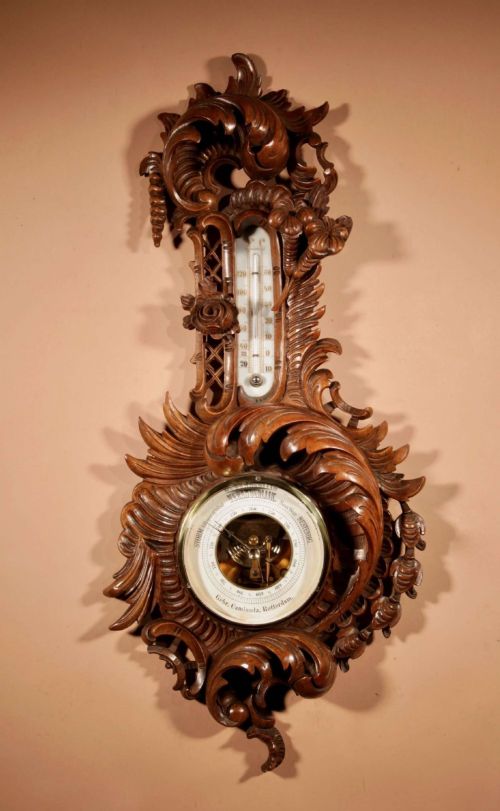
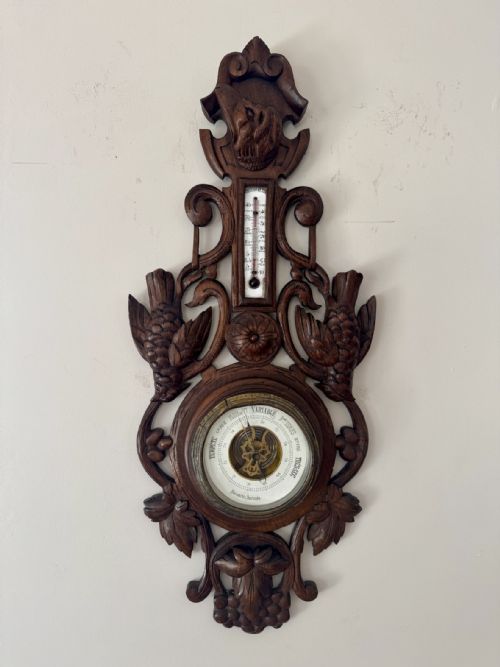
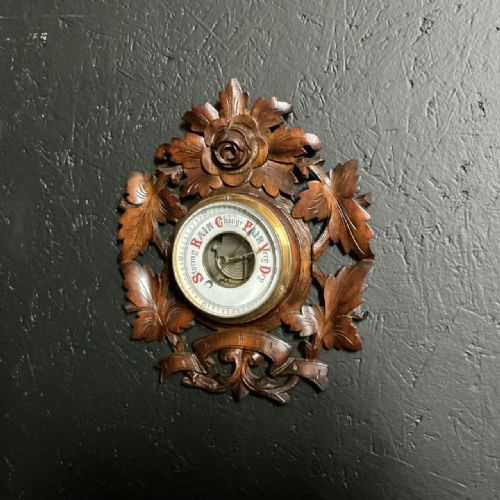
A black forest aneroid barometer combines mechanical weather recording with elaborate hand-carved woodwork from the nineteenth century and the Edwardian era. These wall barometers usually take the form of wall barometers featuring carved wooden frames, often executed in walnut or lindenwood.
The version most commonly encountered on this page is the Victorian Black Forest wall barometer with a carved wooden surround and an exposed dial behind glass. Pieces span several decades from eighteen-sixty through to nineteen-ninth-century examples and Edwardian variations.
How they were made
Carvers shaped timber such as walnut, lindenwood, and oak into detailed naturalistic motifs and rocaille scrolls. These wooden frames were constructed by hand, housing mechanical aneroid barometer movements alongside brass bezels and glass dial covers.
Some dials incorporate ceramic components, while other examples integrate horn elements into the detailed wooden assembly. The combination of precision barometer mechanics and deep wood carving defined the workshop practice.
Some barometer dials feature charming spelling errors from nineteenth-century workshops, reminding us that even scientific instruments had a human hand behind them.
What varies in quality
The depth and crispness of the wood carving separate standard wall barometers from exceptional examples. Finer pieces display undercut foliage, crisp detail in the wooden scrolls, and carefully selected golden walnut or lindenwood.
The integration of the brass bezel, the legibility of the ceramic or glass-covered dial, and the precision of the mechanical movement dictate the overall standard. Superior works maintain crisp definition across every carved wooden element without softening of the original form.
The Black Forest Aneroid Barometer Glossary
- Aneroid barometer
- A scientific instrument that measures atmospheric pressure using an expanding metal capsule rather than liquid mercury. It drives a pointer around a graduated dial behind glass.
- Rocaille
- An asymmetrical shell and rockwork decorative style inspired by natural forms. It appears frequently in the carved wooden frames of these barometers.
- Bezel
- The metal ring, usually brass, that holds the glass cover securely in front of the barometer dial. It frames the face of the instrument.
- Lindenwood
- A pale, close-grained timber favoured by carvers for its even texture and suitability for intricate detail. It holds sharp edges exceptionally well.
- Golden walnut
- A richly figured timber selected for its warm tone and decorative grain pattern. Carvers utilised it for high-status barometer frames.
Black Forest Aneroid Barometer: Frequently Asked Questions
How do I hang a wall barometer?
These wall pieces require a secure fixing point directly into a wall stud or a robust wall plug capable of supporting the combined weight of the carved timber and internal mechanism. Ensure the fixing matches the hanging loop or bracket integrated into the back of the wooden frame.
Once mounted, tap the instrument gently to settle the internal aneroid linkage before noting the local atmospheric reading.
How do I clean the carved wood?
Dust the carved wooden frame regularly using a soft, dry brush to prevent accumulation in the recesses of the foliage and scrolls. Avoid liquid polishes, damp cloths, and chemical cleaners that can damage the antique timber finish.
Maintain a stable indoor environment away from direct sunlight and excessive humidity to protect the wood and the mechanical interior.
How do aneroid movements function?
An aneroid movement relies on a sealed flexible metal box that expands or contracts as atmospheric pressure changes. Mechanical linkages connect this expanding capsule to the visible pointer on the dial.
This design removes the need for liquid mercury, making the barometer safer and more practical for domestic wall mounting.
How do I date these pieces?
Dating relies on stylistic clues in the carving, the typography on the dial, and the materials used in the frame construction. Victorian examples often feature deep, naturalistic foliage, while Edwardian pieces can show different stylistic interpretations.
Comparative study of surviving workshop output helps narrow the decade of manufacture between eighteen-sixty and nineteen-ten.