




1930s Walnut Mantel Clock
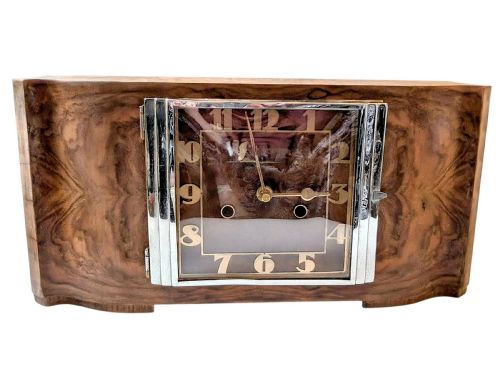
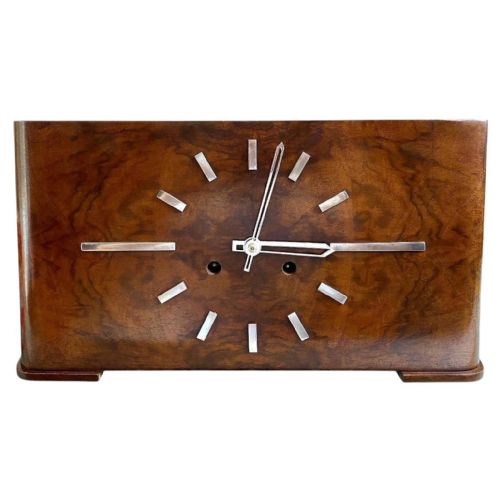
A 1930s walnut mantel clock brings striking architectural geometry and rich warm timber tones to a room.
1930s Walnut Mantel Clock
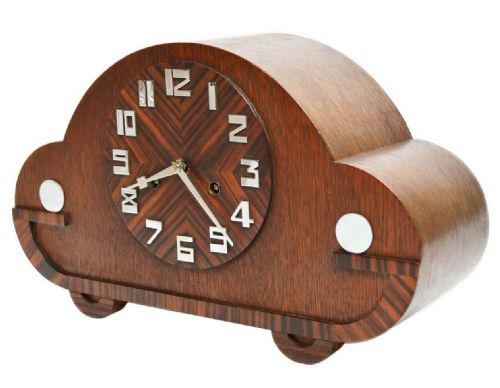
A 1930s walnut mantel clock embodies the characteristic styling of the Art Deco period, combining clean architectural lines with rich timber grain. These timepieces typically sit upon a desk, sideboard, or mantelpiece, serving both a functional and a decorative purpose.
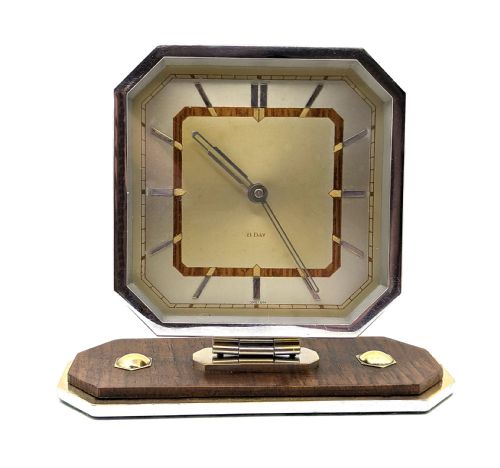
Most examples found in the listings originate from the 1930 or 1920 periods and take the form of mantel clocks or desk clocks. Makers and workshops from England, Germany, and France produced these pieces, often incorporating contrasting materials into the design.
The primary material underpinning these objects is walnut, frequently applied as burr walnut or walnut veneer over a wooden body. Brass, chrome, glass, and metal elements frequently appear alongside the wood to accent the geometric Art Deco forms.
How they were made
Cabinet makers utilised solid walnut and walnut veneer, often selecting burr walnut to create striking figured patterns across the front of the case. Geometric two-tone wooden designs relied on precise carpentry to juxtapose different timber tones.
Metal components such as brass and chrome were integrated into the bezels, feet, and dial surrounds to provide a sharp contrast against the warm timber. Glass protects the clock face, framed by bezels that reflect the industrial influences of the era, such as Bauhaus and Art Deco styles.
German workshops placed their trademark arrows inside stars right on the clock movement backplate.
What varies in quality
The standard of a 1930s walnut mantel clock rests upon the intricacy of the timber selection and the complexity of the movement. Pieces featuring figured burr walnut veneers or two-tone geometric woodwork demonstrate a higher level of cabinet work than plain wooden cases.
Haller·Junghans·Bravingtons Ltd of London·Pfeilkreuz Junghans
The 1930s Walnut Mantel Clock Glossary
- Walnut veneer
- A thin slice of walnut timber applied over a secondary wood base to provide a decorative surface without using solid hardwood throughout.
- Burr walnut
- A prized timber growth filled with swirling grain patterns, used on high-end cabinet fronts to create visual texture.
- Art Deco
- A design style spanning the 1920s and 1930s defined by geometric shapes, stylised motifs, and sleek modern lines.
- Westminster chime
- A melodic quarter-hour chime sequence played by the clock mechanism using multiple hammers and gongs.
- Eight day
- A clock movement designed to run for eight days on a single wind before requiring attention.
1930s Walnut Mantel Clock: Frequently Asked Questions
How do I wind an eight day clock?
An eight day clock requires winding approximately once a week using a matching key inserted into the winding holes on the dial. Care must be taken not to overwind the mainspring.
Most movements from this era utilise a spring-driven mechanism rather than hanging weights, making them straightforward to maintain on a mantelpiece.
Where were these clocks made?
Production of these timepieces centred in England, Germany, and France during the interwar years. German factories produced many of the mechanical movements used in these cases.
English and continental workshops designed the distinctive wooden housings to suit contemporary interior styles.
What is a Westminster chime?
A Westminster chime is a specific four-note melody played on the quarters of each hour by the clock movement. Clocks with this function often feature multiple gongs inside the case.
Heavier chiming movements required robust wooden frames to support the acoustic resonance.
How do I identify the period?
The period is identified through a combination of Art Deco styling, geometric case architecture, and materials like chrome and walnut veneer. Many pieces bear maker marks on the dial or movement backplate.
Details such as Bauhaus influences and Arabic numerals on the face help date the object to the interwar decades.