




1930s Chrome Bedside Lamps
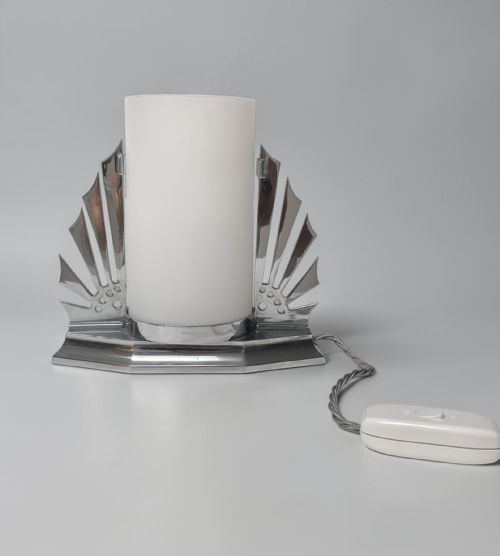
These 1930s chrome bedside lamps bring sharp Art Deco geometry and industrial sheen directly to a table.
1930s Chrome Bedside Lamps
These 1930s chrome bedside lamps belong firmly to the Art Deco movement, taking the form of functional table lamps created during the 1920s, 1930s, and 1940s. The selection on this page centres primarily on standard table lamps and pairs, alongside distinct figural designs and geometric motifs.
Makers of the period applied bright metallic finishes to structural forms, incorporating materials such as frosted glass, opal glass, and dark plastics to diffuse light. Collectors encounter variations ranging from simple twisted stems to figural subjects like an athlete holding a ball or a zig zag lightning flash light.
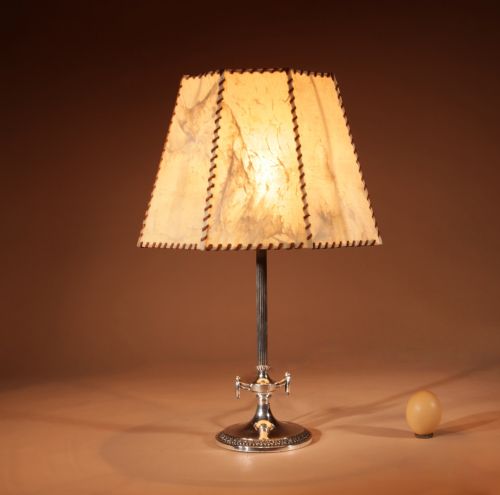
Many examples combine metal with contrasting substances, including polished white metal with parchment leather, or integrate dark elements like Bakelite and catalin phenolic bakelite. This mix of industrial plating and tactile body materials defines the visual character of the lighting encountered here.
How they were made
Workshops built these lamps using metal foundations plated in chrome, silver plate, or nickel to achieve a reflective, durable finish. This metallic shell was frequently paired with blown or moulded glass shades in pink, frosted, or opal varieties.
Moulders shaped early plastics like Bakelite and catalin phenolic bakelite for bases and fittings, exploiting the rigidity and dark tones of synthetic resin. Artisans also integrated organic textures such as parchment leather alongside polished white metal.
What varies in quality
Quality in these lamps rests on the crispness of the casting and the integrity of the plating over the underlying metal. Stronger examples maintain a heavy, stable footing and clean junctions between the metal body and the glass or plastic components.
The sophistication of the design sets superior pieces apart from standard manufacturing, particularly in figural subjects or complex geometric configurations like double shade forms. Pairs also demand a consistent matching of materials and patination across both items.
The 1930s Chrome Bedside Lamps Glossary
- Chrome
- A thin electroplated coating of chromium applied over a base metal to provide a bright, corrosion-resistant shine. This finish defines the reflective surface seen across these Art Deco pieces.
- Bakelite
- An early form of thermosetting phenol formaldehyde resin prized for its dark, dense finish and durability in electrical components. It appears frequently in the bases and switches of period lighting.
- Catalin
- A cast phenolic resin that allowed manufacturers to produce brightly coloured or marbled plastic elements. It shares similarities with Bakelite but offers distinct translucent depth.
- Opal glass
- A milky, semi-translucent white glass used extensively for lamp shades to soften and diffuse bulb glare. It creates an even, gentle spread of light suited to domestic interiors.
- Figural lamp
- A lighting piece incorporating a sculpted human or symbolic subject, such as an athlete or a lightning flash. These designs blend sculptural art with functional illumination.
1930s Chrome Bedside Lamps: Frequently Asked Questions
How do I style a chrome bedside lamp?
Pair these metallic forms with simple wooden furniture to let the reflective surfaces catch the surrounding light.
Keep surrounding objects minimal to maintain the clean lines characteristic of the Art Deco period.
Are these lamps safe for daily use?
Original wiring often requires professional rewiring to meet modern safety standards before connecting to mains power.
An accredited electrician can update internal cables while preserving the external metallic and plastic components.
What is the difference between chrome and nickel plating?
Chrome plating yields a bright, blue-white metallic lustre that resists tarnishing and remains highly reflective.
Nickel plating tends to exhibit a warmer, slightly yellowish or softer metallic tone under direct room light.
How do I identify an Art Deco lamp?
Look for geometric motifs, streamlined silhouettes, and a combination of polished metal with glass or synthetic resins.
Designs from this era frequently favor symmetry, stepped bases, and industrial materials over floral ornamentation.