
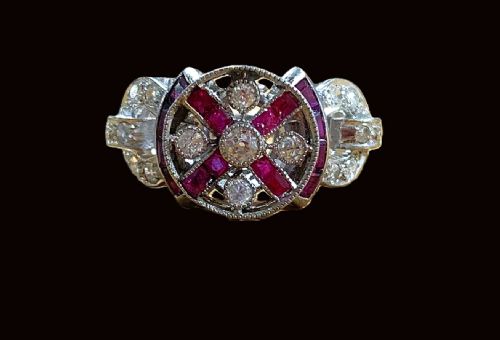
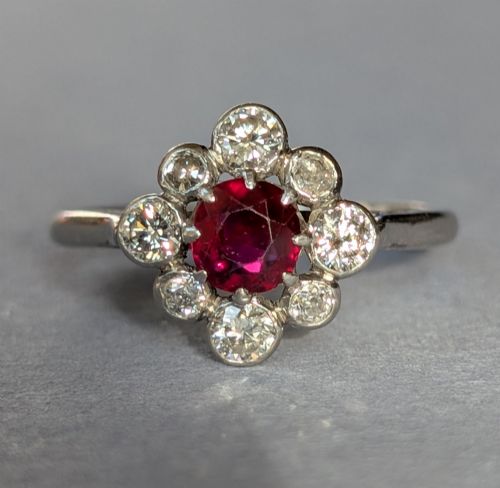


1920s Ruby Diamond Ring
A 1920s ruby diamond ring brings together rich red gems and fiery stones in geometric settings that define twentieth-century design.
1920s Ruby Diamond Ring
When you search for a 1920s ruby diamond ring, you encounter jewels that capture the geometric energy of the early twentieth century. The selection spans the 1920 period alongside pieces from the Edwardian era, 1930, and 1940.
Dress rings and cocktail rings dominate the forms, often taking the shape of clusters, target rings, marquis mounts, and twist designs. European and French origins appear frequently among these surviving examples.
The aesthetic leans heavily into Art Deco principles, prioritising symmetry, straight lines, and striking colour contrasts between red rubies and white diamonds.
Metals and Stone Settings
Platinum serves as the primary metal for mounting stones securely while maintaining delicate visual lines. 18ct white gold, 18ct gold, and 14ct yellow gold also support the gem structures.
Cut stones include old cut diamonds and rose cut diamonds alongside natural rubies originating from sources such as Mogok in Burma.
What Separates Fine Examples
The distinction between standard and exceptional pieces rests upon stone origin, gemstone weight, and metal purity. Burmese rubies of notable size command particular attention from collectors.
Precision in the geometric layout and the condition of the platinum or gold work dictate the overall refinement of each jewel.
The 1920s Ruby Diamond Ring Glossary
- Art Deco
- A design style from the interwar period characterised by geometric shapes, stylised motifs, and sleek lines. It remains the dominant aesthetic for these rings.
- Cluster ring
- A ring design featuring a central gemstone surrounded by a border of smaller stones. This format maximises visual presence on the hand.
- Old cut
- A diamond cutting style predecessor to the modern brilliant, featuring a small table and high crown that catch candlelight warmly. These cuts are typical of period work.
- Target ring
- A circular cluster ring with concentric rings of contrasting gemstones resembling a bullseye. Platinum is often used to frame each colour tier.
- Marquis
- A boat-shaped gemstone cut with pointed ends, designed to elongate the finger. It is frequently deployed as the focal point in cluster settings.
1920s Ruby Diamond Ring: Frequently Asked Questions
How do I care for a 1920s ruby diamond ring?
Clean the metal and stones gently with warm soapy water and a soft brush, avoiding harsh chemical dips that might harm the settings.
Store the ring separately in a fabric-lined box to prevent the diamonds from scratching softer gold or platinum surfaces.
Can I wear a 1920s ruby diamond ring daily?
Platinum and gold mountings from this era are durable, but antique settings require mindful wear during manual tasks.
Have a jeweller inspect the claws periodically to ensure the rubies and diamonds remain secure in their original mounts.
What defines an Art Deco ring?
Art Deco pieces rely on strict symmetry, stepped architectural motifs, and high-contrast colour pairings like red ruby and white diamond.
This aesthetic rejected nineteenth-century curves in favour of clean geometric discipline.
Are Burmese rubies common in these rings?
Mogok Burmese rubies appear in select period pieces, prized for their natural colouration and saturation.
These stones sit alongside other natural rubies within platinum and gold settings.