
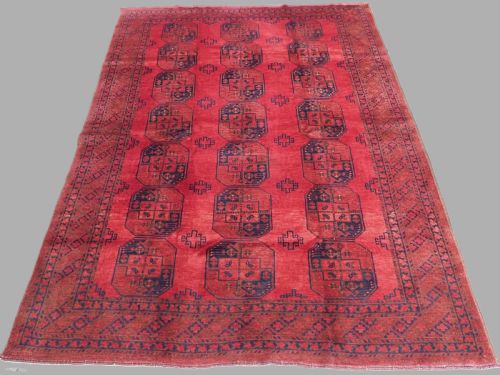


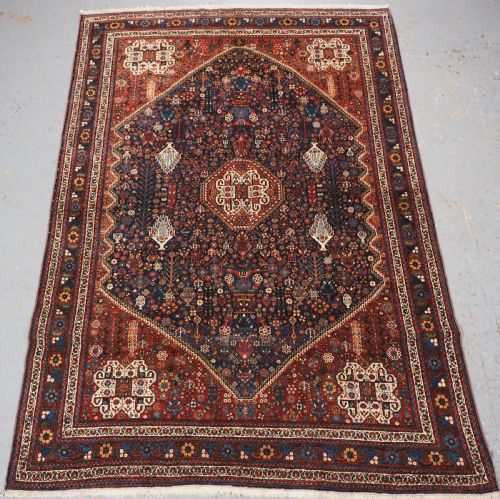


1920s Persian Carpet
When searching for a 1920s persian carpet, buyers encounter hand-knotted room-sized rugs and village runners woven with natural dyes.
1920s Persian Carpet
A 1920s persian carpet encompasses room-sized floor coverings, area rugs, and long hallway runners originating from major weaving centres and tribal regions. The selection spans city workshop productions from Kashan, Tabriz, and Isfahan alongside village and tribal pieces from Heriz, Hamadan, and Afghan makers.
Buyers frequently find traditional floral medallion designs, all-over Herati patterns, and tribal geometric motifs produced during the 1910 and 1920 periods. These textiles serve as durable floor coverings and decorative focal points in residential interiors, ranging from compact formats to substantial room sizes.
Materials and construction
Weavers utilised hand-spun wool, lambswool, and occasional silk for the pile, set upon sturdy cotton or silk foundations. Natural dyes provide the underlying palette, yielding warm reds, soft pastels, and ivory grounds across tribal and city workshop pieces.
The construction relies on traditional hand-knotting techniques executed by village weavers and urban workshops. Finer city pieces demonstrate extremely dense knot counts, while tribal and village carpets employ robust weaves suited for everyday wear.
1920s Persian Carpet Retail Price Guide 2026
Typical asking prices for 1920s persian carpet among the pieces listed under this phrase on Sellingantiques today, from the lower quarter to the upper quarter. They describe what is for sale here now, not the wider market.
Regional attributions span Afghan, Isfahan, Kashan, Tabriz, Heriz, Hamadan, Abedhe, and Shiraz origins.
Quality variations
Quality diverges between city workshop productions and village pieces through the density of the weave and the complexity of the design. Urban workshops in centres like Tabriz or Isfahan achieved intricate floral detailing and fine wool on silk foundations.
Village and tribal examples rely on bold graphic impact, regional character, and the quality of the natural dyes. The handling of traditional motifs and the integrity of the wool foundation determine the distinction between standard room-sized furnishings and finer collectible pieces.
Benlian·Saber
The 1920s Persian Carpet Glossary
- Herati
- A repeating floral lattice pattern featuring a central rosette flanked by leaf blades, commonly seen in Persian Tabriz rugs. This classical design creates a dense, uniform field across the carpet.
- Medallion
- A large central ornamental motif placed in the middle of the rug field, frequent in Heriz and Tabriz carpets. It anchors the symmetrical layout of the surrounding floral or geometric elements.
- Prayer rug
- A small format rug featuring a mihrab or arch design at one end, traditionally used for individual prayer. Kashan examples frequently utilise this specific format with floral vase designs.
- Kilim
- A flat-woven textile produced without a pile, seen here in runner formats. These pieces offer a lighter weight and distinct geometric patterning created by interlocking weft threads.
- Foundation
- The structural base of the carpet consisting of warp and weft threads, typically made of cotton or silk. The pile is knotted directly onto this underlying grid.
1920s Persian Carpet: Frequently Asked Questions
How do I identify a Heriz carpet?
Heriz carpets are generally recognised by their bold, large-scale geometric medallions set against prominent red or ivory grounds. They were built as hard-wearing furnishings with substantial room sizes.
The village weavers of this region favoured structural durability and strong rectilinear patterns over the curved floral lines found in city workshop rugs.
Where were Kashan rugs made?
Kashan rugs originated from a major city in north-west central Persia known for sophisticated urban workshop production. These pieces often feature fine floral vase designs and intricate prayer rug formats.
The workshop output from this centre focused on refined execution and balanced composition using quality wool pile.
What is the difference between a runner and a carpet?
Runners are long, narrow formats specifically produced for hallways, corridors, and staircases. Carpets and room-sized rugs offer a broader rectangular area intended to anchor central living spaces.
Both categories utilise similar hand-knotted wool construction techniques from the 1920 period, scaled for different architectural requirements.
Are these carpets made with natural dyes?
The pieces from this period frequently incorporate natural dyes derived from plants and minerals, contributing to the rich warm reds and soft pastel tones observed across the inventory. These colorants age gracefully within the wool pile.
Over time, natural dyes develop subtle variations in shade known as abrash, which add visual depth to the surface.