
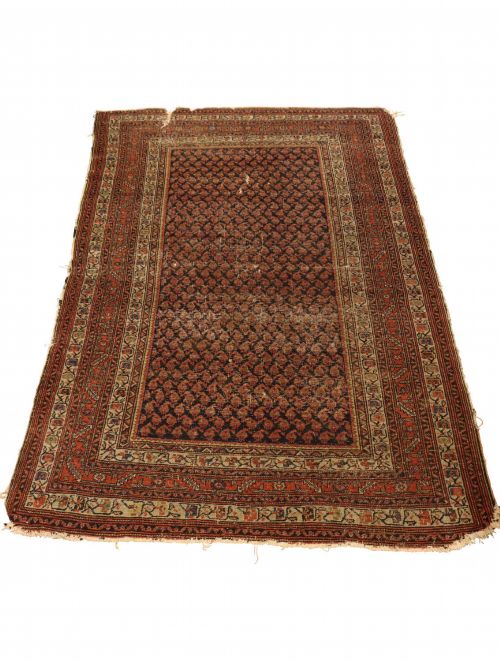


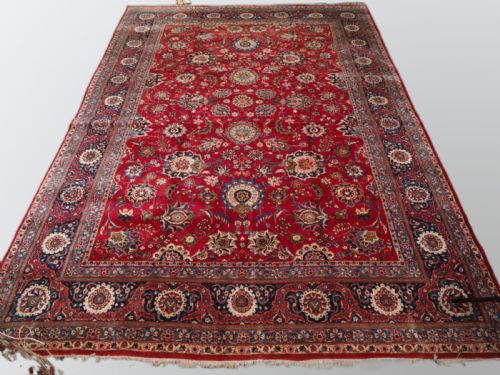


All Over Design Carpet
An all over design carpet provides a continuous decorative field without a central medallion, creating a balanced and harmonious floor covering.
All Over Design Carpet
When searching for an all over design carpet, a buyer encounters pieces where motifs repeat across the entire field rather than focusing on a central medallion. These textiles encompass large room sizes as well as smaller formats, runners, and corridor carpets.
The selections on this page originate predominantly from Persian weaving centres alongside Indian, Turkish, and Balkan workshops, dating from the late nineteenth century into the early decades of the twentieth century.
The most common versions met here include Heriz, Mahal, and Tabriz room-size carpets, alongside tribal rugs featuring recurring boteh, Herati, and Mina Khani patterns.
Materials and construction methods
These floor coverings are constructed using hand-knotted techniques executed on foundations primarily composed of cotton or wool.
The pile utilises soft wool, sometimes noted for its fine weave or dense handle, dyed in varied colour grounds including red, ivory, and soft tones.
Production dates span from the late nineteenth century through the nineteen-thirties.
Evaluating quality and execution
Quality separates across these pieces through the precision of the hand-knotting and the fineness of the weave, which dictates how sharply the repeating motifs are rendered.
The depth and variation of the dyed colours, alongside the overall condition of the pile, determine the visual impact of the repeat pattern across the field.
Saber·Hereke
The All Over Design Carpet Glossary
- Boteh
- A stylised almond or pear-shaped motif representing a floral spray or cypress tree. This recurring element appears frequently in repeating fields.
- Herati
- A traditional recurring pattern composed of a central rosette enclosed by a rectangle and flanked by leaf motifs. It forms a dense, continuous network across the carpet.
- Mina Khani
- An all-over pattern featuring daisy-like flowers connected by curved stems in a symmetrical grid. This design creates a balanced rhythm across the ground.
- Kilim
- A flat-woven carpet or rug produced without a pile. These pieces rely on warp and weft interlocking techniques to form traditional flat surfaces.
All Over Design Carpet: Frequently Asked Questions
What is an all over design carpet?
An all over design carpet is a textile featuring a repeating pattern that spreads uniformly across the entire central field. This layout avoids any dominant central medallion, allowing motifs to flow continuously from edge to edge.
Such carpets offer a balanced visual rhythm that makes furniture placement straightforward within a room. The absence of a focal medallion creates a cohesive decorative background.
How were these antique carpets used originally?
These carpets served as durable floor coverings in substantial residential rooms, hallways, and country houses. Their continuous patterns were designed to withstand heavy foot traffic while anchoring the surrounding interior decor.
Runners and long rugs specifically accommodated corridors and narrow spaces. Larger room-size examples anchored formal sitting areas and reception rooms.
How do I live with an antique carpet?
Living with an antique carpet involves placing a suitable underlay beneath it to prevent slipping and reduce wear from friction. Regular gentle vacuuming without a beater bar helps maintain the wool pile.
Keeping the textile out of direct, harsh sunlight preserves the natural dyed colours over time. Rotating the carpet periodically ensures even wear across high-traffic areas.
How can I tell different regional types apart?
Regional types are distinguished by their specific structural characteristics, knotting density, and characteristic repeat motifs. For instance, Heriz carpets often display geometric interpretations, while Tabriz pieces present finer, more curvilinear weaving.
Palette choices also offer clues, as specific workshops and tribal groups favoured particular dye combinations and ground colours. Examining the foundation materials further clarifies the origin of the piece.