




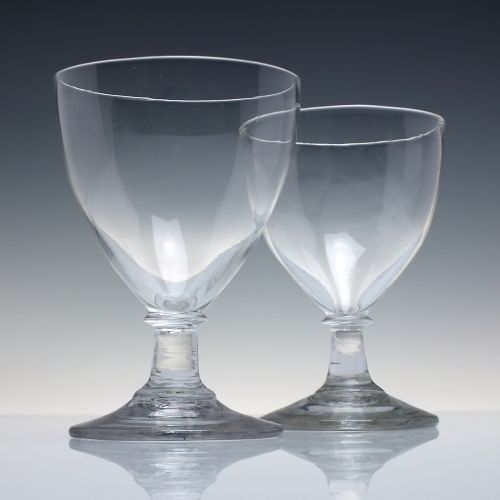


18th Century Rummer
An 18th century rummer is a sturdy vessel for spirits and wine, prized by collectors for its heavy handle and substantial Georgian form.
18th Century Rummer
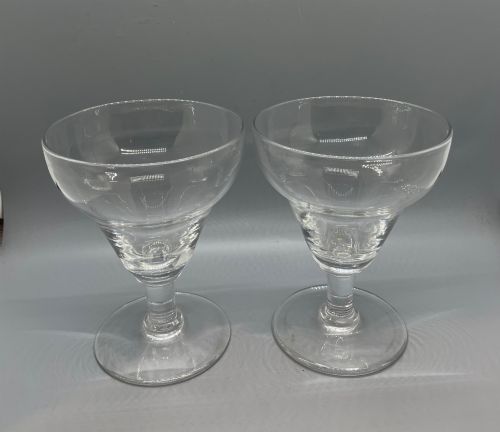
An 18th century rummer is a heavy drinking glass designed for ale, wine, and spirits during the Georgian period. Buyers meeting these pieces will frequently encounter robust forms like ogee bowls, bucket bowls, and pan top designs dating around seventeen-eighty to eighteen-hundred.
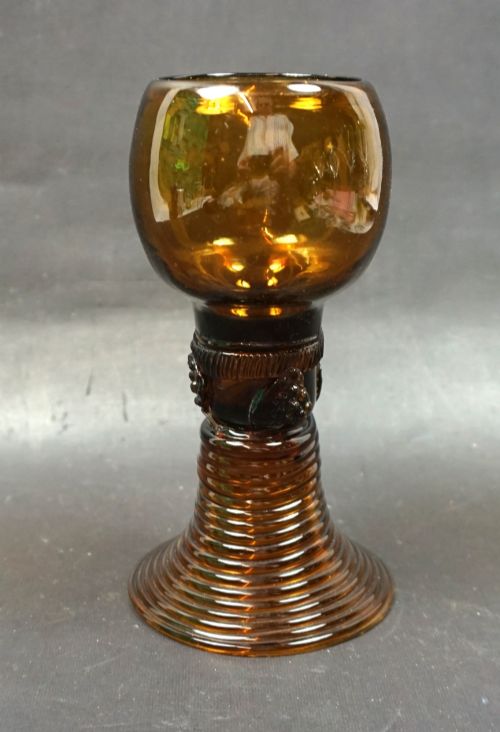
The selection ranges from clear lead glass examples to darker hues, including green export glasses and amber German roemers. Many items show engraved or etched decoration, from hunting scenes and monograms to specific tavern toasts.
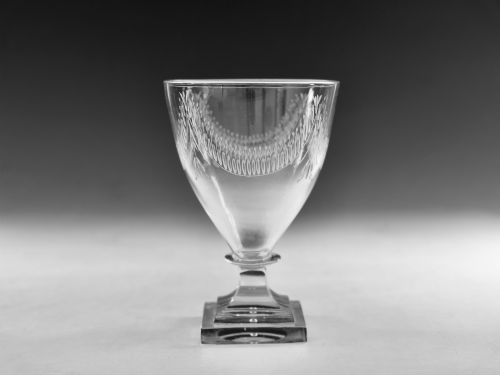
Forms vary from standard plain stems to square lemon squeezer feet and petal moulded bowls. The style reflects the transition towards heavier, more utilitarian drinking vessels at the end of the eighteenth century.
How they were made
These glasses are formed from hand-blown lead glass, flint glass, or clear glass, often shaped using moulds to create distinctive petal or wrythen patterns. The metal contains lead oxide for clarity and weight, allowing craftsmen to blow thicker walls suitable for daily tavern or dining room use.
Decoration is applied by hand, utilising wheel-engraving or etching to produce hunting scenes, monograms, and inscriptions. Feet are shaped with folded rims, hollow stems, or pressed into square lemon squeezer bases using specialised metal blocks.
18th Century Rummer Retail Price Guide 2026
Typical asking prices for 18th century rummer among the pieces listed under this phrase on Sellingantiques today, from the lower quarter to the upper quarter. They describe what is for sale here now, not the wider market.
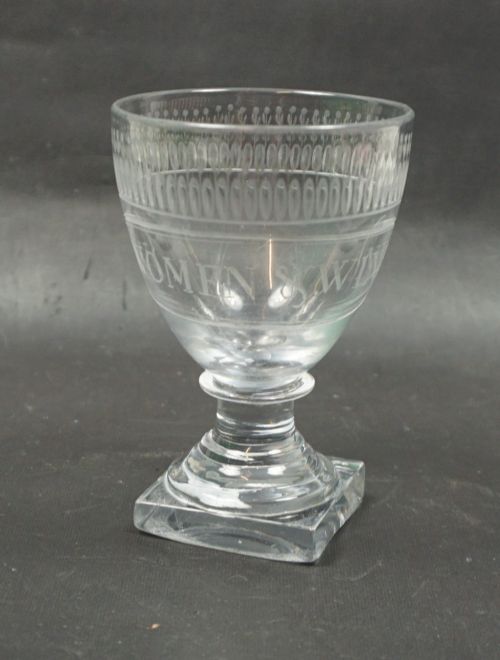
One surviving small rummer bears the specific, spirited tavern engraving reading 'Women & Wine'.
What varies in quality
Quality in an 18th century rummer rests upon the clarity of the metal, the crispness of the mould work, and the skill of the engraving. Superior examples display deep, sharp wheel-cutting and well-balanced proportions without excessive surface distortion.
The presence of a distinct form, such as a square lemon squeezer base or a complex engraved motif like the 'Women & Wine' inscription, elevates the piece. Lesser items show heavier bubble inclusions or asymmetrical bowl formations from hurried production.
The 18th Century Rummer Glossary
- Roemer
- A continental drinking vessel, often in green or amber glass, featuring a rounded bowl and a decorated hollow stem with applied prunts. German examples are frequently found alongside English pieces.
- Lemon squeezer base
- A square, pressed glass foot with indented corners resembling a citrus juicer tool. This style provides stability for large, heavy goblets.
- Petal moulded
- A decorative technique where the lower bowl is blown into a ribbed mould to form overlapping petal shapes. This adds texture and light reflection to the glass.
- Ogee
- An S-shaped profile curving concave above and convex below, forming a graceful bowl shape on many drinking vessels. This silhouette is common in Georgian glassware.
18th Century Rummer: Frequently Asked Questions
What is a rummer used for?
These vessels were originally designed for serving wine, ale, and spirits in taverns and homes. Their generous capacity made them ideal for large toasts and social drinking.
Over time, the thick walls helped maintain the temperature of stronger drinks, distinguishing them from delicate wine glasses of the same era.
How do I date an 18th century rummer?
Dating relies on examining the metal composition, bowl shape, and foot formation characteristic of the Georgian period. Pieces around seventeen-eighty often feature petal moulding or hollow stems.
Later examples approaching eighteen-hundred introduce square lemon squeezer bases and pan top bowls. Pontil marks on the underside also offer clues to the manufacturing date.
Are German roemers different from English rummers?
German roemers typically utilise green or amber glass and feature distinctive hollow stems wrapped with applied glass prunts for grip. They originate from continental traditions dating back to the Baroque era.
English rummers more commonly employ clear lead glass or flint glass with engraved decoration, focusing on heavy ogee or bucket bowl forms.
How should I clean antique glass?
Wash these pieces gently by hand using warm water and a mild detergent. Avoid sudden temperature changes to prevent thermal shock and cracking in the old metal.
Dry them immediately with a soft lint-free cloth to maintain clarity and prevent water spots from forming on the surface.
What does a pontil mark indicate?
A pontil mark is the rough scar left on the bottom of the glass where the punty rod was snapped off after blowing. Its presence confirms that the vessel was hand-blown rather than machine-made.
Collectors look for a smooth or polished pontil as an indicator of finishing quality in Georgian glassware.