


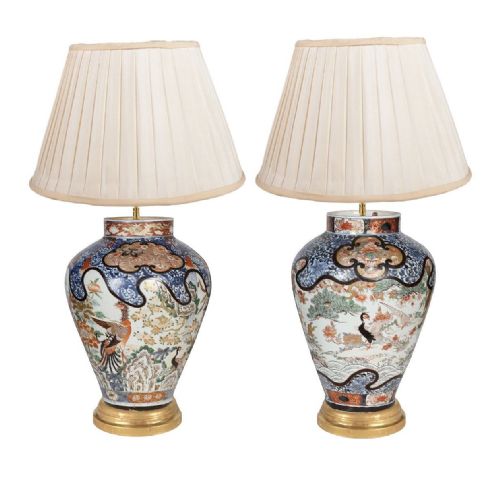


18th Century Imari Vase
An 18th century imari vase brings rich hand-painted palettes and Japanese Arita porcelain into a room with striking presence.
18th Century Imari Vase
An 18th century imari vase typically takes the form of Japanese Arita porcelain shaped as standard vessels, trumpet silhouettes, lidded jars, or bottle vases. The evidence shows pieces spanning the late seventeenth century through the nineteenth century, reflecting enduring production runs.
Many examples arrive with paired configurations or as garnitures, alongside conversions into table lamps incorporating brass, wood, and gold leaf elements. Decoration relies heavily on traditional motifs including birds, chrysanthemums, horses, and hares executed in the characteristic Imari palette.
Materials and Construction
The foundation rests on hard-paste Arita porcelain formed into thrown vessels, lidded containers, and trumpet shapes. Kiln work requires precise firing temperatures to set the body before surface decoration is applied.
Pigments form the classic Imari palette, often accented with gilding or enamel work. Later alterations integrate brass fittings and wooden bases when vessels are adapted into lamps.
Early seventeenth and eighteenth-century decorators frequently populated these export surfaces with energetic depictions of running hares and grazing horses.
Judging Quality and Execution
The strength of the painted brushwork defines the visual impact of the piece, separating briskly detailed birds and flora from more mechanical pattern work. Clarity in the cobalt blue underglaze and rich saturation of the iron red and gold enamel indicate superior workshop output.
Proportion and potting thickness alter the balance of trumpet and bottle forms. Intact lids on jars and minimal intervention from later lamp conversions preserve the integrity of the original porcelain shape.
The 18th Century Imari Vase Glossary
- Imari palette
- A decorative colour scheme utilising underglaze cobalt blue, iron red, and supplementary gold enamel. This distinctive combination originated in Japanese kilns and gained immense popularity across European markets.
- Arita porcelain
- Hard-paste ceramic material produced in the Hizen province around the town of Arita in Japan. It forms the structural base for most export wares of the period.
- Garniture
- A matched set of three or more vases designed for display together on a mantelpiece or cabinet. These sets share uniform decorative schemes and potting styles.
- Trumpet vase
- A vessel featuring an elongated body that flares outward toward the rim in the shape of a musical horn. This specific silhouette showcases expansive surface decoration.
18th Century Imari Vase: Frequently Asked Questions
How do I spot a lamp conversion?
Lamp conversions generally involve drilled bases or fitted metal hardware to secure electrical components.
These alterations reflect how previous owners adapted antique porcelain for domestic lighting.
What motifs appear on these vases?
Decoration commonly incorporates floral arrangements featuring chrysanthemums alongside birds, horses, and hares.
These subjects are painted directly onto the Arita porcelain body using the traditional Imari palette.
Are lids original to the vases?
Lidded jars and garnitures occasionally retain matching covers that complete the vertical silhouette of the piece.
Surviving lids add significant cohesion to multi-part sets from the period.
How do I date an imari vase?
Dating relies on assessing the potting style, the tone of the underglaze blue, and the complexity of the enamel painting.
Evidence points to production spanning the late seventeenth century through the nineteenth century.