
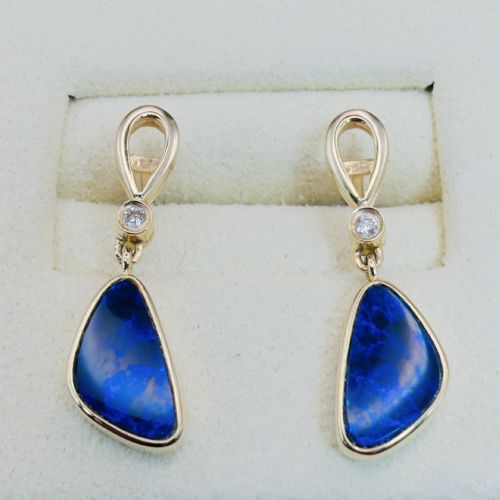
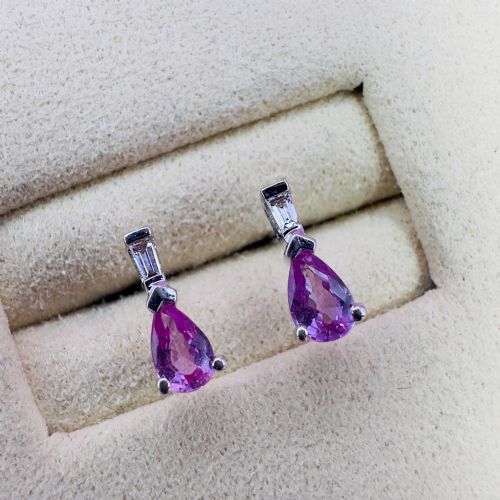


18ct Diamond Drop Earrings
18ct diamond drop earrings combine gold settings with suspended stones spanning the Victorian, Edwardian, and Art Deco periods.
18ct Diamond Drop Earrings
When buyers search for 18ct diamond drop earrings, they encounter swinging pendant designs created from the late nineteenth century through to the mid-twentieth century. The selection spans several distinct stylistic eras, including delicate Edwardian platinum-topped motifs, geometric Art Deco arrangements, and robust Victorian clusters.
Most examples pair a secure upper stud or fitting with a mobile lower section that catches the light with movement. Alongside pure diamond solitaires and clusters, many pieces incorporate coloured gems such as aquamarines, sapphires, rubies, pearls, and opals.
Originating largely from British and French workshops, these jewels demonstrate how goldsmiths adapted wearable proportions across decades. Whether choosing an ornate bow-form Edwardian drop or a streamlined 1930s articulated line, collectors find considerable diversity in surviving antique forms.
How they were made
Goldsmiths utilised 18ct yellow, white, and rose gold alongside platinum, often combining metals in a single mount to contrast warm gold shanks with white platinum claw settings that enhanced diamond brilliance. Silver was also employed in early settings, particularly on face-up surfaces during the Victorian and Edwardian transitions.
Diamonds were predominantly hand-cut with old mine, old European, or rose cuts during the Victorian and Edwardian eras, displaying open culets and softer facet patterns before brilliant cuts became standard in later decades. Master jewellers secured these stones using delicate claw settings, millegrain borders, and precise flush mounting.
What varies in quality
Quality rests upon the structural integrity of the articulating joints and hinges, which must allow smooth movement without looseness or metal thinning. Fine craftsmanship is evident in uniform millegrain work, symmetrical stone layouts, and secure claw placement that protects girdle edges.
The choice and matching of central diamonds alongside secondary gems - such as natural pearls, emeralds, or sapphires - dictates overall refinement. Pieces retaining original French or British hallmarks and intact proprietary closures command greater appreciation among serious collectors.
The 18ct Diamond Drop Earrings Glossary
- Old cut
- A diamond cut characterised by a high crown, small table, and open culet, typical of stones fashioned before modern brilliant cutting standards emerged. These stones exhibit distinctive soft light dispersion under candle or ambient light.
- Millegrain
- A decorative technique featuring a thin raised border of tiny beads along the edges of metal settings. This finish was heavily favored during the Edwardian and Art Deco periods to soften metal outlines.
- Articulated
- Designed with hinged or joined sections that allow the drop portion of the earring to swing freely. This mechanical construction enhances sparkle by shifting angles with the wearer's movement.
- Rose cut
- A vintage diamond cut featuring a flat base and a domed crown faceted with triangular patterns resembling an unopened rosebud. It yields a subtle, translucent glow rather than sharp brilliance.
- Culet
- The small flat facet at the bottom tip of an antique diamond, left intentionally by early cutters to secure the stone's base. Its presence is a key indicator of hand-cut antique stones.
18ct Diamond Drop Earrings: Frequently Asked Questions
How do I care for antique drop earrings?
Store each pair in a soft-lined compartment to prevent the diamonds from scratching softer gems like pearls or opals.
Clean them gently with a soft brush and warm soapy water, avoiding harsh ultrasonic cleaners that can dislodge fragile settings.
Are these earrings suitable for everyday wear?
Most 18ct gold and platinum drops are robust enough for regular use provided the settings and backings are checked periodically by a professional.
Delicate Edwardian filigree or pieces featuring soft stones like opals require greater care and are best reserved for special occasions.
How can I tell an Edwardian pair from Art Deco?
Edwardian designs lean towards lacy platinum-topped motifs, floral garlands, bows, and soft yellow gold backs utilising old cut or rose cut diamonds.
Art Deco examples favour strict geometric symmetry, white gold or platinum construction, and structured pendant lines.
What types of clasps do antique earrings have?
Victorian and Edwardian drops frequently utilise secure wire hooks, hinged omega clips, or threaded posts designed for pierced ears.
Some mid-century variations incorporate versatile fittings that accommodate both pierced and non-pierced lobes.