
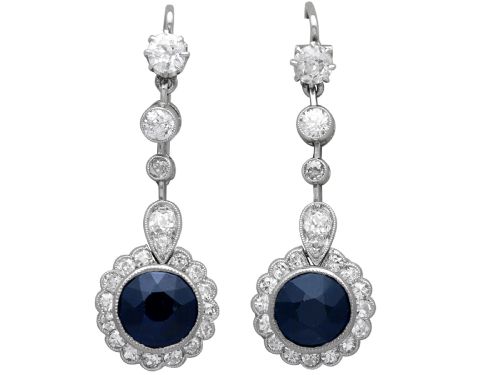
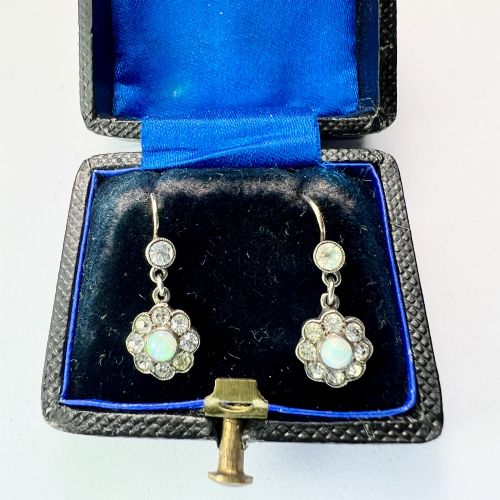


Edwardian Diamond Cluster Earrings
Edwardian diamond cluster earrings combine delicate gold and silver settings with bright old-cut stones.
Edwardian Diamond Cluster Earrings
When you search for edwardian diamond cluster earrings, you find delicate antique jewellery centred on a central stone surrounded by smaller gems. Most examples on this page date from the Edwardian era, alongside pieces from the Victorian and Art Deco periods.
The designs range from simple studs to drop earrings featuring sapphires, rubies, pearls, or paste alongside diamonds. They appear in configurations of yellow gold, white gold, silver, and platinum.
Makers frequently employed old cut, rose cut, and old European cut diamonds to catch the candlelight. These clusters represent a refined aesthetic focused on lightness and intricate metalwork.
How they were made
Goldsmiths constructed these clusters using combinations of 18ct gold, 15ct gold, silver, and platinum. Silver was frequently laid over gold fronts to provide a bright, white surface that enhanced the sparkle of old cut diamonds.
Stone setting relied entirely on hand-working, utilising collets and claw settings to secure diamonds, sapphires, and pearls. Artisans cut stones by hand, producing characteristic facets such as rose cuts and old European cuts.
The inventory spans the Edwardian, Victorian, Art Deco, and 1930s periods.
What varies in quality
Quality in these clusters rests upon the matched proportion of the central stone to its surrounding gems. Finer examples maintain crisp metalwork and secure, original settings without heavy re-tipping.
The choice of materials also dictates the tier of the piece, with platinum and 18ct white gold settings generally housing higher-grade diamonds and matched sapphires or natural pearls.
Knoll And Pregizer
The Edwardian Diamond Cluster Earrings Glossary
- Cluster
- A jewellery design featuring a central gemstone encircled by a ring of smaller stones. This arrangement maximises visual impact and brilliance.
- Old cut
- A generic term for early diamond cutting styles characterised by higher crowns, smaller tables, and large culets. These cuts produce a softer, distinct glow under low light.
- Rose cut
- A diamond cut featuring a flat base and a domed crown faceted with triangular shapes. It resembles an unopened rosebud.
- Platinum
- A dense, durable white metal utilised in fine jewellery to hold stones securely with minimal visible metal. It gained widespread popularity during the Edwardian and Art Deco periods.
- Paste
- Hand-cut lead glass used historically as a gemstone substitute in fine antique jewellery. It offers considerable brilliance and weight.
Edwardian Diamond Cluster Earrings: Frequently Asked Questions
How do I clean antique cluster earrings?
Clean these earrings gently with warm soapy water and a soft brush, avoiding harsh chemical dips that can damage foil-backed stones or pearls.
Dry them thoroughly with a soft cloth before storing them away in a secure box.
Are these earrings suitable for daily wear?
Antique cluster earrings require careful handling due to their delicate silver-on-gold construction and older stone settings.
Removing them before sleeping or physical activity preserves the original claw work and delicate drops.
How can I tell Edwardian from Victorian clusters?
Edwardian pieces tend to feature lighter platinum or white-metal tops with airy, garland-style wirework.
Victorian examples often display heavier yellow gold mountings and warmer, chunkier stone arrangements.
What is the difference between old cut and modern cut diamonds?
Old cut diamonds are shaped by hand with fewer, larger facets designed to catch gaslight and candlelight.
Modern brilliant cuts are engineered with precise mathematical symmetry to maximise return in electric light.