
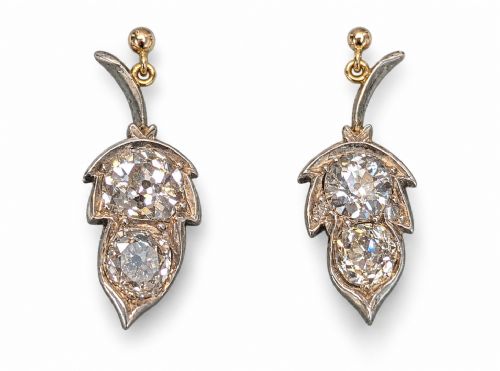
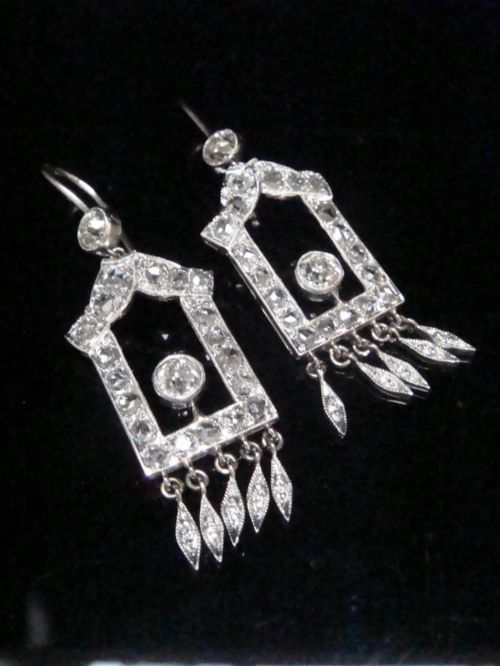


Old European Cut Earrings
Old European cut earrings bring historic sparkle to the ear, featuring hand-faceted diamonds set in gold, silver, and platinum.
Old European Cut Earrings
Old European cut earrings unite historic diamond-cutting traditions with wearable drop, stud, and cluster formats. These pieces appear primarily as drop earrings and cluster designs, though simpler stud configurations also emerge.
The materials span from yellow gold and white gold to silver and platinum, often paired with Edwardian and Art Deco stylistic frameworks. Pieces range across Victorian, Edwardian, 1920s, and mid-century periods, showing varied mount constructions from different European workshops.
Materials and construction
Makers set diamonds by hand into precious metals including platinum, silver, 18ct white gold, and 18ct yellow gold. Metal choice shifts across eras, moving from yellow gold and silver combinations toward platinum and white gold in later decades.
The stones themselves feature hand-cut facets characteristic of historic lapidary work, often arranged in claw settings or integrated into halo and flowerhead formations. Pierced ear mechanisms and lever-backs appear across the various periods of production.
Old European Cut Earrings Retail Price Guide 2026
Typical asking prices for old european cut earrings among the pieces listed under this phrase on Sellingantiques today, from the lower quarter to the upper quarter. They describe what is for sale here now, not the wider market.
Listings feature periods from the Victorian era through the Edwardian period, the 1920s, and into mid-century modern design.
Quality differences
Quality rests in the precision of the stone cutting and the integrity of the original metal setting. Heavier carat weights combined with fine platinum or 18ct gold mountings distinguish more ambitious pieces from lighter, simpler studs.
The harmony between the historic diamond and its metal housing dictates the overall success of the piece. Settings that preserve original claw work without later alteration retain greater architectural coherence.
The Old European Cut Earrings Glossary
- Drop earrings
- An earring style where the main ornament hangs below the earlobe. These pieces move independently as the wearer turns.
- Cluster earrings
- A design grouping multiple smaller stones around a central focal gem. This arrangement often creates a flowerhead appearance.
- Lever-back
- A secure earring closure featuring a hinged lever that snaps shut against a curved wire behind the earlobe. This mechanism protects against loss.
- Platinum
- A dense, durable white metal utilised extensively in Edwardian and Art Deco mountings. Its strength permits delicate claw settings that secure old-cut stones.
Old European Cut Earrings: Frequently Asked Questions
How do I care for antique diamond earrings?
Clean these pieces gently with warm water and a soft brush to remove everyday oils from the historic settings. Avoid harsh ultrasonic cleaners that might stress older claws and settings.
Store each pair separately in a lined box to prevent metal and diamond surfaces from scratching one another during storage.
Can these earrings be worn daily?
Sturdy platinum and gold mountings allow for regular wear if handled with reasonable care. Lever-back and secure stud fastenings provide reliable daily security for the wearer.
Very delicate Edwardian drop designs benefit from slightly more mindful wear during active tasks to protect antique metalwork.
How do I identify an Edwardian pair?
Edwardian examples frequently utilise platinum or 18ct white gold with intricate openwork metal details. The overall aesthetic leans toward light, airy garland styles and graceful drops.
Checking the fastening type and overall craftsmanship helps separate these pieces from later mid-century reinterpretations.
What is a flowerhead earring?
Flowerhead designs arrange smaller diamonds around a central stone to resemble the petals of a flower. This geometric clustering was particularly favoured during the Edwardian and early twentieth-century periods.
The resulting outline provides strong visual presence on the ear while showcasing multiple old-cut facets simultaneously.