
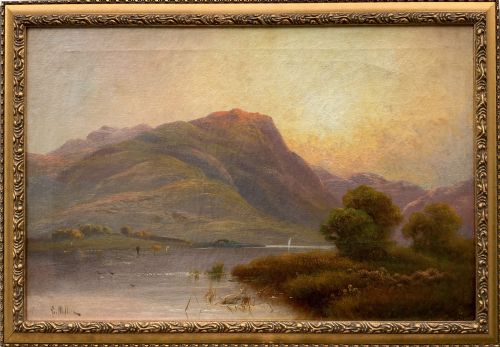


1880s Framed Oil Painting
An 1880s framed oil painting brings Victorian life into a room through rich canvas and gilded wood.
1880s Framed Oil Painting
An 1880s framed oil painting captures the subjects of the late nineteenth century, ranging from maritime scenes and rural Cornish coasts to intimate portraits of children and animals. Buyers seek out these works to anchor a room with period character and genuine canvas texture.
The pieces on this page span French academic and realist works alongside British Victorian scenes, often framed in period wood and gesso. Portraits of greyhounds, equestrian meet scenes, and floral still lifes represent the primary subjects available.
Dated precisely between 1880 and 1890, these works connect directly to artists working across Britain, France, and Belgium during the height of the Victorian era. Each painting serves as a direct window into the aesthetic priorities of the decade.
How they were made
Painters of this decade applied oil paint onto stretched canvas, building up rich impasto and subtle tonal gradations. Pigments were worked with brushes to capture the play of light, particularly visible in luminist and academic works.
The surrounding frames utilise wood carved with gesso ornamentation, frequently finished in gold leaf or gilt. These frames were built to complement the depth of the canvas and protect the edges from environmental wear.
A prizewinning greyhound and a tiny toy share wall space here with serious maritime scenes and quiet garden moments.
What varies in quality
The strength of the composition and the handling of light separate standard academic exercises from masterworks. Works by named artists with documented exhibition histories display superior draughtsmanship and pigment retention.
Frame preservation also dictates overall value, as original gilt wood and gesso mouldings suffer from cracking and loss over time. Intact frames that match the period of the canvas elevate the integrity of the piece.
Charles William Wyllie·Frans Gailliard·Rowland Holyoake·Paul Viry·Albert-Ernest Brockbank·Robert Gemmell Hutchison·William Edward Millner
The 1880s Framed Oil Painting Glossary
- Oil on Canvas
- A painting medium where pigments suspended in drying oils are applied to a woven fabric support. This combination allows for rich blending and textured brushwork.
- Gesso
- A plaster mixture applied to wood frames to provide a smooth surface for gilding. It enables intricate relief moulding around the painting.
- Luminism
- An American and European painting style focusing on effects of light and atmospheric clarity. Artists using this approach emphasise horizontal brushwork and glowing skies.
- Impasto
- Paint applied thickly to a canvas, standing out from the surface. This technique adds tactile dimension to elements like water or foliage.
- Giltwood
- Wood that has been coated with a thin layer of gold leaf or gold paint. It provides a reflective, ornate border for nineteenth century canvases.
1880s Framed Oil Painting: Frequently Asked Questions
How do I hang a heavy framed oil painting?
Heavy nineteenth-century frames require picture hooks secured directly into wall studs or appropriate wall anchors. Steel wire rated well above the weight of the canvas ensures secure suspension.
Position the centre of the canvas at eye level to replicate gallery standards and prevent strain on the hanging hardware.
How do I identify an 1880s frame?
Period frames from this decade often feature composition or gesso ornamentation over a wooden substrate, displaying corner mitres joined by hand. Examining the reverse reveals oxidized fixings and aged pine or hardwood backing.
Original frames frequently show craquelure in the gesso matching the age of the canvas it surrounds.
Where should I place these paintings at home?
Display oil paintings away from direct sunlight and strong heat sources to prevent the canvas from drying and the oil paint from cracking. Stable indoor humidity protects both the wooden stretcher bars and the delicate gilt frame.
Interior walls with indirect ambient light showcase the brushwork without risking UV degradation.