




1830 Mahogany Chest
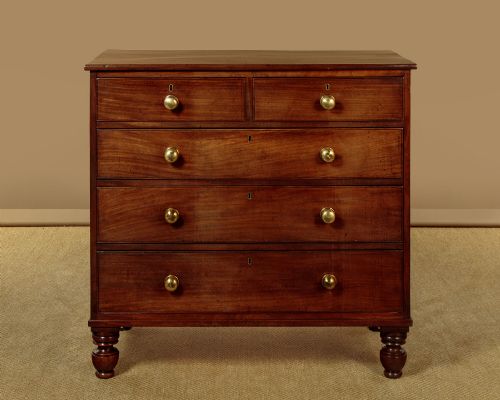
An 1830 mahogany chest delivers the rich grain and solid proportions that collectors prize in early nineteenth-century furniture.
1830 Mahogany Chest
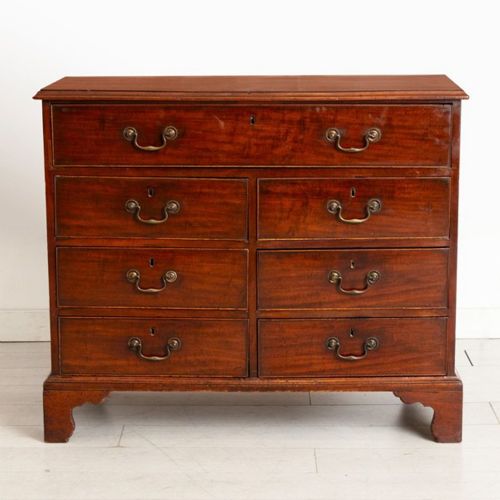
Buyers searching for an 1830 mahogany chest encounter pieces spanning the Georgian, Regency, and William IV periods, alongside nineteenth-century examples. The standard form is a chest of drawers, often appearing in bow front, compact, tallboy, or Wellington configurations.
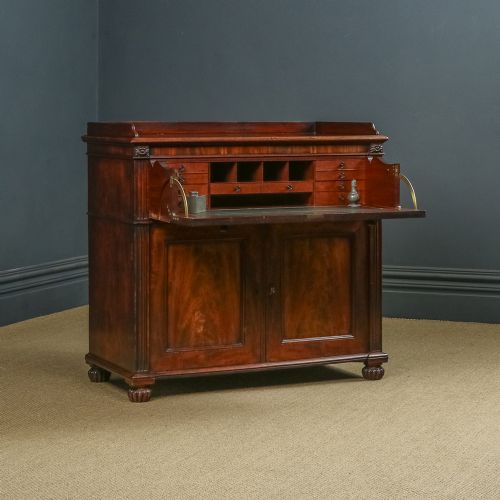
Beyond straightforward drawer units, the category extends to specialised pieces such as secretaire desks, military campaign chests built in two sections, linen presses, and collectors cabinets. These variations reflect the diverse domestic and campaign needs of the era.
Most entries demonstrate a transition between late Georgian severity and the bolder curves of William IV design. Oak commonly lines the internal drawers, while the exterior presents distinct cabinet-making traditions from British and continental workshops.
Materials and Construction
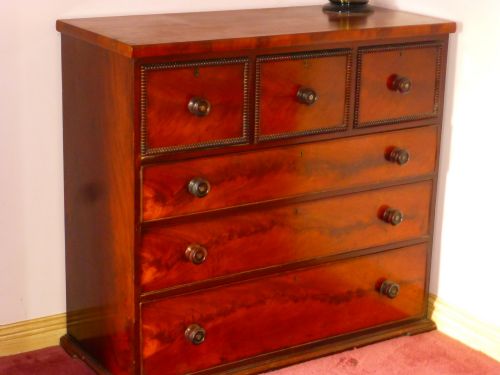
Makers utilised solid mahogany and wood veneer, frequently selecting flame mahogany or fiddle-back variations to create striking grain patterns across drawer fronts. Oak and other secondary woods provided the structural support for drawer linings and internal framing.
Metal hardware played a functional and decorative role, with brass handles, campaign mounts, and glass elements appearing across various pieces. Cross-banding, string inlay, and bracket feet finished the exterior surfaces of finer examples.
Secret drawers hidden within the upper framework gave owners a private place to stash their most valuable keepsakes.
Distinctions in Craftsmanship
Quality rests heavily on the selection of timber veneers and the precision of the cabinet work, where symmetrical flame mahogany patterns distinguish superior examples from plain surfaces. The integration of secondary woods like oak within the drawer construction indicates the standard of the workshop.
Signed pieces or works attributed to established makers carry distinct structural sophistication, such as secret drawers, tightly fitted campaign sections, and finely carved bracket feet. Original brass hardware and well-preserved drawer linings further separate standard utility pieces from collector grade cabinets.
Charles William Schofield·William John Burchall·Gillows of Lancaster
The 1830 Mahogany Chest Glossary
- Flame mahogany
- A veneer cut from the fork of the mahogany tree to produce a rippling, flame-like pattern across drawer fronts. This decorative cut was favoured for high-status furniture of the period.
- Wellington chest
- A tall, slender chest of drawers secured by a locking hinged side pilaster that fastens over the drawer edges. It typically holds a stack of shallow drawers.
- Campaign chest
- A portable chest of drawers built in two separate sections with recessed brass handles and corner brackets designed for easy transport. These pieces were constructed for military officers on active service.
- Secretaire
- A chest of drawers incorporating a fitted writing drawer with a drop-front desk surface and small internal compartments. It combines storage with a dedicated workspace.
- Bow front
- A cabinet front that curves outward in a convex arc, softening the linear geometry of the room. This shape required skilled joinery to bend veneers and match drawer edges.
1830 Mahogany Chest: Frequently Asked Questions
What is a Wellington chest?
A Wellington chest is a tall, narrow stack of drawers secured by a vertical locking flap on one side.
This hinged side bar fastens over the drawer edges, locking the entire column with a single key.
How do campaign chests work?
Campaign chests are built in two separate modular sections designed for transport on military journeys.
Recessed brass handles and corner brackets protect the wood and prevent snagging during travel.
What is flame mahogany?
Flame mahogany is a decorative wood veneer harvested from the fork where branches meet the trunk.
Cabinet makers arranged these symmetrical grain patterns across prominent drawer fronts for visual impact.