
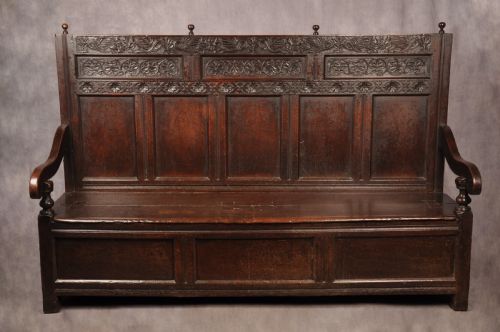


17th Century Carved Settle
These 17th century carved settle examples are substantial historic seats that anchor a room with centuries of timber character.
17th Century Carved Settle
When you search for a 17th century carved settle, you are looking at substantial wooden benches designed to keep draughts at bay in early domestic halls and parlours. The pieces on this page are most commonly encountered in oak, taking the form of high-backed benches, box settles with storage beneath, or enclosed armchairs.
The regional variety is wide, spanning English, British, and North Country workshops alongside examples featuring specific regional descriptors like Westmoreland. Many pieces incorporate high panelled backs and carved top rails, whilst some variants include drawers or marriage box compartments.
Earlier forms demonstrate the heavy structural framing typical of the period, whilst later interpretations sometimes introduce barley spiral twist supports. Across the selection, these benches serve as both seating and architectural room dividers.
Materials and construction
The primary material across the majority of these pieces is solid oak, supplemented occasionally by fruitwood and iron components. Timber was heavily worked using traditional framing methods, relying on pegged joints and panelled construction to build rigid, load-bearing frames.
Carving was executed directly into the dense wood of the top rails, panels, and arm supports, often utilising geometric or floral motifs specific to the Jacobean style. Structural additions such as drawers and enclosed box bases required careful joinery to integrate storage compartments beneath the seat.
The recorded styles include Jacobean and regional British variants, incorporating carved top rails and panelled backs.
Assessing quality in early seating
Quality in a 17th century carved settle rests on the crispness of the timber carving and the integrity of the original framing. Pieces with deeply carved top rails and well-proportioned panelled backs stand apart from simpler domestic variants.
The 17th Century Carved Settle Glossary
- Settle
- A wooden bench with a high back, solid arms, and often a closed base designed to block cold air. They formed central pieces of furniture in early halls.
- Box settle
- A settle featuring a storage compartment or chest built beneath the seat. The solid base provided secure storage for household goods.
- Wainscot
- A term describing wooden panelling, frequently applied to early chairs and settles constructed with panelled backs. It reflects the joinery methods used in wall lining.
- Barley spiral twist
- A decorative turning technique resembling a twisted rope, found on the upright supports of certain pieces. This detail adds sculptural movement to the rectilinear frame.
- Marriage box settle
- A specialised variant often inscribed or carved to commemorate a union. These pieces incorporate enclosed box compartments or specific commemorative carving.
17th Century Carved Settle: Frequently Asked Questions
What is a 17th century carved settle?
A 17th century carved settle is a heavy wooden bench featuring a high back and solid arms, designed to shield occupants from draughts in early homes.
These pieces often include panelled construction and decorative carving along the top rail, serving both as seating and as room dividers.
How were box settles used?
Box settles were utilised both for seating multiple people near the hearth and for storing household goods within the enclosed base beneath the seat.
The solid wooden construction kept stored items protected from dust and damp conditions in the room.
What wood are these settles made from?
The majority of these pieces are constructed from solid oak, which was the primary structural timber available to joiners of the period.
Some examples utilise alternative hardwoods such as fruitwood, occasionally accompanied by iron fixings and panelled fabric elements.
What is a wainscot settle?
A wainscot settle is a bench built using the framed panel construction methods traditionally employed for wood wall panelling.
This technique provided exceptional structural rigidity to the high back and sides of the seat without requiring excessive internal bracing.
How do I identify Jacobean style features?
Jacobean pieces typically display geometric moulding, strapwork, and relief carving directly into the oak panels and top rails.
The overall aesthetic emphasises solid rectilinear framing, sometimes accented with turned supports like barley twists.