
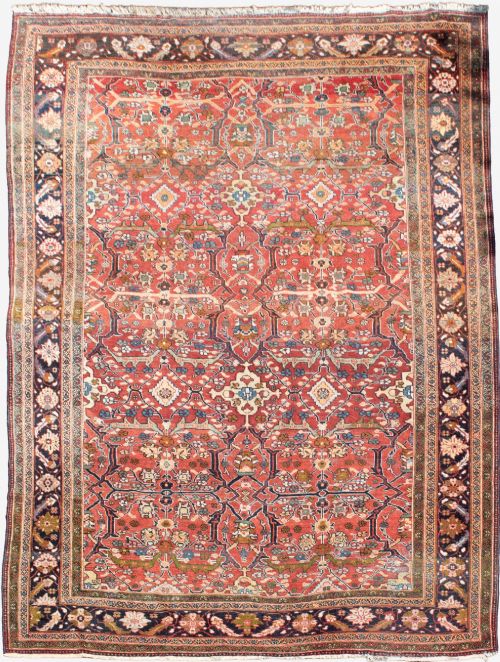


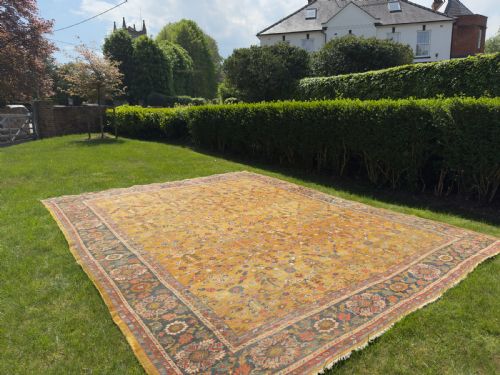


Ziegler Floral Carpet
A ziegler floral carpet brings expansive nineteenth-century Persian design into a room, offering muted palettes and large-scale botanical patterns suited to grand interiors.
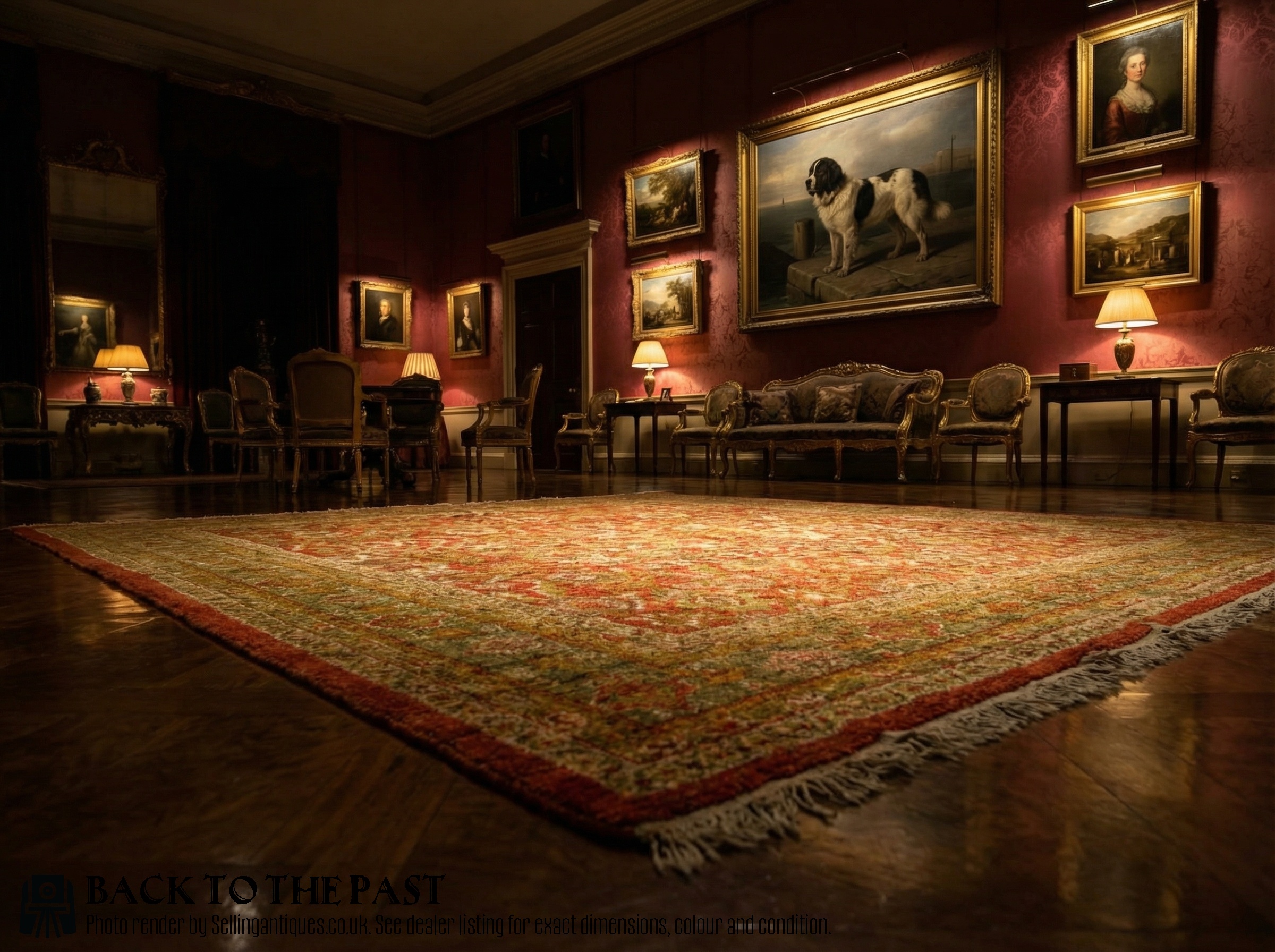
Ziegler Floral Carpet
When you search for a ziegler floral carpet, you encounter large woven floor coverings originating from Persia during the late nineteenth century. These pieces encompass related regional classifications such as Sultanabad and Mahal, often grouped under the broader Ziegler designation due to their commercial history.
The version you are most likely to meet on this page is a room-sized or palace-sized carpet dated between eighteen-eighty and nineteen-hundred. They frequently display expansive floral motifs across softer, room-friendly backgrounds rather than the saturated hues of earlier Persian weaving.
How they were made
These carpets are constructed primarily using wool pile knotted onto sturdy cotton foundations, providing the dense yet pliable structure necessary for daily use. The materials reflect the commercial output directed toward Western decoration during the late nineteenth century.
Weavers in the Sultanabad and Mahal regions utilised traditional hand-knotting techniques while adapting their scale and colour palette to suit European and American tastes of the period.
Many nineteenth-century carpets were woven large enough to anchor an entire Victorian dining set.
What varies in quality
The distinction between average and exceptional pieces rests upon the finesse of the drawing and the subtlety of the botanical composition. Finer examples display balanced proportions and sophisticated handling of the large-scale floral elements across the field.
Colour harmonisation also divides the range, as superior carpets retain gentle, nuanced vegetable dye patination rather than harsh or uneven tones. The overall visual impact depends on how successfully the weavers integrated expansive open space with detailed floral drawing.
Ziegler and Co
The Ziegler Floral Carpet Glossary
- Ziegler
- A nineteenth-century commercial designation for Persian carpets produced or commissioned under European influence, noted for muted palettes and grand floral designs. These pieces were tailored specifically for Western drawing rooms.
- Sultanabad
- A regional carpet-weaving centre in West Persia associated with large-scale botanical patterns and robust construction. Carpets from this origin are frequently linked with nineteenth-century export production.
- Mahal
- A West Persian village and regional designation describing nineteenth-century carpets that share stylistic traits with Sultanabad production. They often feature spacious floral arrangements on relaxed, open grounds.
- Pile
- The upright yarn loops or cut ends that form the usable surface of a carpet. In these pieces, wool pile provides both durability and tactile softness.
Ziegler Floral Carpet: Frequently Asked Questions
What is a ziegler floral carpet?
A ziegler floral carpet is a large nineteenth-century Persian floor covering characterised by expansive botanical motifs and muted colour palettes. These pieces were originally produced for Western export markets by weavers in regions like Sultanabad and Mahal.
They combine traditional Persian knotting techniques with decorative schemes tailored to large European and American interiors of the period.
Where were these carpets made?
These carpets originate from the West Persian districts surrounding Sultanabad and Mahal, which served as major centres for nineteenth-century rug production. The industry was heavily influenced by foreign firms such as Ziegler and Co, who organised manufacturing for Western homes.
Production in these regions focused on adapting traditional designs to suit the scale and decorating preferences of nineteenth-century drawing rooms and halls.
How do I live with a large antique carpet?
Living with a room-sized nineteenth-century carpet involves placing it in a low-traffic area or a principal room where its scale can be appreciated without excessive wear. Using a quality underlay helps protect the cotton foundation and wool pile from friction against hard flooring.
Regular gentle vacuuming without a beater bar keeps the wool pile clean while preserving the structural integrity of the antique foundation.
How can I tell Sultanabad and Mahal carpets apart?
Sultanabad and Mahal carpets share overlapping regional origins in West Persia during the late nineteenth century, making stylistic boundaries fluid. Both types typically feature large-scale floral patterns on room-sized or palace-sized formats.
Distinctions often rely on subtle variations in drawing density and wool quality rather than strict structural differences.