
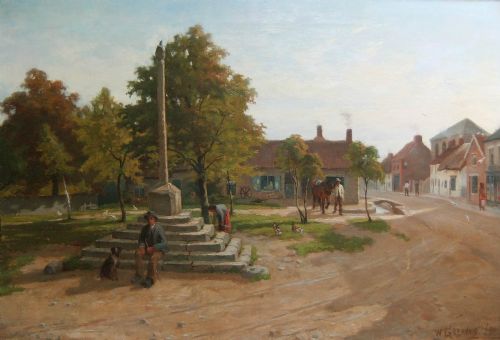


Yorkshire Rural Scene Artwork
Yorkshire rural scene artwork captures the open moors, stone farmsteads and river valleys of the northern county through the direct observation of regional painters.
Yorkshire Rural Scene Artwork
When you search for yorkshire rural scene artwork, you encounter paintings that record the agricultural landscape, moorland pastures and stone farmsteads of the county during the late nineteenth and mid-twentieth centuries. These pieces translate regional topography into visual records, focusing on daily labour, seasonal farm work and familiar local landmarks.
The works on this page lean heavily towards oil paintings and watercolours executed across diverse rural settings including Wharfedale, Swaledale and the outskirts of Leeds. Canvas and paper serve as the primary supports for capturing these specific localities.
You will regularly meet works originating from the Victorian period through to the mid-century modern era, reflecting shifts in regional artistic output. The subjects remain rooted in the immediate surroundings of the painters, showing fields, farmyards and river banks.
Evaluating the Work
Quality rests upon the artist's ability to handle natural light and atmospheric depth within a specific regional setting, distinguishing routine topographical recording from accomplished handling. Stronger examples demonstrate confident brushwork that defines the weight of heavy soils, winter skies and traditional stone architecture.
Compositional balance separates standard regional sketches from fully resolved paintings, where foreground elements like farm animals or labourers anchor the wider valley or moorland view. The handling of the medium, whether oil or watercolour, dictates the lasting visual presence of the landscape.
The listings on this page span several decades, stretching from the late nineteenth century into the nineteen fifties.
William Greaves·Herbert Royle·Ernest Higgins Rigg·Owen Bowen·Florence Hess·William Joseph Boyes·William Manners·John Frederic Greenwood·Rowland Henry Hill·Lester Sutcliffe·Fred Lawson·James William Booth·Arthur Bateman·George Jackson·Fred Cecil Jones
The Yorkshire Rural Scene Artwork Glossary
- Canvas
- A heavy woven fabric stretched across a wooden frame to serve as a support for oil painting. It provides a textured surface that holds thick applications of pigment.
- Watercolour
- A painting method in which the paints are made of pigments suspended in a water-based solution. Applied to paper, it creates translucent washes of colour.
- Impressionism
- An artistic approach focusing on the visual impression of the moment, particularly regarding shifting light and colour. In regional art, it translates to looser brushstrokes and outdoor observation.
- Realism
- The precise and unidealised representation of subject matter as it appears in everyday life. Victorian examples focus heavily on accurate depictions of rural labour and local topography.
- Pastoral
- Pertaining to rural life, particularly the tending of livestock and farming. These scenes idealise the quiet rhythm of the countryside.
Yorkshire Rural Scene Artwork: Frequently Asked Questions
What periods do these paintings cover?
The works span from the late nineteenth century through to the middle of the twentieth century, capturing regional views across several decades of artistic change.
You will find pieces created during the Victorian and Edwardian eras, alongside later mid-century examples that continue the tradition of northern landscape painting.
Where are the depicted locations?
The scenes focus firmly on Yorkshire settings, including Wharfedale, Swaledale, Wensleydale and the rural edges of Leeds and surrounding villages.
Artists frequently painted specific farms, rivers and moorland paths that they encountered during their travels across the county.
Are these works original paintings?
The selection consists entirely of original hand-painted works rather than mass-produced prints or mechanical reproductions.
Artists applied oil paint or watercolour directly to canvas, board, panel or paper to create each unique landscape.
How should I frame an older watercolour?
Older watercolours on paper require acid-free mounts and framing materials to protect the delicate pigments from degradation over time.
Keeping the paper away from direct sunlight preserves the subtle washes of colour characteristic of these regional landscapes.