


Late Victorian Pastoral Painting
Late victorian pastoral painting brings the quiet charm of the English countryside and traditional rural life straight onto your walls.
Late Victorian Pastoral Painting
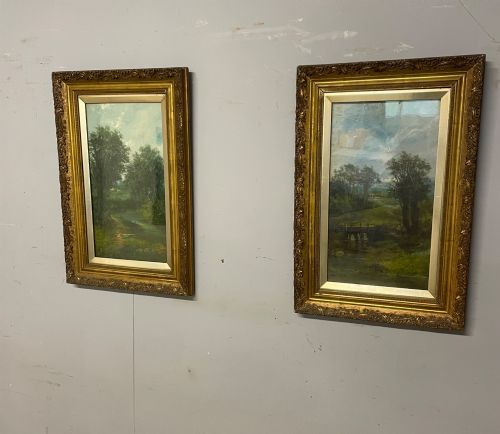
A late victorian pastoral painting captures the traditional countryside, depicting shepherds, farmland, rivers, and cattle across rural Britain and Ireland. These works record a romanticised view of agricultural life during the late nineteenth and early twentieth centuries.
You are most likely to encounter framed watercolours and oil paintings on canvas depicting peaceful landscapes and rural workers. The selection includes works created in Victorian, Pre-Raphaelite, and British Impressionism styles.
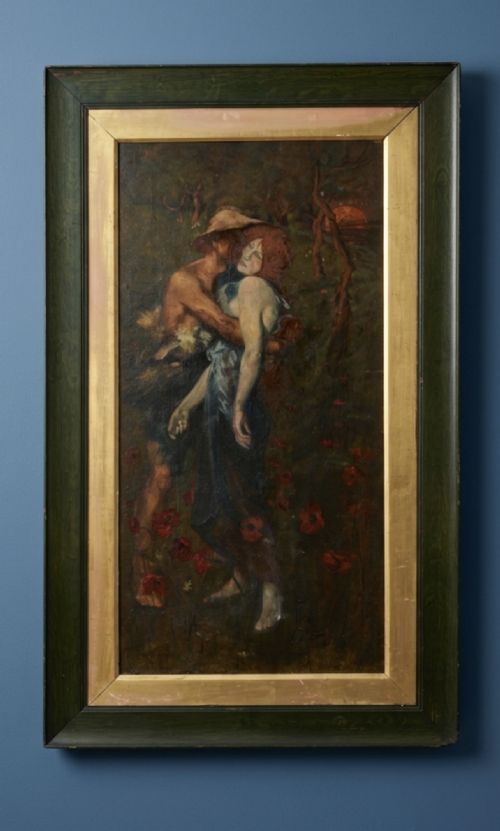
The subjects range from solitary figures gathering sticks by the water to cattle drinking from rivers and couples in intimate countryside poses. Each piece reflects the artistic preoccupation with nature and vanishing rural traditions during the period.
Materials and methods
Artists painted primarily using oil paint on canvas or watercolour pigment on paper, capturing light and atmosphere across rural scenes. Canvases were stretched over wooden supports and finished within decorative gilt wood frames.
The technical approach combines detailed realism with softer impressionistic touches, particularly in works influenced by the Pre-Raphaelite movement. Skilled handling of pigment creates depth in skies, water, and foliage.
Listings span the nineteenth and early twentieth centuries, featuring oil on canvas, watercolour pigment, and bisque porcelain.
Judging the work
Quality rests upon the artist's ability to render natural light and atmospheric depth convincingly within the landscape. Works by named painters with documented exhibition histories display superior draughtsmanship and composition compared to anonymous studio copies.
The preservation of the original paint surface and the condition of the accompanying gilt wood frame influence the overall visual impact. Fading in watercolours or craquelure in heavy oils distinguishes the relative preservation of individual examples.
Philip Richard Morris·Robert John Hammond·Alfred Grey RHA·William Manners·Frederick William Jackson·Frederick J Knowles·William Greaves
The Late Victorian Pastoral Painting Glossary
- Pastoral painting
- A genre of artwork depicting the rural life of shepherds, farmers, and country landscapes in an idealized manner. These scenes emphasise harmony between humans and nature.
- Pre-Raphaelite
- An artistic movement focusing on detailed observation, bright colours, and complex composition inspired by Italian art before Raphael. Works in this style often feature intense botanical accuracy and narrative depth.
- Bisque porcelain
- Unglazed ceramic material resulting from a single firing, valued for its matte, marble-like texture. It was frequently utilised for Victorian decorative figures.
- Watercolour pigment
- Finely ground colour suspended in a water-soluble binder, applied to paper to achieve translucent washes of colour. It requires swift, precise brushwork to capture light effectively.
Late Victorian Pastoral Painting: Frequently Asked Questions
What is a pastoral painting?
A pastoral painting is an artwork depicting rural scenes, farmland, shepherds, and agricultural life. These pieces celebrate the simplicity and beauty of the countryside.
Artists during the late nineteenth century turned to these idyllic subjects as a contrast to rapid industrialisation in growing cities.
How do I date a Victorian painting?
Dating relies on stylistic clues, framing techniques, signatures, and sometimes inscriptions left on the reverse of the canvas. Costume details and architectural elements within the scene also provide chronological markers.
Many works include artist signatures or exhibition labels that help pinpoint their creation within the nineteenth or early twentieth century.
Where should I hang these paintings?
These artworks suit traditional living rooms, studies, or hallways where their warm gilt frames and calming rural subjects complement classic interior decor. Keep them away from direct sunlight to protect watercolours and oil pigments from fading.
Pairing them with period furniture enhances the historical atmosphere of the room.
What is the difference between oil and watercolour?
Oil paintings utilise thick pigments suspended in drying oils applied to canvas or wood panels, allowing for rich textures and deep colours. Watercolours use water-soluble pigments on paper, producing lighter, translucent effects.
Oils are typically heavier and framed behind glass only when delicate, whereas watercolours require framing under glass for protection.