
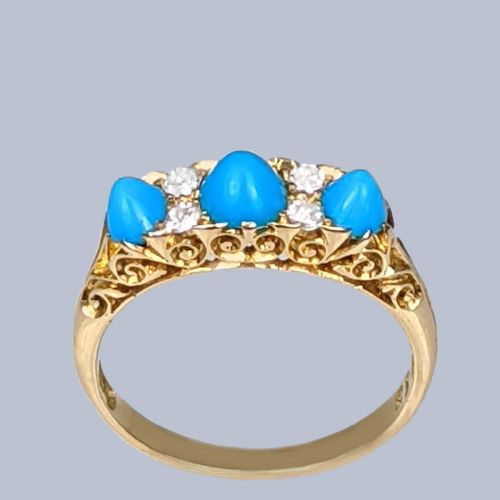
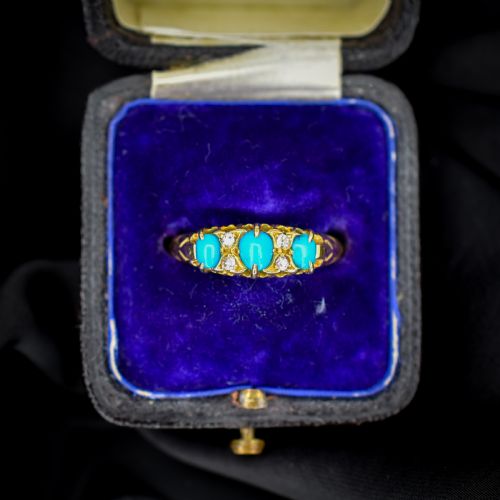


Yellow Gold Turquoise Ring
A yellow gold turquoise ring brings together vibrant robin-egg blue stones and warm precious metal, prized for both striking colour and enduring charm.
Yellow Gold Turquoise Ring
A yellow gold turquoise ring unites vibrant blue or greenish-blue turquoise stones with warm gold settings, capturing a distinct look spanning Victorian and mid-century periods. The examples found here range from cluster designs to buckle bands and gypsy settings.
Victorian pieces dominate the available selection, often pairing the bright stones with rose-cut diamonds or seed pearls in high-carat gold bands. Mid-century modernist iterations also appear, showing how the combination endured long after the nineteenth century.
Most pieces centre on yellow gold, specifically in 15ct and 18ct purities, giving each ring a rich, buttery tone that complements the vivid hue of the turquoise.
Materials and construction
Goldsmiths utilised 15ct and 18ct yellow gold to form sturdy bands and detailed settings, securing the softer turquoise stones alongside diamonds and pearls.
Stones are typically set by hand, whether clustered tightly together in floral or geometric arrangements or flush-mounted into thicker gypsy bands.
Yellow Gold Turquoise Ring Retail Price Guide 2026
Typical asking prices for yellow gold turquoise ring among the pieces listed under this phrase on Sellingantiques today, from the lower quarter to the upper quarter. They describe what is for sale here now, not the wider market.
Listings feature 15ct and 18ct yellow gold settings, pairing turquoise with rose-cut diamonds, seed pearls, and traditional cluster formations.
Distinguishing quality across pieces
Quality rests in the uniform colour and stability of the turquoise stones, alongside the complexity of the surrounding goldwork. Fine pieces feature stones with minimal matrix discolouration paired with meticulous diamond or pearl accents.
Substantial gold weight and crisp detailing in specialist motifs, such as buckle bands or cluster arrangements, elevate the character and presence of the ring on the hand.
The Yellow Gold Turquoise Ring Glossary
- Cluster ring
- A ring featuring a central stone surrounded by a border of smaller gems. In these pieces, turquoise often forms the centrepiece or the surrounding border alongside diamonds.
- Gypsy ring
- A style where stones are flush-set directly into a heavy, tapering band of gold. This technique protects the gems and creates a smooth, continuous profile.
- Seed pearl
- A very small, naturally formed pearl often used as an accent. Victorian jewellers frequently paired them with turquoise for delicate contrast.
- Rose-cut diamond
- An antique diamond cut featuring a domed top with triangular facets and a flat base. These stones offer a soft, subtle shimmer rather than modern brilliance.
Yellow Gold Turquoise Ring: Frequently Asked Questions
How do I care for a turquoise ring?
Turquoise is a softer stone that absorbs oils, moisture, and chemicals easily. Remove your ring before washing hands, applying lotions, or swimming.
Clean the metal gently with a soft cloth and avoid ultrasonic cleaners or harsh chemical dips entirely.
Can I wear my turquoise ring daily?
These antique rings require mindful wear due to the delicate nature of the turquoise and seed pearls. Occasional daily wear is fine if you take care during physical tasks.
Storing the ring in a dedicated box prevents scratching from harder gemstones.
How do I date a Victorian turquoise ring?
Dating relies on stylistic clues like cluster arrangements, buckle motifs, and the specific gold purity marks used in the nineteenth century. Hallmarks and maker stamps inside the band provide further chronological clues.
Victorian makers often combined turquoise with rose-cut diamonds in 15ct or 18ct yellow gold.
Why does turquoise change colour over time?
Turquoise is porous and can react to skin acidity, cosmetics, and sunlight, sometimes shifting from bright blue to a greener shade. This natural patina is characteristic of older stones.
Keeping the ring away from direct heat and chemicals helps preserve the original colour.