
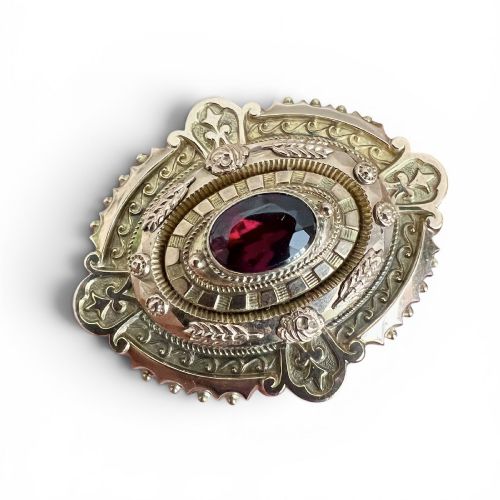


Yellow Gold Garnet Pendant
These yellow gold garnet pendant pieces span Victorian, Edwardian and mid-century designs, offering deep red stones set in warm gold for everyday wear.
Yellow Gold Garnet Pendant
A yellow gold garnet pendant combines rich red garnets with gold settings, appearing as drop designs, cluster necklaces or convertible brooch pendants. These items span Victorian, Edwardian, Art Nouveau, Art Deco and mid-century periods, reflecting shifting tastes in jewellery design over the decades.
The version most commonly met on this page is the 9ct gold mid-century pendant or the Victorian locket brooch, often enhanced with pearls or seed pearls. Such pieces range from simple oval cut stones to elaborate Etruscan Revival creations containing multiple gems.
How they were made
Goldsmiths utilised varying purities of gold, predominantly 9ct, 14ct and 18ct yellow gold, to form the mountings, chains and settings for these gems. Stones were secured using traditional claw settings, bezel mounts or collaborative cluster arrangements alongside pearls and diamonds.
Techniques evolved from the detailed wirework of Victorian Etruscan Revival pieces to the flowing organic lines of Art Nouveau designs and the cleaner geometric structures of the 1930s and 1950s.
Several pieces double as secret lockets, offering a tiny hidden space once used to store a curl of hair.
What varies in quality
The distinction between tiers rests upon the depth of the gold work and the selection of the stones, such as demantoid, mandarin or imperial garnet varieties. Heavier gauge 18ct gold settings and intricate secondary embellishments like natural pearls elevate certain items above standard production.
Artisanal execution in period pieces, particularly the precision of granulation or bezel setting, dictates the overall character and durability of the finished item.
The Yellow Gold Garnet Pendant Glossary
- Etruscan Revival
- A nineteenth-century design movement inspired by ancient archaeological discoveries, characterised by applied wirework and tiny gold granules. This style frequently appeared on Victorian brooches and pendants.
- Seed pearl
- A very small natural or cultured pearl, often utilised in Victorian and Edwardian clusters to frame central garnets. These tiny pearls require delicate setting techniques.
- Slide chain
- A necklace mechanism featuring a movable slide that adjusts the length or position of the pendant. This form occurs in twentieth-century items.
Yellow Gold Garnet Pendant: Frequently Asked Questions
How do I date a garnet pendant?
Dating relies on the stylistic markers of the setting, such as Victorian Etruscan granulation or mid-century minimal claw mounts. Hallmarks stamped into the gold provide further chronological evidence.
Examining the type of gold purity used and the cut of the garnet also helps assign pieces to specific decades like the 1900s or 1960s.
Are these pendants suitable for daily wear?
Most yellow gold garnet pendant items withstand regular wear if handled with reasonable care. Garnet possesses a moderate hardness suited to necklaces and earrings.
Pieces incorporating fragile elements like seed pearls benefit from more careful storage and occasional checks on the setting claws.
What is imperial garnet?
Imperial garnet denotes a specific colour variation of the gemstone prized for its particular warmth and saturation. It appears in mid-century selections alongside standard red stones.
Such stones enhance the visual depth of cluster necklaces and pendant designs.
Can these pendants be worn as brooches?
Certain Victorian items function as dual-purpose locket brooches featuring both a pin mechanism and a suspension loop. This versatility allowed wearers to pin the piece to clothing or suspend it from a chain.
Examining the reverse side reveals the hinged pin and safety catch alongside the pendant bail.