

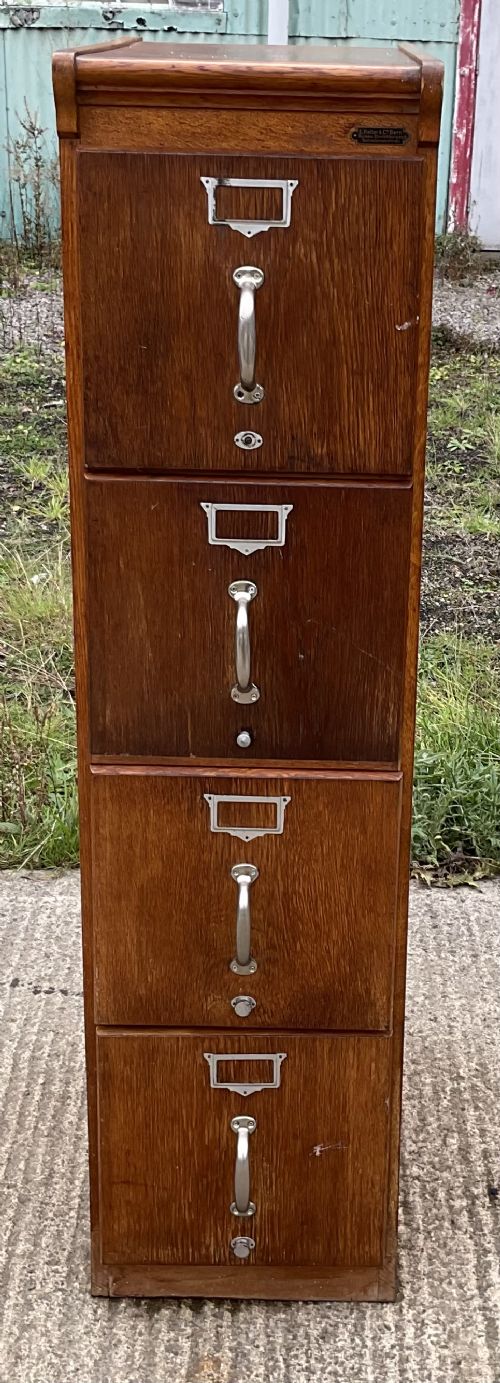
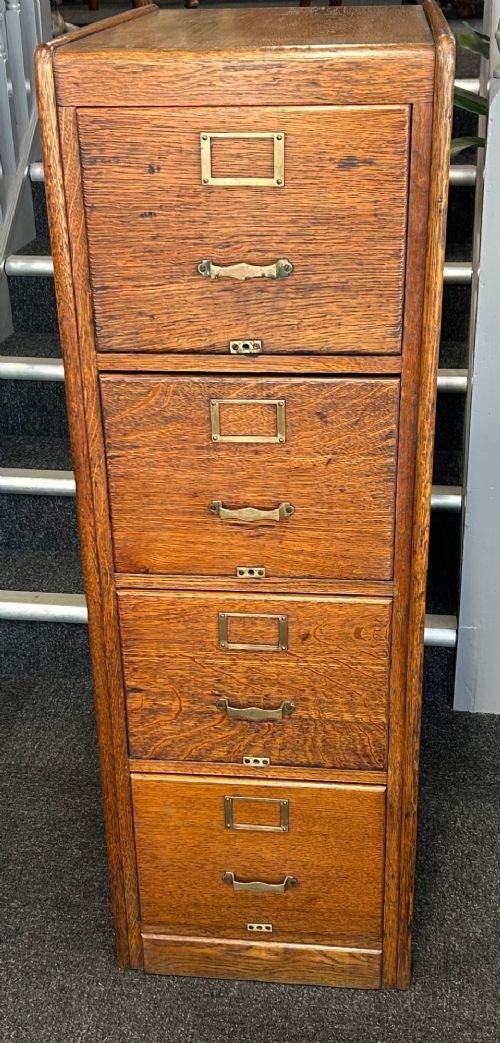
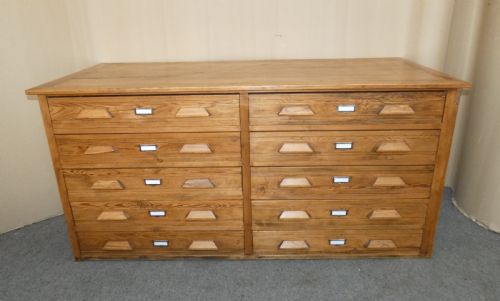

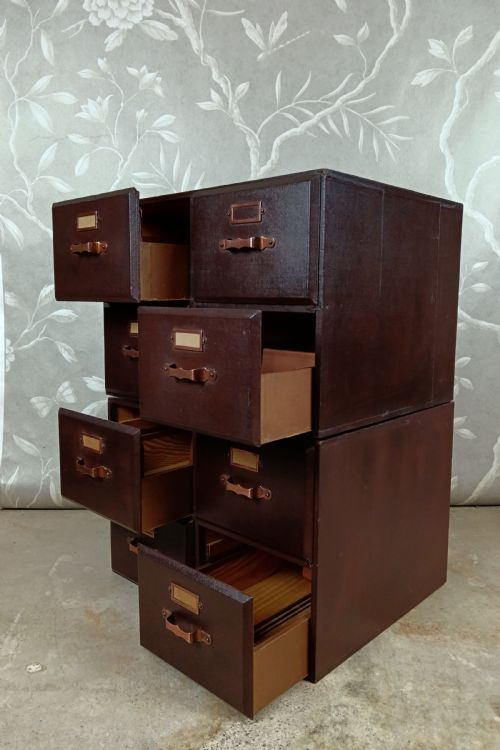


Wooden Index Card Drawers
Wooden index card drawers organise desk life with deep banks of small compartments, built to last through decades of office work.
Wooden Index Card Drawers
When you search for wooden index card drawers, you are looking at utilitarian office furniture built to sort small documents, reference slips, and correspondence. The examples here span the nineteenth century, Edwardian era, and mid-twentieth century, showing how workplaces stored paper before digital sorting took over. Most items on this page take the form of desktop filing drawers, banks of drawers, and filing cabinets made for commercial or institutional use.
The dominant forms you will meet combine narrow timber carcasses with numerous small compartments designed to hold specific card sizes. These range from single desktop blocks to towering multi-drawer banks that once lined factory offices, libraries, and legal practices. Oak and mahogany appear frequently among the listings, alongside pine and walnut, reflecting the standard timbers chosen by period cabinet makers for heavy daily use.
How they were made
Workshops constructed these cabinets using durable hardwoods like oak and mahogany, often pairing them with pine carcases and interior partitions. Dovetail joints secured the drawer corners to withstand the constant pull of heavy card files, while panelled backs added rigidity to tall banks of drawers.
Hardware played a functional role, utilising cast brass or iron pull handles that doubled as label holders. These card frames allowed clerks to slide in paper labels to identify contents at a glance, fastened securely with small screws to the drawer fronts.
Wooden Index Card Drawers Retail Price Guide 2026
Typical asking prices for wooden index card drawers among the pieces listed under this phrase on Sellingantiques today, from the lower quarter to the upper quarter. They describe what is for sale here now, not the wider market.
A sixty-six drawer office cabinet offers enough tiny compartments to lose your paperclips for the rest of the century.
What varies in quality
Quality rests upon the density of the timber and the precision of the joinery within the drawer runners. Superior pieces employ tight dovetailing and solid oak or mahogany throughout, ensuring each drawer glides smoothly without binding in its slot.
The sophistication of the internal mechanism also distinguishes standard commercial boxes from patented filing systems. Cabinets featuring specialised spring-loaded followers or branded ironmongery demonstrate a higher tier of period office design.
Shannon·Amberg
The Wooden Index Card Drawers Glossary
- Dovetail joint
- A method of joining two pieces of wood by interlocking wedge-shaped fingers. This construction provides high tensile strength, preventing the drawer corners from pulling apart under heavy loads.
- Brass pull
- A handle made from copper and zinc alloy attached to the front of a drawer. Many period examples incorporate a window for paper labels.
- Carcase
- The main structural body or shell of a cabinet without the drawers inserted. It provides the rigid frame necessary to support multiple loaded tiers.
- Patent file
- A proprietary storage system designed to hold documents or cards upright using mechanical compression plates. These mechanisms kept papers flat and sorted alphabetically.
Wooden Index Card Drawers: Frequently Asked Questions
What were wooden index card drawers used for?
These cabinets served as the primary database for businesses, libraries, and institutions before computers existed. Clerks kept customer records, inventory tallies, and reference notes sorted by name or subject within the shallow compartments.
The small format of the drawers forced a standardised system of paper slips. Offices relied on them to maintain fast access to active accounts and library catalogues.
How do I date an oak filing cabinet?
Dating relies on observing construction methods, timber choices, and ironmongery details. Edwardian pieces often feature richer mahogany grains and refined brass label pulls, whereas later twentieth-century examples lean towards simpler pine or utilitarian oak.
Patents stamped into the hardware or timber frame provide a precise point of origin. Makers registered specific locking mechanisms and compression followers, which help narrow down the decade of production.
How do I clean a vintage desktop filing cabinet?
Maintenance requires gentle cleaning to preserve the original patina built up over decades of office use. A soft cloth dampened with mild soap removes surface dust without stripping the aged polish from the wood.
Avoid harsh chemical solvents that can damage the wax finish on oak or mahogany surfaces. Applying a quality beeswax afterwards helps nourish the dry timber and protects the grain.
Are these cabinets suitable for modern home offices?
The compact dimensions and numerous small compartments make them exceptionally practical for modern desktop organisation. They fit standard stationery items, craft supplies, and contemporary note cards while adding period character to a workspace.
Placing a heavy multi-drawer unit requires a sturdy surface due to the combined weight of solid timber and dense contents. Ensure the furniture sits level so the numerous small drawers open and close without resistance.