

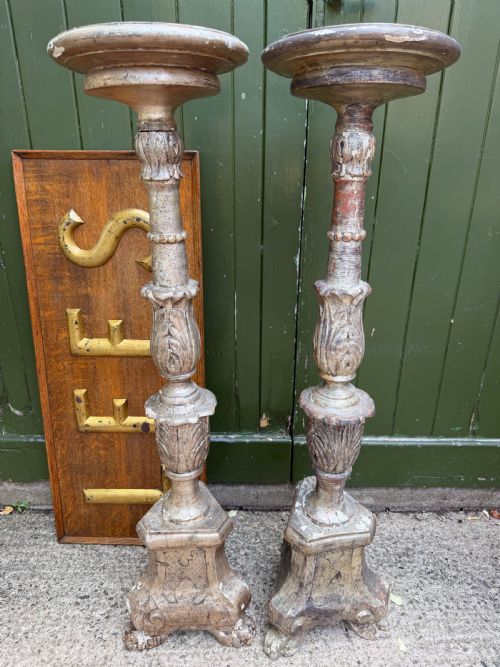


Wooden Floor Candlestick
These wooden floor candlestick pieces bring architectural height and warm illumination to a room, offering the sculptural presence collectors seek for period interiors.
Wooden Floor Candlestick
The wooden floor candlestick category encompasses tall altar-type candle-holders, torcheres, standard lamps, and candle stands designed to raise light well above table level. Pieces span the eighteenth and nineteenth centuries, originating predominantly from Italian and French workshops.
Buyers encounter substantial carved timber structures, often rendered as pairs, standing with the presence of small architectural columns. Forms draw heavily on baroque and provincial styles, utilising height to command a corner or flank a piece of furniture.
Surviving examples reflect ecclesiastical and domestic lighting needs of the past, executed in formats ranging from slender torchere shafts to heavy block-based candle-holders. The selection leans heavily towards Italian craftsmanship, particularly Florentine and Venetian designs.
Construction and materials
Carved pinewood and hardwood form the structural core of these objects, shaped by hand using traditional gouging and chisel techniques. Craftsmen applied gesso over the timber base to create a smooth, receptive surface for subsequent surface decoration.
Finishes rely on giltwood, silver leaf, and mecca - a warm translucent golden varnish applied over silver leaf to imitate gold leaf economically. Polychrome paint and marbleized effects appear across surfaces, adding depth and colour to the carved details.
Wooden Floor Candlestick Retail Price Guide 2026
Typical asking prices for wooden floor candlestick among the pieces listed under this phrase on Sellingantiques today, from the lower quarter to the upper quarter. They describe what is for sale here now, not the wider market.
Listings feature items spanning the eighteenth and nineteenth centuries, dominated by Italian baroque and revival styles.
Assessing quality and execution
Quality rests in the depth and crispness of the hand-carving, where deeply undercut acanthus leaves and fluid scrollwork distinguish superior work from softer, mechanical production. The proportion between the slender stem and the weighted base dictates the visual balance of the piece.
The integrity of the original gesso and surface gilding determines historical value, as secondary repainting alters the character of the piece. Surviving pairs matched in height and decoration hold greater weight than single standards found in isolation.
The Wooden Floor Candlestick Glossary
- Torchere
- A tall ornamental stand for a candle or lamp, originating in the seventeenth century and designed to illuminate a specific area of a room. These pieces often feature slender turned or carved wooden shafts.
- Giltwood
- Timber coated with fine gold leaf or gold powder over a prepared gesso ground. This technique provides the rich metallic sheen seen on many baroque stands.
- Mecca
- A transparent yellow or golden lacquer applied over silver leaf to simulate genuine gold at a lower cost. It creates a warm, slightly aged metallic tone.
- Gesso
- A plaster mixture applied to wood to create a smooth surface for gilding or painting. It allows intricate relief ornamentation to be modelled before finishing.
- Altar-type
- Design characteristics derived from large candlesticks used on church altars, typically featuring substantial weighted bases and prominent proportions.
Wooden Floor Candlestick: Frequently Asked Questions
Where should I place a wooden floor candlestick?
These tall stands suit corners, empty wall spaces, or flanking large pieces of furniture where their height can fill vertical voids. They work well in living rooms and hallways to introduce ambient illumination.
Keep them away from heavy foot traffic or doors where accidental knocks might destabilise their tall frames. Pairing them with unlit candles preserves their sculptural integrity without risking wax drips on the floor.
How do I distinguish eighteenth-century pieces from nineteenth-century revivals?
Eighteenth-century examples often display deeper, more fluid hand-carving and authentic wear patterns in the gesso and gilding layers. Revival pieces made in the nineteenth century tend to show heavier construction methods and cleaner tool marks.
Examining the underside of the base reveals the joinery methods and the type of timber used, which helps anchor the piece to a specific period. Italian workshops produced both eras using similar regional styles, making surface analysis essential.
Can these stands be converted for modern electricity?
Many tall stands function as standard lamps, while others remain configured strictly for candles as originally intended. Conversion depends on whether the central shaft is hollow to accommodate electrical wiring safely.
Purists prefer maintaining the original socket or candle pricket, but non-invasive wiring allows modern lighting without altering the historic wood. Consulting a professional restorer ensures the structural integrity of the timber remains protected.
Why are many of these pieces Italian?
Italian workshops excelled in the production of decorative wooden furnishings for both grand domestic interiors and ecclesiastical settings. The baroque and revival styles favoured elaborate carving and surface gilding, which Italian artisans executed in volume.
Regional hubs like Florence and Venice developed distinct aesthetic signatures that survived through the centuries and reached collectors today. The abundance of pinewood and local carving traditions sustained this output over generations.