

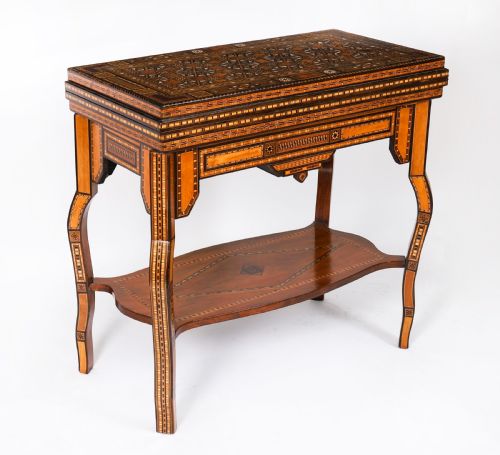
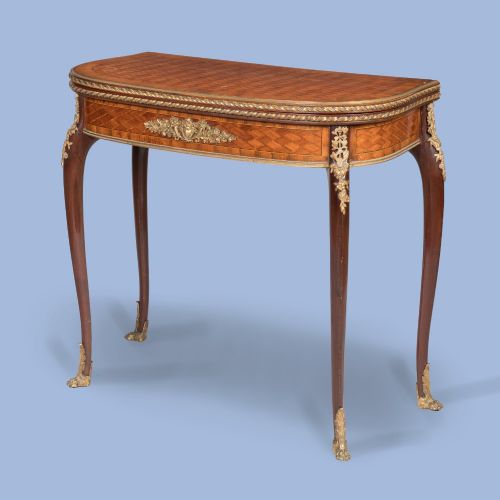


Wood Parquetry Games Table
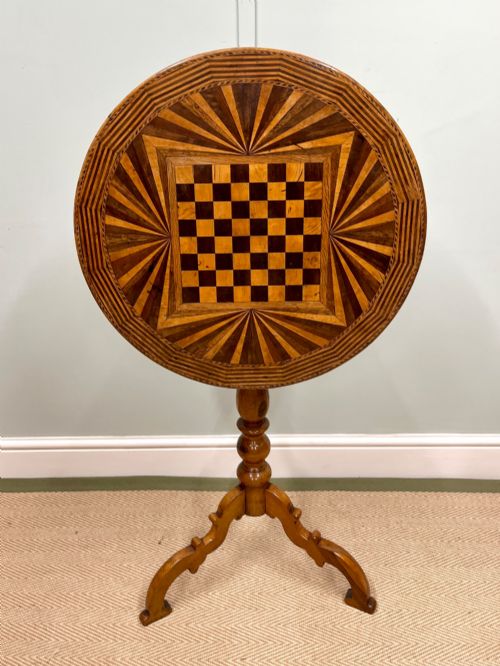
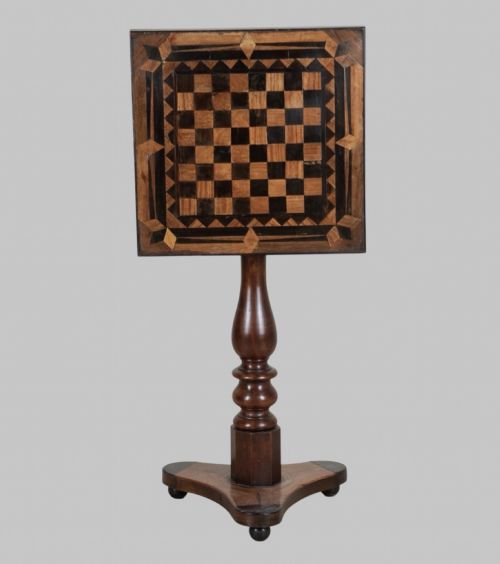
These wood parquetry games tables combine intricate geometric wood surfaces with ingenious folding or pivoting tops designed for card play and board games.
Wood Parquetry Games Table
A wood parquetry games table is a multifunctional piece designed for entertainment, featuring specialist surfaces arranged in geometric patterns. When exploring the selection, buyers encounter formats spanning the Georgian era through to the twentieth century.
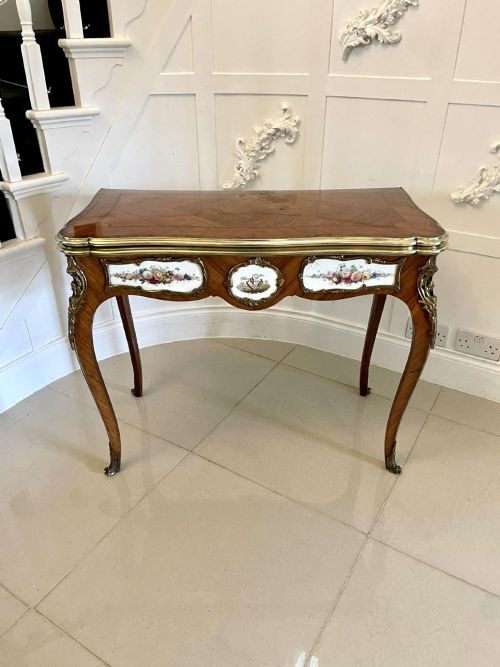
The assortment on this page includes card tables, occasional tables, and console card tables executed in revival styles such as Louis XV and Louis XVI, alongside Ottoman and Moorish interpretations. These pieces serve as decorative furniture while preserving mechanisms for chess, backgammon, and general card playing.
Origins vary across French workshops, English makers, and Middle Eastern centres of production, showing diverse approaches to inlay. Examples range from eighteenth-century craftsmanship to late nineteenth-century iterations incorporating ormolu mounts and porcelain plaques.
Materials and construction methods
Makers constructed these tables using a foundation of dense timbers like mahogany, walnut, or rosewood, upon which they laid precise geometric veneers. Woods such as kingwood, satinwood, and fruitwood provided contrasting tones for the intricate parquetry surface patterns.
Craftspersons integrated secondary materials including ormolu mounts, bone details, and porcelain components to enhance the visual weight of the furniture. Complex pivoting, folding, and envelope mechanisms were engineered into the frames to support heavy folding leaves and concealed storage wells for gaming pieces.
Wood Parquetry Games Table Retail Price Guide 2026
Typical asking prices for wood parquetry games table among the pieces listed under this phrase on Sellingantiques today, from the lower quarter to the upper quarter. They describe what is for sale here now, not the wider market.
The furniture spans multiple distinct aesthetic revivals, including Louis XV, Louis XVI, Ottoman, and Moorish styles.
Assessing quality in parquetry tables
Quality rests upon the precision of the timber tessellation and the stability of the geometric parquetry top over time. Superior examples maintain perfectly flush veneer joints without shrinkage gaps, even across expanding and folding leaf hinges.
The standard of foundational cabinetmaking dictates longevity, particularly in the joints of pivoting or folding mechanisms that bear regular mechanical strain. Finer works incorporate heavily chased ormolu mounts and select exotic timbers rather than simple stained veneers.
G T Morant·François Linke·Maison Mottheau
The Wood Parquetry Games Table Glossary
- Parquetry
- A geometric mosaic of wood veneers laid down in repeating patterns like cubes or triangles. It creates a durable, decorative surface across table tops.
- Ormolu
- Gilded bronze mounts cast and chased by hand to ornament the corners, legs, and aprons of fine furniture. This technique gained prominence in French cabinetmaking.
- Kingwood
- A dense, richly figured tropical timber displaying dark brown and violet stripes. Cabinetmakers utilised it extensively for contrasting borders in high-end parquetry.
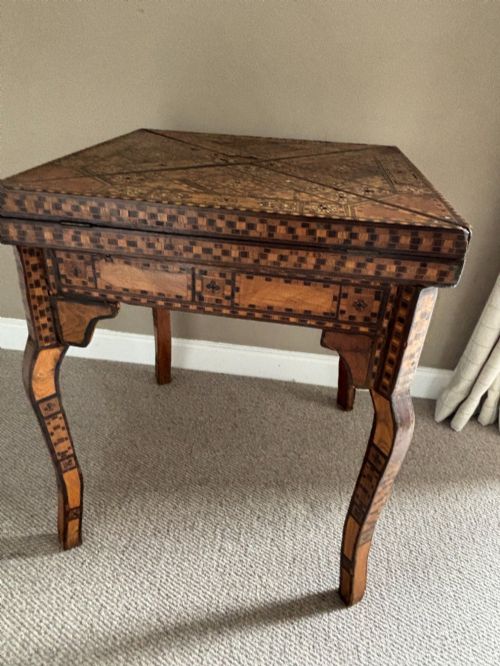
- Envelope table
- A square table with four triangular flaps that swivel and fold open to reveal a baize-lined playing surface. The clever folding action resembles an unfolded letter envelope.
Wood Parquetry Games Table: Frequently Asked Questions
How do these folding games tables work?
Many models feature a pivoting top that rotates ninety degrees before folding out to double the surface area for card games. Others employ clever hinged leaves or rotating mechanisms that conceal internal storage wells for dice, counters, and cards.
Inside these compartments, makers often incorporated dedicated spaces lined with baize, leather, or velvet to protect counters and playing pieces during use.
Can I use an antique games table daily?
These tables were designed for active use in the drawing room, though modern owners typically treat them with greater care. Folding leaves and rotating pivots require gentle handling to preserve the antique hinges and internal wooden tracks.
Using coasters and avoiding direct sunlight will protect the delicate parquetry veneer and polished timber finishes from moisture rings and fading.
How do I identify a Louis XVI style table?
Louis XVI style tables typically exhibit straight, tapered legs, often fluted, reflecting a shift toward neoclassical symmetry and geometric restraint. Makers frequently paired this architectural framework with crisp parquetry patterns and restrained ormolu mounts.
In contrast to the earlier curved lines of Louis XV revival pieces, these tables favour straight angles, circular tops, or rectangular forms with crisp corners.
What is the difference between card and chess tables?
Chess tables usually feature a permanent inlaid board design executed in contrasting woods directly on the top surface. Card tables generally offer a smooth or baize-lined field intended for general card play, sometimes with reversible or multi-game tops.
Multi-game variations incorporate sliding or flipping surfaces that transform a simple occasional table into a dedicated board game station.