






Wood Drum Table
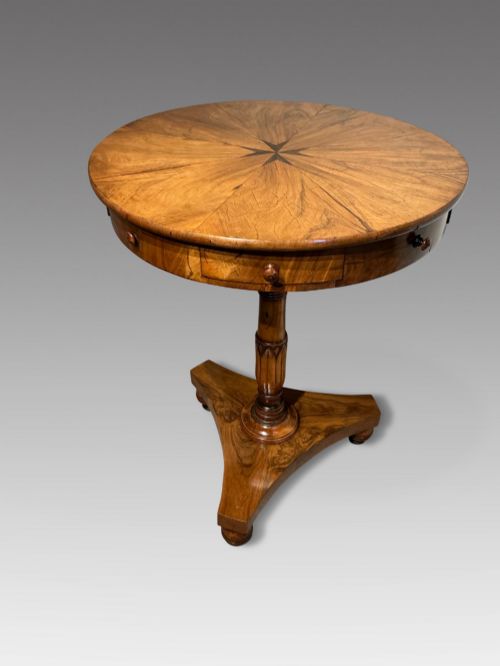
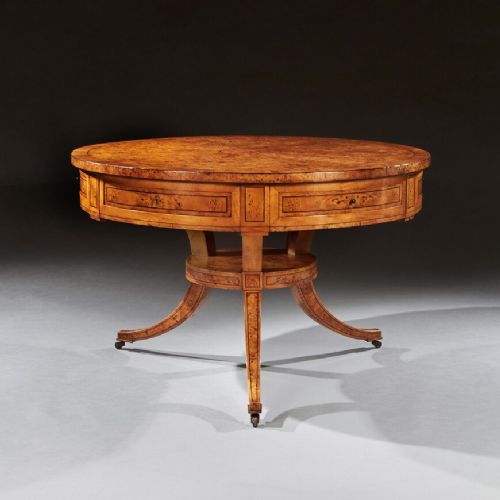
A wood drum table gives a room a strong circular presence, combining deep mahogany or burr maple with practical storage beneath a leather or wood top.
Wood Drum Table
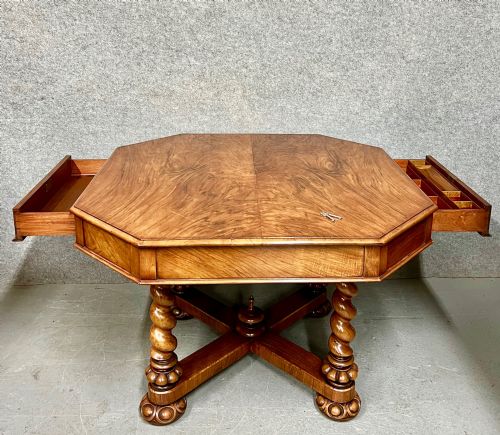
A wood drum table takes its name from the deep cylindrical body that houses drawers around the perimeter, sitting on a central pillar and tripod or platform base. When you search for a wood drum table, you encounter pieces primarily from the Regency and Victorian periods, alongside occasional Scandinavian and nineteenth-century designs.
The form functions equally well as a centre table or a library table, offering a generous circular surface atop a substantial column. Most examples you meet on this page feature mahogany, rosewood, or burr maple, often paired with inset leather writing surfaces.
How they were made
Cabinetmakers constructed the cylindrical drum body to house multiple frieze drawers, often utilising flame mahogany veneers or burr root maple to create rich surface patterns. Brass inlay, ebonised detailing, and mother-of-pearl embellishment frequently decorate the frames of finer pieces.
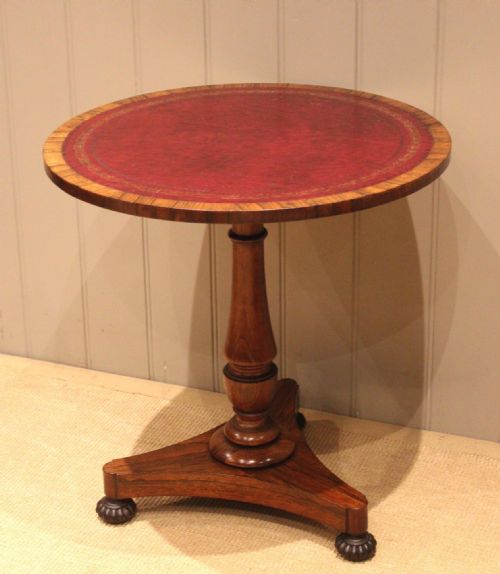
Support structures rely on robust central timber pillars rising from multi-legged platforms or brass-clawed tripod bases. Tops are commonly finished with tooled leather inserts framed by the primary timber of the table.
Wood Drum Table Retail Price Guide 2026
Typical asking prices for wood drum table among the pieces listed under this phrase on Sellingantiques today, from the lower quarter to the upper quarter. They describe what is for sale here now, not the wider market.
The listings show nineteenth-century pieces spanning Regency, Victorian, and Qing Dynasty styles, constructed in mahogany, rosewood, burr maple, and lacquer.
What varies in quality
Quality rests upon the selection of timber veneers, such as figured mahogany or burr maple, and the precision with which the circular drawers are joined into the drum body. Finer workshops invested heavily in matched grain patterns across the frieze and subtle brass or inlaid ornamentation.
The proportion between the heavy circular top and the supporting pedestal dictates the visual balance of the piece. Superior examples maintain crisp carving on the base and smooth operation within the cylindrical drawer arrangement.
D Robertson of Perth
The Wood Drum Table Glossary
- Drum table
- A circular library or centre table with a deep cylindrical apron containing drawers, supported by a central pillar. The cylindrical form resembles a drum, hence the traditional designation.
- Centre table
- A freestanding table designed to be viewed from all sides rather than placed against a wall. These pieces frequently occupy the middle of a principal room.
- Burr maple
- A distinctively knotted and swirled wood grain highly prized for decorative veneer work. Cabinetmakers used it to cover expansive circular surfaces with rich natural patterns.
- Hongmu
- A traditional Chinese term for dense hardwoods, often translated as red wood. Such timbers allowed for deep and intricate carving on nineteenth-century Asian furniture.
Wood Drum Table: Frequently Asked Questions
What is a wood drum table?
A wood drum table is a freestanding circular furniture piece featuring a deep cylindrical body that contains built-in drawers. It typically stands on a central column with branching feet.
The design originated to serve libraries and studies, providing both a large writing surface and concealed storage for papers and books.
How were drum tables used?
These tables functioned primarily in libraries and drawing rooms as central writing or reading stations. The rotating or stationary drawers allowed individuals to store manuscripts close to hand.
Their freestanding nature meant they sat comfortably in the middle of a room, accessible from every seated position around the perimeter.
How do I date a drum table?
Dating relies on identifying the prevailing timber choices, structural proportions, and decorative motifs characteristic of specific eras. Regency examples often display brass inlay and clean mahogany surfaces, while Victorian versions can be heavier and feature elaborate carving.
Comparing the base construction and secondary woods inside the drawers provides further clues regarding the workshop origin and decade of manufacture.
Where should I place a drum table?
A drum table suits the centre of a spacious room or library where its circular silhouette can be appreciated from all angles. It serves effectively as a focal point beneath a central ceiling light.
Ensure sufficient clearance around the perimeter so the drawers remain fully accessible and the base structure is not crowded by surrounding seating.