
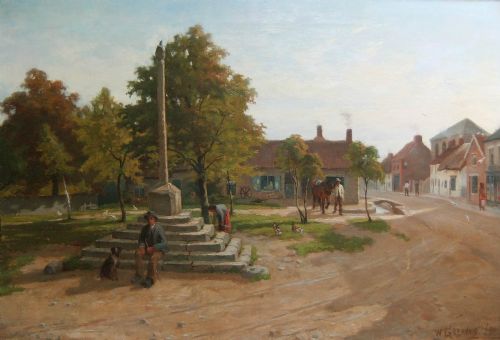


William Greaves Oil Artwork
William greaves oil artwork captures northern landscapes through the lens of British Impressionism and Victorian realism across several decades.
William Greaves Oil Artwork
A william greaves oil artwork represents regional British scenes, frequently depicting Yorkshire locations such as Leeds, Filey, and East Keswick. These paintings record local landmarks, country lanes, churches, and coastal views with descriptive topographical detail.
The pieces on this page span from the late Victorian era through the Edwardian period into the early twentieth century. Most examples date from the decades around nineteen hundred, showing rural and industrialising northern settings.
Oil paintings form the entirety of these listings, executed on canvas, canvas board, and canvas panel. They range from intimate pastoral studies to broader coastal and village compositions.
Materials and technique
Artists applied oil paint to stretched canvas or rigid supports like wood panels and canvas boards. This medium allowed for rich colour mixing and varied application, from smooth blended skies to thick impasto highlights.
Support materials varied according to the scale and date of the work, with traditional woven canvas and flat canvas panels both employed. Each support was prepared with a ground layer before the oil pigments were brushed onto the surface.
Support materials recorded across the collection include traditional canvas alongside canvas boards and wood panels.
Gradations in quality
Quality rests upon the handling of light, atmospheric depth, and the clarity of composition within the regional landscape. Stronger examples balance tonal harmony with confident brushwork that brings movement to water, foliage, and skies.
Condition and preservation of the oil pigment and its support also determine standing. Works retaining stable paint layers without extensive cracking or retouching present the original composition more clearly.
William Greaves
The William Greaves Oil Artwork Glossary
- Canvas panel
- A thin sheet of canvas glued to a rigid backing board. This support provides a stable surface for oil painting without requiring a stretcher frame.
- British Impressionism
- A painting style influenced by French movements that focused on natural light and everyday subjects. British practitioners often retained a stronger emphasis on drawing and tonal structure.
- Impasto
- Paint applied thickly to a canvas, leaving visible brush or palette knife marks. This technique adds tactile dimension and catches light across the surface.
- Victorian Realism
- An artistic approach aiming to portray subjects truthfully without artificiality or idealisation. In landscape painting, this meant recording regional topography and rural life with direct observation.
William Greaves Oil Artwork: Frequently Asked Questions
Who was William Greaves?
William Greaves was a British artist who painted landscapes primarily set in Yorkshire and surrounding northern regions during the late nineteenth and early twentieth centuries.
His works document specific local places such as Leeds, Filey, and Otley, capturing the character of rural and semi-rural communities.
What periods do these paintings cover?
The available works date from the eighteen eighties through to the nineteen thirties, encompassing late Victorian, Edwardian, and early twentieth-century periods.
This timespan reveals stylistic shifts from detailed Victorian realism towards looser British impressionist techniques.
What subjects appear in the artwork?
Subjects focus heavily on Yorkshire landscapes, including village streets, churches, mills, coastal views, and pastoral river scenes.
Named locations like Thornton le Dale and Scholes provide precise geographical context for each composition.
What materials were used?
Painters utilised oil paint applied to traditional canvas, canvas boards, and canvas panels supported by wood.
These durable materials have preserved the pigment colours and brushwork over the decades.