
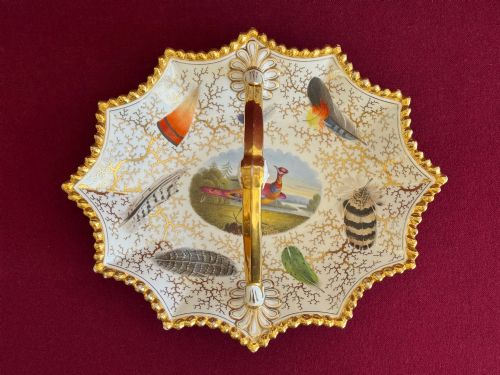


White Porcelain Comports
White porcelain comports are elevated serving vessels and centrepieces that bring height and refinement to a table, prized for their sculptural forms and crisp glazes.
White Porcelain Comports
White porcelain comports and centrepieces function primarily as serveware, decorative baskets, and dessert stands designed to display fruit or confections with architectural presence. The pieces available range from single-tier compotes to elaborate two-tier dessert stands and large figurative centrepieces.
Makers produced these vessels across several distinct periods, with examples appearing from the Georgian and Regency eras, through the nineteenth century and Victorian period, up to Edwardian iterations around nineteen hundred. Forms frequently draw upon Regency, Victorian, and Rococo Revival styles.
Buyers will most commonly encounter white porcelain comports rendered in hard-paste porcelain and ironstone, often embellished with gilt, gold leaf, enamel, and glazed ceramic finishes. Elaborate models incorporate applied flowers and figurative elements such as putti and cherubs.
How they were made
Manufacturers shaped hard-paste porcelain and ironstone into complex vessels, utilising moulding and hand-forming techniques to create openwork baskets and tiered dessert stands. Artisans then applied smooth glazes to the ceramic bodies before firing.
Decoration relied upon hand-applied enamel painting, gilding, and gold leaf highlights, alongside meticulously modelled three-dimensional figures and applied floral motifs fixed prior to the final kiln process.
Several comports feature cheerful cherubs and putti forever clinging to porcelain rosebushes, ensuring your fruit bowl comes with permanent company.
What varies in quality
Quality rests heavily on the crispness of the porcelain modelling and the delicacy of applied elements such as putti, cherubs, and flowers, where finer examples display sharper detail and deeper relief. The ambition of the form, ranging from simple footed bowls to multi-tiered architectural stands, dictates the maker's skill.
The application of surface enrichment marks another distinction, separating simpler glazed pieces from those enhanced with rich gilding, gold leaf, and carefully hand-painted enamel patterns like Chinoiserie.
Schierholz Plaue·C.G. Schierholz and Sohn·Mason·Swansea Porcelain·Flight Barr and Barr·Meissen·Minton·Dresden
The White Porcelain Comports Glossary
- Comport
- An elevated dish or bowl used for serving fruit or dessert at the table. These pieces often stand on a central foot or pedestal.
- Centrepiece
- A large decorative object placed in the middle of a dining table. They frequently incorporate elaborate figural modelling and floral decoration.
- Ironstone
- A heavy, durable type of earthenware developed as a robust alternative to porcelain. It shares a similar white aesthetic and takes glaze effectively.
- Hard-paste porcelain
- A vitrified ceramic composed of kaolin and petuntse fired at high temperatures. It produces a brilliantly white, durable body favoured by European factories.
- Gilding
- The application of gold leaf or powdered gold to the surface of the porcelain. This technique highlights rims, handles, and sculptural details.
White Porcelain Comports: Frequently Asked Questions
What were white porcelain comports used for?
These elevated vessels served primarily to hold fruit, sweetmeats, and small cakes during formal dining courses. Placed centrally on the table, they added height and visual interest to the dessert service.
Beyond their functional dining role, large centrepieces and ornamental baskets acted purely as decorative showpieces to demonstrate household status and taste.
How do I style a comport in a modern home?
A comport works effectively as a standalone decorative object on a sideboard, mantelpiece, or dining table. Its height allows you to display seasonal fruit, glass spheres, or floral arrangements without cluttering surface space.
Pairing different tiers and heights from the nineteenth century creates a balanced display that highlights the crisp white porcelain and gilt details against darker wood furniture.
How do I tell Regency comports apart from Victorian ones?
Regency pieces often display neoclassical restraint, featuring clean lines, basketweave textures, and refined hand-painted patterns like Chinoiserie. They tend to rely on understated elegance rather than heavy ornamentation.
Victorian and Rococo Revival examples embrace exuberant decoration, including applied flowers, cherubs, putti, and rich gilding. These later pieces favour dynamic, asymmetrical forms and deeply moulded details.
What is the difference between porcelain and ironstone comports?
Porcelain is a vitrified, translucent ceramic fired at high temperatures, offering a refined, glass-like body. Hard-paste porcelain provides exceptional whiteness and a crisp surface for detailed enamel painting.
Ironstone is an opaque, heavy earthenware designed for durability while mimicking the appearance of porcelain. It offers a thicker, robust alternative suitable for practical service.