


Whitby Landscape Painting
Whitby landscape painting captures the distinctive Yorkshire coast and moors through the eyes of Victorian and twentieth-century artists.
Whitby Landscape Painting
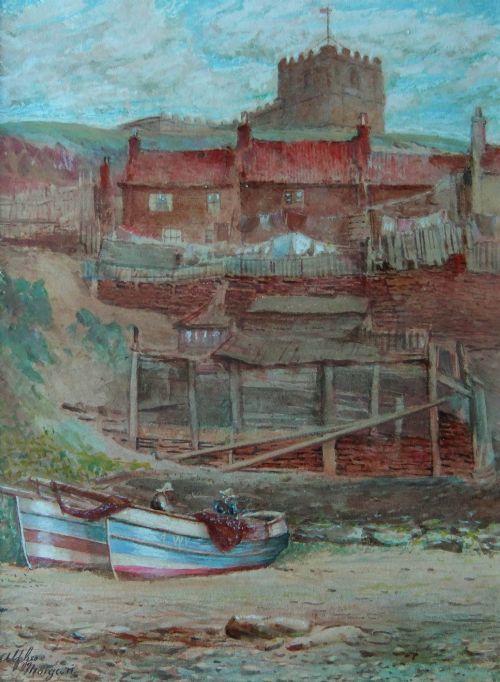
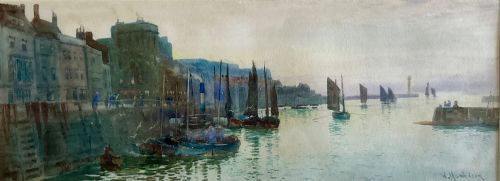
A whitby landscape painting depicts the historic Yorkshire port, its dramatic abbey ruins, bustling harbour, and surrounding moors. These works record local landmarks such as the East Cliff, Tate Hill Pier, and the winding streets of the old town.
Most examples found here date from the Victorian and Edwardian eras through to the 1930s. The selection heavily comprises watercolours alongside oil paintings on canvas, board, and card.
Artists focused on shifting coastal light, fishing boats at low tide, and rural views along the River Esk. This visual record preserves the topography and maritime character of the region from past centuries.
Materials and methods
Watercolour pigment applied to paper remains the dominant medium in this collection. Artists captured the translucent atmospheric conditions of the Yorkshire coast using fluid washes and fine brushwork.
Oil paintings in the selection utilise canvas, wooden panels, and card supports. Pigments were built up to render heavier textures of harbour waters, stone buildings, and moorland vegetation.
Geese and donkeys occasionally wander into the scenery alongside traditional views of fishing vessels.
Determining quality
Quality rests upon the artist's command of light, atmosphere, and local topography. Stronger compositions convey the specific mood of the harbour or cliffs rather than relying on generic formulas.
Condition plays a part, particularly with works on paper where preservation behind glass protects watercolour pigments from fading.
Alfred G. Morgan·William Matthison·Tom Clough·George Weatherill·Frederick William Booty·Albert Robert Quinton·Rowland Henry Hill·Frank Rousse
The Whitby Landscape Painting Glossary
- Watercolour painting
- A work executed with water-soluble pigments on paper supports. This medium allows for delicate washes and immediate recording of light.
- British Impressionism
- A painting style focusing on light and everyday subjects that influenced many early twentieth-century artists. Practitioners sought to capture transient effects outdoors.
- Gilt wood
- A wooden frame finish covered with a thin layer of gold leaf. These frames often accompany period paintings to complement the artwork.
- Diptych
- A two-part artwork consisting of two panels or sheets hinged or displayed together. Such pieces often present complementary views of a single location.
Whitby Landscape Painting: Frequently Asked Questions
What periods do these paintings date from?
The works span from the nineteenth century through the Edwardian period and into the 1930s. Victorian examples sit alongside British Impressionist pieces.
Most items reflect regional artistic activity from 1900 to 1930, capturing the evolving appearance of the Yorkshire coast.
Which subjects appear most frequently?
Harbour scenes, fishing boats, and Whitby Abbey dominate the compositions. Views extend inland to the River Esk and surrounding moorland villages.
Street scenes of historic alleys also feature across the selection.
How should these works be framed?
Watercolours require conservation framing behind glass to shield pigments from light damage. Mounts should be acid-free to prevent discolouration over time.
Oil paintings on canvas or board generally benefit from traditional wood or gilt frames appropriate to their period.
Are these works signed by the artists?
Many examples carry signatures or monograms from the painters who recorded the region. Attributions rely on these contemporary inscriptions and documented signatures.
Some historical pieces remain unsigned but are attributed through style and subject matter.