


Whitby Landscape Art
Whitby landscape art captures the Yorkshire coast through watercolours and oil paintings from the Victorian era into the 1930s.
Whitby Landscape Art
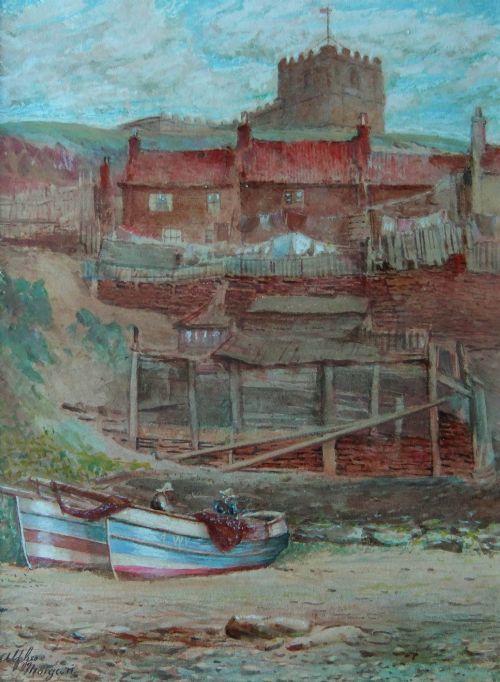
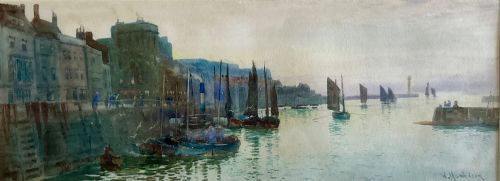
Whitby landscape art brings together framed paintings depicting the Yorkshire coast, harbour scenes, and landmarks such as the abbey and St Mary's Church. Buyers seeking these works encounter pieces executed across the nineteenth and twentieth centuries, spanning Victorian, Edwardian, and later periods.
The watercolours and oil paintings available focus heavily on local topography, including Henrietta Street, Flowergate, and the River Esk. Artists record the distinct atmosphere of the northern port through varied stylistic lenses, from British Impressionism to marine realism.
Watercolour paintings on paper remain the predominant form met on this page, often preserved behind glass within wooden frames. Oil paintings on canvas also appear, showing maritime views and moonlight scenes of the historic town.
Materials and methods in regional views
Artists deployed watercolour pigment on paper to capture translucent light over the harbour, employing fluid brushwork suited to coastal weather. These works frequently utilise gilt wood frames and glass protection to preserve the delicate pigment.
Oil paintings on canvas bring heavier texture and depth to nocturnal and marine compositions of the Yorkshire coast. Painters combined traditional media with observational skill during the turn of the century to record changing light on stone and sea.
The listings span watercolours, oil paintings, and diptychs created across the Victorian period, the Edwardian era, and the 1930s.
Distinctions in standard and handling
Quality rests in the sureness of the brushwork and the artist's ability to render the atmospheric light specific to the Yorkshire coast. Stronger examples demonstrate confident draughtsmanship in architectural elements like the abbey, paired with subtle handling of sky and water.
Condition of the paper, preservation of the original pigment, and the integrity of the frame influence the overall appeal of watercolours from this period. Works that retain their original colour without excessive fading or foxing represent the upper tier of the selection.
Alfred George Morgan·William Matthison·Tom Clough·Fred Waugh·George Weatherill·George Hamilton Constantine·James Thomas Watts·Frederick William Booty·Frederick Williamson·Albert Robert Quinton·William Samuel Horton·William Kay Blacklock·Rowland Henry Hill·Harry Wanless·H. Hadfield Cubley·John Sanderson Wells·Thomas Clavering Alder·Walter Emsley·Frank Rousse·John J. Hamer·Donald Wood·A.G. Stevens·R. J. S. Bertram
The Whitby Landscape Art Glossary
- Diptych
- A painting comprising two separate panels hinged or displayed together as a single artwork. These pieces show paired Yorkshire views such as the abbey and church.
- Impressionism
- A style of painting emphasising light and rapid brushstrokes rather than meticulous detail. British practitioners applied this approach to coastal and marine subjects.
- Watercolour pigment
- Ground colour mixed with a water-soluble binder, applied to paper to create transparent washes. It defines the majority of the works recorded here.
- Gilt wood
- Timber frames finished with a thin layer of gold leaf or gilt preparation. They enclose many of the period watercolours and oils.
- Marine realism
- An artistic approach dedicated to accurate depiction of ships, harbours, and coastal conditions. Edwardian painters used this method for bustling dock scenes.
Whitby Landscape Art: Frequently Asked Questions
What periods do these paintings date from?
The works originate largely from the Victorian and Edwardian eras, extending into the 1930s. Artists worked actively through the turn of the century to record local landmarks.
Dates typically reflect the period of British Impressionism and late nineteenth-century fine art traditions found across Yorkshire subjects.
Are most of these works watercolours?
Watercolour paintings on paper form the majority of the available works, capturing coastal light with delicate washes. Framed examples often include protective glass.
Oil paintings on canvas also appear among the selections, offering heavier texture for nocturnal or marine compositions.
Which landmarks appear most often?
Whitby Abbey and St Mary's Church dominate the topographical views, positioned above the harbour and the River Esk. Artists frequently painted these historic structures from various vantage points.
Streets like Henrietta Street and Flowergate, along with local piers and dockyards, also provide recurring subjects for the painters.
How should I care for a period watercolour?
Keep watercolours away from direct sunlight to prevent the pigments from fading over time. Maintaining stable indoor humidity protects both the paper support and the gilt wood frame.
Displaying works behind glass shields the delicate surface from atmospheric dust and environmental moisture.