
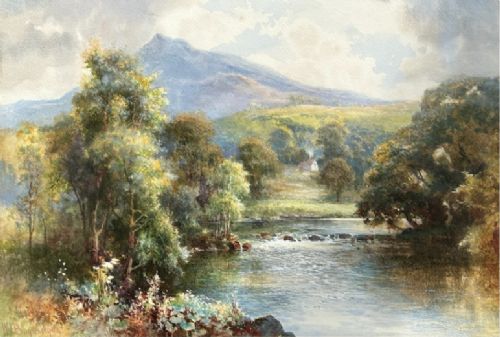


Welsh Valley Landscape Painting
These welsh valley landscape painting examples capture mountains, rivers, and rural expanses across the nineteenth and twentieth centuries.
Welsh Valley Landscape Painting
A welsh valley landscape painting captures specific regional locations such as the Ogwen Valley, Conwy Valley, Wye Valley, and Cardiganshire, focusing on rivers, wooded glens, and mountain backdrops. The pieces span from the nineteenth century into the mid twentieth century, showing rural scenery through changing artistic movements.
Most examples found here date to the nineteenth century or the early twentieth century, reflecting Victorian, Edwardian, and Modern British sensibilities. Subject matter centres on North Wales and surrounding terrain, recorded by both named artists and the broader British School.
Materials and Techniques
Artists worked primarily in oil paint or watercolour, applying pigment to canvas, wood panels, card, or paper supports. Oil paintings often utilise sturdy wooden panels or stretched canvas, while watercolours rely on paper substrates.
Framing frequently involves gilt wood or gilt frames, enhancing the visual depth of the landscapes. Many nineteenth-century watercolours and oils are preserved behind glass or within period decorative frames.
At least one nineteenth-century watercolour arrives refreshingly unglazed, offering an unfiltered view of the artist's original paper surface.
Evaluating Quality
Quality rests on the handling of light, atmosphere, and topographical detail, distinguishing accomplished topographical artists from amateur recorders. The articulation of water, foliage, and distant mountain ranges shows the painter's brushwork control and compositional skill.
Condition of the medium and the retention of original framing elements also shape the standing of a piece. Well-preserved pigment layers on canvas or clean paper surfaces without excessive toning elevate the visual impact.
William Joseph Boyes·Hubert Wellington·Clarence Henry Roe·William Mellor·J Barclay·John Syer·Harold Lawes·Cornelius Pearson·John J. Hamer·Archer L Smith·H. Max Krause
The Welsh Valley Landscape Painting Glossary
- Watercolour
- A painting method where fine pigment is suspended in a water-based solution, typically applied to paper. It allows for translucent washes and delicate atmospheric effects.
- Oil on canvas
- A technique using pigments bound in a drying oil, applied to a woven fabric stretched across a wooden frame. This method permits rich texture and deep colour saturation.
- Wood panel
- A rigid flat support made from timber used by artists instead of canvas. Panels provide a stable surface for detailed brushwork in oil.
- Gilt wood
- Wood coated with a thin layer of gold leaf or metallic gilt finish. It is commonly found on traditional picture frames surrounding nineteenth-century art.
Welsh Valley Landscape Painting: Frequently Asked Questions
What periods do these paintings cover?
The available selection spans from the mid nineteenth century through the Edwardian era and into the nineteen-forties. Most pieces date to the Victorian period.
Styles range from nineteenth-century naturalism and pastoral scenes to early twentieth-century British interpretations of the landscape.
Which valleys are most commonly depicted?
Artworks frequently feature recognised North Wales locations including the Conwy, Ogwen, Wye, Deganny, and Dysynni valleys. Rivers and mountain rivers like the Llugwy also appear often.
These specific regional settings reflect the Victorian and Edwardian fascination with British tourism and picturesque rural scenery.
How should I care for a watercolour painting?
Watercolour works on paper require protection from direct sunlight to prevent fading of the delicate pigments. Keeping them in stable humidity environments preserves the paper support.
Glazing helps shield the paper surface from atmospheric pollutants and dust accumulation over time.
How do oil paintings on panel differ from canvas?
Wood panels offer a rigid, firm surface that prevents the flexing and cracking sometimes seen in aged canvas supports. Artists often used panels for smaller, detailed plein-air studies.
Paint applied to wood tends to retain crisp brushstrokes and offers different surface textures compared to woven fabric.