


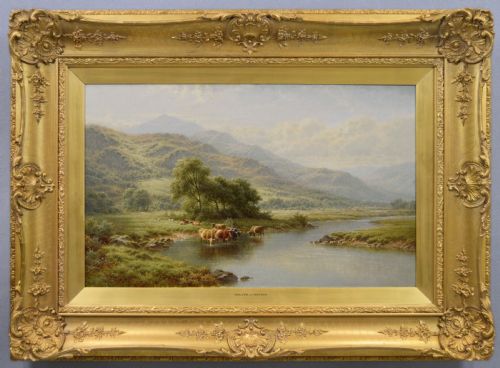


Welsh River Painting
A Welsh river painting captures the dramatic topography and rushing waters of the principality through nineteenth-century brushwork.
Welsh River Painting
A Welsh river painting depicts natural waterways, valleys, and mountainous terrain across the nineteenth century, capturing scenes from locations such as the Conwy, the Llugwy, and North Wales.
The pieces on this page appear primarily as oil paintings on canvas and framed watercolour paintings on paper, reflecting Victorian landscape and pastoral styles.
Most examples date from the Victorian period, ranging from the Georgian era through to the early twentieth century, encompassing works by named British artists.
How they were made
Painters applied oil paint to stretched canvas or watercolour paint to paper, utilising pigments to render the atmospheric light of Welsh river valleys.
Many works sit within period frames constructed from wood, gesso, and giltwood or gilt wood, which complement the traditional artistry of the paintings.
Welsh River Painting Retail Price Guide 2026
Typical asking prices for welsh river painting among the pieces listed under this phrase on Sellingantiques today, from the lower quarter to the upper quarter. They describe what is for sale here now, not the wider market.
Artists frequently braved persistent Welsh rain to capture these rushing rivers, ensuring posterity gets damp boots without the chill.
What varies in quality
The degree of finesse in handling light, water movement, and topographical detail separates standard topographical records from works of higher artistic ambition.
The execution of framing materials, such as the depth of moulded gesso and the preservation of giltwood surfaces, influences the overall presentation of the artwork.
Cornelius Pearson·Thomas Spinks·Clarence Henry Roe·Sidney Richard Percy·William Mellor·Walter J Watson·John Syer·Harold Lawes·William Langley·John Cuthbert Salmon·William Henry Mander·David Bates·Alfred de Breanski·George Parson-Norman·James Poole·Henry Bright
The Welsh River Painting Glossary
- Oil on canvas
- Pigments bound in a drying oil applied to a woven fabric support stretched across a wooden frame. This medium allowed artists to build rich textures and deep tones.
- Watercolour painting
- Pigments suspended in a water-soluble vehicle applied to paper. This technique yields translucent washes that suit atmospheric river mists.
- Giltwood
- Wood carved and coated with gold leaf or a metallic substitute. It frequently forms the decorative surrounds of Victorian art.
- Gesso
- A plaster mix applied to wood frames as a base for gilding. It permits intricate moulded decoration around the edge of the painting.
- Victorian naturalism
- An artistic approach focusing on the accurate depiction of the natural world. It informs many nineteenth-century representations of Welsh scenery.
Welsh River Painting: Frequently Asked Questions
What subjects appear in these paintings?
These works focus on rivers, valleys, and mountains within Wales, frequently featuring specific locations like the Conwy, the Llugwy, and Snowdonia.
Human figures, cattle, cottages, and travellers occasionally populate the riverbanks alongside historical sites such as Tintern Abbey.
How do I date a Welsh river painting?
Dating relies on stylistic markers of the nineteenth century, including Victorian landscape conventions, dress styles of any figures depicted, and artist signatures.
Framing materials like gesso and giltwood, alongside canvas stamps from period suppliers, also help determine the era of production.
Are these paintings signed by the artists?
Many examples on this page carry signatures or attributions to nineteenth-century painters who specialised in British and Welsh topography.
Documentation and artist dates help confirm the authorship and active working period of the creator.
How should I display these watercolours?
Watercolour paintings on paper require careful placement away from direct sunlight to prevent the fading of pigments and paper discolouration.
Maintaining stable indoor humidity levels protects both the paper support and the historical giltwood or wooden frame.