
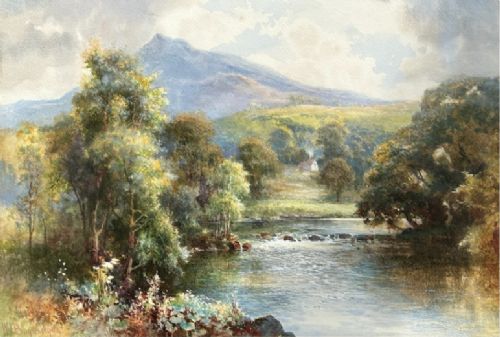


Welsh Countryside Picture
These pieces capture the quiet drama of a welsh countryside picture, offering pastoral valleys and river views through Victorian and mid-century eyes.
Welsh Countryside Picture
A welsh countryside picture typically takes the form of an original painting, rendering landscapes from regions such as North Wales, Cardiganshire, and the Wye Valley. These artworks focus on rural topography, featuring rivers, valleys, and mountainous terrain captured by British artists.
The selections found here span from the nineteenth century into the mid-twentieth century, encompassing Victorian realism, Edwardian views, and modern British school interpretations. Works range from detailed watercolour paintings on paper to oil paintings executed on canvas and wood panel.
Buyers encounter pastoral scenes populated by figures or farm workers set against expansive rural backdrops. Prominent locations like the River Llugwy, Beddgelert, and Cardigan Bay recur across the collected works.
Materials and Methods
Artists utilise oil paint applied to canvas or wood panel, as well as watercolour applied to paper, capturing the changing light of rural landscapes. These mediums define the texture and tonal range of each composition.
Many works are housed in traditional wooden frames, frequently enhanced with gesso and giltwood finishes to complement the painted scene. These framing materials provide period integrity to the surviving pieces.
Cardigan Bay waves and Welsh farm workers keep eternal company with nineteenth-century giltwood.
Assessing Quality
Quality rests in the artist's ability to render atmospheric depth and topographical precision within the Welsh landscape. Works by established named painters demonstrate superior brushwork and compositional balance compared to anonymous sketches.
The preservation of the underlying paper, canvas, or wood panel dictates the longevity and visual clarity of the piece. Intact original frames with period gesso ornamentation further elevate the standing of the work.
William Joseph Boyes·Hubert Wellington·Walter J Watson·Harold Lawes·William Langley·John Cuthbert Salmon·Samuel Towers·Clarence Woodburn·David Bates·George Parson-Norman
The Welsh Countryside Picture Glossary
- Watercolour painting
- A work executed with water-soluble pigments on paper, valued for its translucent washes and delicate handling of light.
- Oil on canvas
- Pigments bound in a drying oil applied to a stretched fabric support, allowing for rich texture and deep tonal layering.
- Wood panel
- A rigid wooden support used by artists as an alternative to canvas, particularly common in smaller landscape studies.
- Giltwood
- Wood carved and covered with a thin layer of gold leaf, often found on period picture frames.
- Gesso
- A plaster-like mixture applied to wood frames to create a smooth surface for gilding and ornamentation.
Welsh Countryside Picture: Frequently Asked Questions
What periods do these paintings represent?
The available selection spans from the nineteenth century through the Victorian and Edwardian eras up to the mid-twentieth century. Works reflect stylistic shifts from nineteenth-century realism to modern British approaches.
Dates and attributions are drawn from the recorded signatures and historical records associated with each individual artist.
Where do these landscape scenes depict?
The subjects focus specifically on Welsh topography, including recognised locations such as the River Llugwy, Bethesda, Beddgelert, and Cardigan Bay. Artists travelled through these rural valleys to record local rivers, mountains, and agricultural life.
Topographical accuracy varies by artist, with some providing precise regional titles while others capture general pastoral moods.
Are these paintings original works?
Every listed item is an original painting rather than a reproduction or print. Artists applied oil or watercolour by hand directly onto canvas, paper, or wood panels.
Signatures from the period frequently accompany the works, identifying the hand of the creator.
How should I display a vintage painting?
Display these works away from direct sunlight and excessive moisture to protect the paper, canvas, and painted surface. Many pieces retain their original wooden or giltwood frames, which should be handled with care.
Maintaining stable indoor temperatures helps preserve both the painting and its period housing.