



Weathered Oak Drawers
These weathered oak drawers bring practical storage and scientific precision to any room, offering tangible history in solid wood.
Weathered Oak Drawers
When you search for weathered oak drawers, you encounter a specialised selection of wooden storage forms alongside scientific instruments incorporating fitted chart drawers. The listings span several distinct periods including the Georgian era, the Victorian period, and the Edwardian epoch, alongside pieces from 1750, 1800, 1910, and 1930.
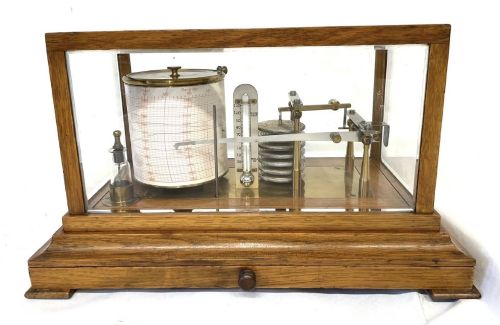
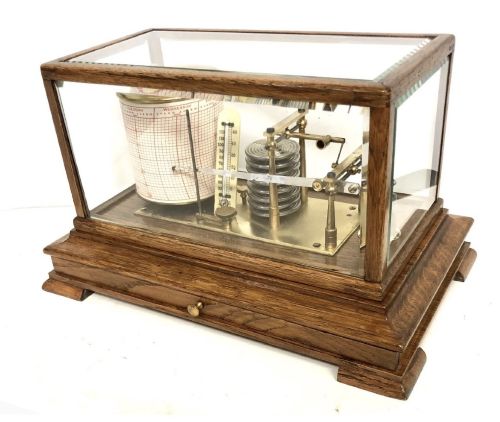
The objects on this page primarily consist of oak cased barographs with chart drawers, alongside small primitive chests of drawers from servants' quarters or sculleries, French commodes, and side tables. These pieces combine utilitarian function with the rich visual character of aged oak.
You are most likely to meet Edwardian and Victorian barographs featuring bevelled glass and dedicated chart drawers, or early primitive oak chests from the nineteenth century. Each piece demonstrates the enduring utility of oak furniture adapted for both domestic storage and meteorological recording.
How they were made
The construction of these items relies fundamentally on oak, paired with brass fittings and glass panels in the scientific instruments. Cases are built to house delicate recording mechanisms, while larger chests utilise traditional timber joining techniques suited for domestic use.
Makers integrated functional elements such as barometer dials, thermometers, and paper chart drawers directly into the wooden enclosures. Bevelled glass is frequently set into frames to protect the internal scientific movements while allowing clear visibility.
Weathered Oak Drawers Retail Price Guide 2026
Typical asking prices for weathered oak drawers among the pieces listed under this phrase on Sellingantiques today, from the lower quarter to the upper quarter. They describe what is for sale here now, not the wider market.
Listings span the Georgian, Victorian, and Edwardian periods, incorporating oak, brass, and bevelled glass across scientific and domestic forms.
What varies in quality
Quality in these pieces is dictated by the refinement of the timber work and the complexity of the integrated mechanisms where applicable. Early French commodes from seventeen-fifty display different cabinet-making traditions compared to nineteenth-century British primitive furniture or Edwardian scientific apparatus.
The preservation of original materials, such as the clarity of bevelled glass and the patina of the oak casing, marks the distinction between standard examples and finer survivals. The presence of maker signatures on instruments further influences the character of an individual piece.
Baines Harrogate·Short and Mason·Negretti and Zambra
The Weathered Oak Drawers Glossary
- Barograph
- A recording meteorological instrument that logs atmospheric pressure onto paper charts. These devices are frequently housed in oak cases equipped with dedicated chart drawers.
- Commode
- A French term for a decorative chest of drawers or low cabinet. Early examples from seventeen-fifty showcase distinct continental styling.
- Primitive
- A descriptor for vernacular furniture made without sophisticated academic design conventions, often found in servants' quarters or sculleries during the early nineteenth century.
- Bevelled glass
- Glass panes featuring an angled edge ground down to create a decorative border. This technique is commonly seen on Edwardian and Victorian scientific instrument cases.
Weathered Oak Drawers: Frequently Asked Questions
What is a chart drawer?
A chart drawer is a slim compartment built into the base of a scientific instrument case, specifically designed to store spare recording paper.
In pieces such as Victorian barographs, this integrated drawer keeps meteorological records neatly organised beneath the main mechanism.
How do I date an oak barograph?
Dating relies on the style of the oak case, the type of glass utilised, and any accompanying maker signatures or patent marks.
Edwardian and Victorian examples often feature bevelled glass and specific mechanical layouts that correspond to documented manufacturing periods.
Where were primitive oak chests used?
Primitive oak chests of drawers were typically utilised in utilitarian domestic spaces such as sculleries or servants' quarters during the early nineteenth century.
Their straightforward construction prioritised function over ornate decoration, reflecting their everyday working environment.
Are French commodes different from British chests?
French commodes from periods like seventeen-fifty display continental proportioning and cabinet-making traditions distinct from British domestic furniture of the same era.
They often serve as decorative focal points rather than simple utility storage.