



Weather Station Clock
These weather station clock pieces combine timekeeping with barometric and temperature instruments, offering a practical nineteenth and twentieth-century desk or wall fixture.
Weather Station Clock
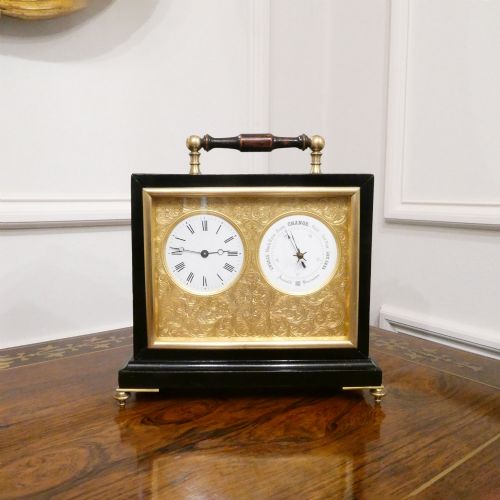
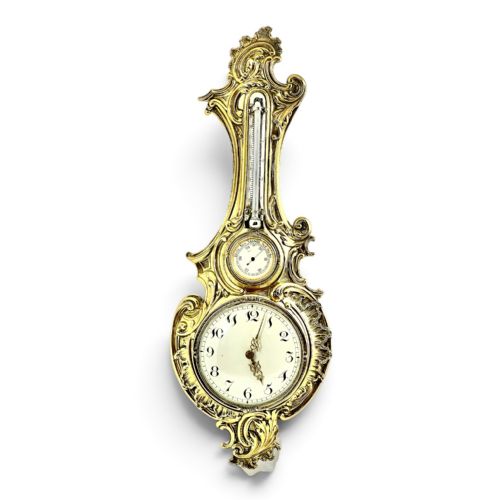
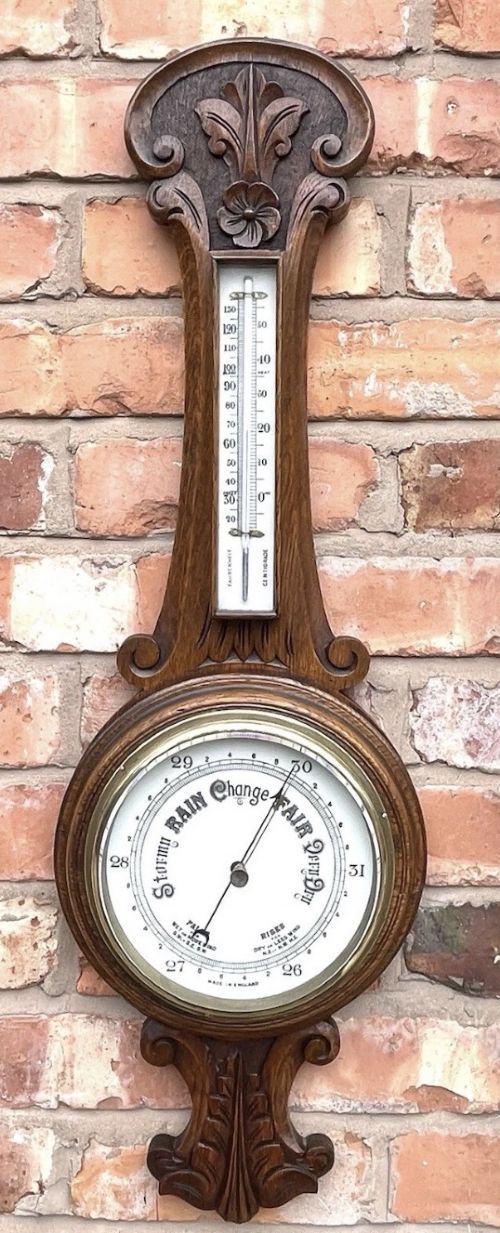
A weather station clock integrates timepieces with barometers and thermometers, creating combined instruments designed for desks, mantels, and walls. When searching for a weather station clock, buyers encounter formats ranging from carved oak banjo barometers to oversized desk compendiums and maritime bulkhead sets.
The objects span periods from the nineteenth century through the Edwardian era and the nineteen-thirties. Victorian and Edwardian examples frequently utilise carved oak or walnut cases, while later pieces adopt Art Deco chrome or onyx designs.
Forms vary from wall-hung banjos to architectural desk clocks and dual brass-mounted ship instruments. The primary function remains the simultaneous reading of time, atmospheric pressure, and temperature within a single housed unit.
Materials and construction
Cases rely heavily on timbers such as oak, walnut, and mahogany, often carved in Victorian, Edwardian, or Chinoiserie styles. Ebonised wood and gilt or silvered bronze also appear, alongside heavy bevelled glass protecting enamel dials and instrument faces.
Mechanical movements power the timepieces, while aneroid barometer capsules and spirit thermometers register meteorological changes. Chrome and brass fittings dominate the maritime and desk compendium formats from later periods.
Weather Station Clock Retail Price Guide 2026
Typical asking prices for weather station clock among the pieces listed under this phrase on Sellingantiques today, from the lower quarter to the upper quarter. They describe what is for sale here now, not the wider market.
Observed periods range across the nineteenth century, Victorian, Edwardian, nineteen-tens, twenties, and thirties.
Distinctions in quality
Excellence in these instruments rests on the crispness of the case carving, the integration of the multiple dials, and the quality of the metals employed, such as solid brass or gilt bronze rather than simpler alloys. Architectural or figural forms, such as caduceus shapes, demonstrate higher ambition in design.
The legibility of enamel dials, the retention of original silvering on barometer scales, and the harmonious arrangement of clock, thermometer, and barometer within a unified housing separate standard production pieces from finer domestic weather stations.
The Weather Station Clock Glossary
- Aneroid barometer
- An instrument that measures atmospheric pressure without liquids, using a flexible-walled metal capsule that expands or contracts.
- Banjo barometer
- A wall-mounted weather instrument housed in a case shaped like a banjo, typically combining a thermometer, hygrometer, and dial barometer.
- Desk compendium
- A multi-functional desk accessory housing a clock alongside instruments like barometers, thermometers, and compasses in a single frame.
- Bulkhead clock
- A marine timepiece designed for mounting on the wall of a ship cabin, frequently paired with a matching barometer in chrome or brass.
- Silver gilt
- Silver objects that have been coated with a thin layer of gold, providing a rich metallic finish seen on certain Victorian instrument stations.
Weather Station Clock: Frequently Asked Questions
What is a weather station clock?
A weather station clock is a combined instrument that brings together a timepiece, a barometer for measuring atmospheric pressure, and a thermometer. These pieces were housed in unified cases made of oak, walnut, bronze, or chrome.
They allowed Victorian and twentieth-century households to monitor weather shifts and tell the time from a single desk, wall, or mantel fixture.
Where were these instruments placed?
Depending on the specific form, these pieces sat upon library desks, hung on domestic walls, or mounted on ships. Banjo barometers and combined wall clocks hung in hallways or studies.
Desk compendiums and architectural clock sets occupied prominent positions on writing tables and mantelpieces where residents could easily consult them.
How do I date a weather station clock?
Dating relies on the case materials, manufacturing styles, and accompanying design motifs. Victorian and Edwardian examples often feature carved oak or walnut cases with ornate detailing.
Art Deco pieces from the nineteen-thirties favour materials like onyx and chrome, while maritime sets use heavy brass bezels suited for bulkhead mounting.
Are the barometers still accurate?
Many aneroid barometers retain their mechanical sensitivity and respond to local atmospheric pressure changes. The internal metal capsules expand or contract to move the indicator needle across the dial face.
Regular handling and environmental shifts can affect calibration, meaning some units require professional adjustment to read local pressure accurately.